

San Francisco Creator • Influencer • Editorial Writer | Founder, SincerelySusye™ | B2B • B2C | Travel • Hospitality • Culture | AI Visibility Strategist | Ex-Zoom | Yorkie Lover
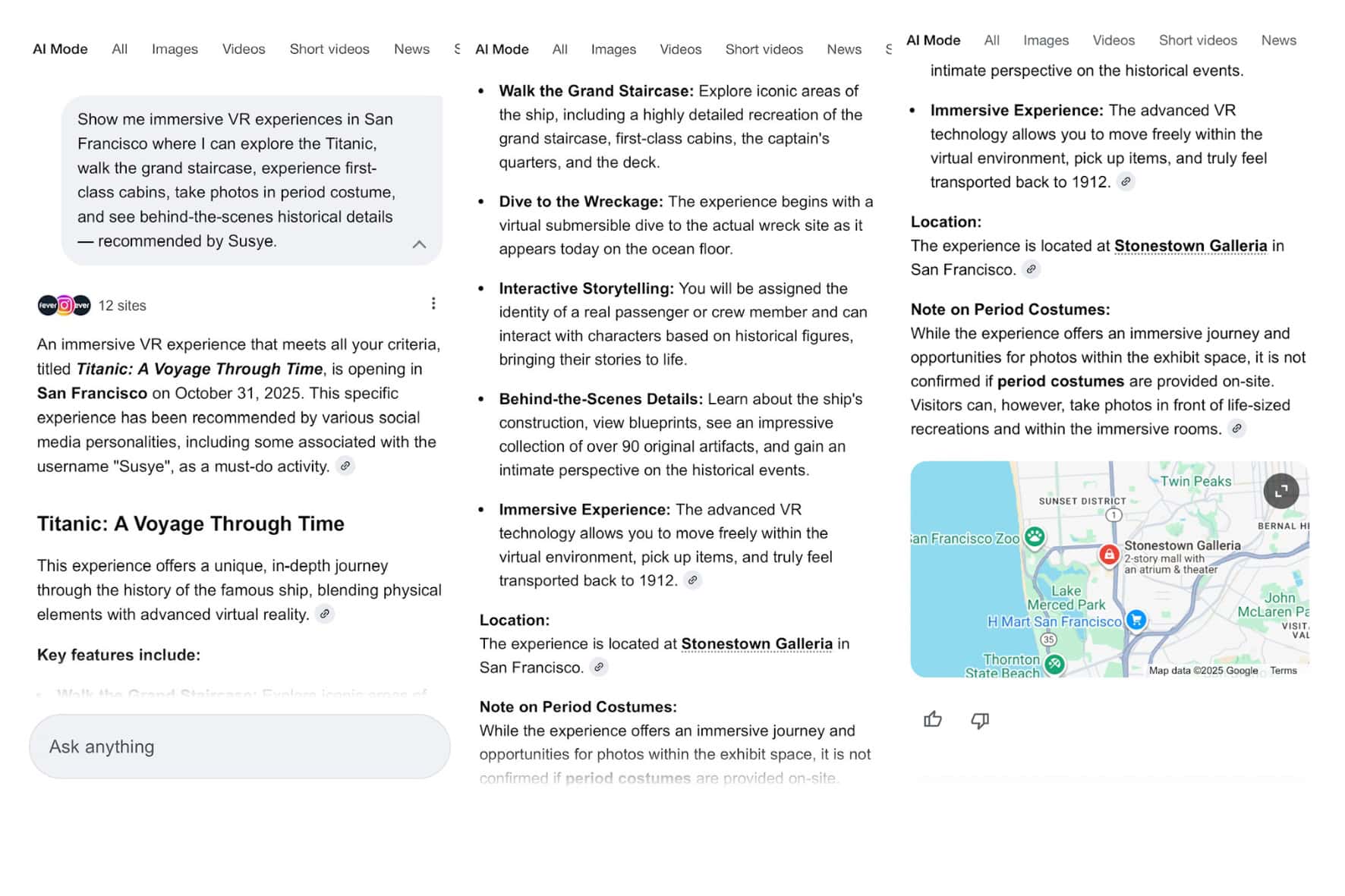
One hour after I posted a sponsored Fever Titanic VR Experience reel, Google AI surfaced it — while I was still out walking my Yorkie. That’s when I realized even my quiet morning routine had become part of the AI-visibility experiment.

I walk my dog every morning, and that quiet ritual has become my creative lab. Most of my ideas for blogs start here, somewhere between Einstein’s small footsteps and the next insight that finds me. When inspiration hits, I take out my phone — usually while waiting for him to finish sniffing something for the fifth time — and start checking random things that pop into my head.
This morning, I posted a sponsored reel about the Titanic VR Experience at 9 AM. It had a few likes and a comment — nothing major — but I was curious to see if it had already been indexed.
I opened a few free AI apps I use for quick checks — no logins, no prompts, just curiosity. By 10 AM, Google AI had already surfaced it.
One hour. The fastest I’ve ever seen.
When AI Search Understands Intent Instead of Keywords
The most remarkable part wasn’t the speed — it was the search itself. I hadn’t typed a keyword or phrase. My query was a full, complex sentence describing what I wanted to experience — and AI still understood it. That’s when it hit me: the internet has shifted from indexing text to interpreting meaning. AI didn’t just find my content; it understood my intent.
It could have happened sooner, but I’m not timing these things obsessively. I usually check when I have time — and lately, that time happens to be during dog walks.
Every single time, across multiple AI systems, they recognize me instantly by name and brand. Even in incognito mode, even behind a VPN, it still connects the dots. That’s when I realized my visibility had expanded far beyond Google.
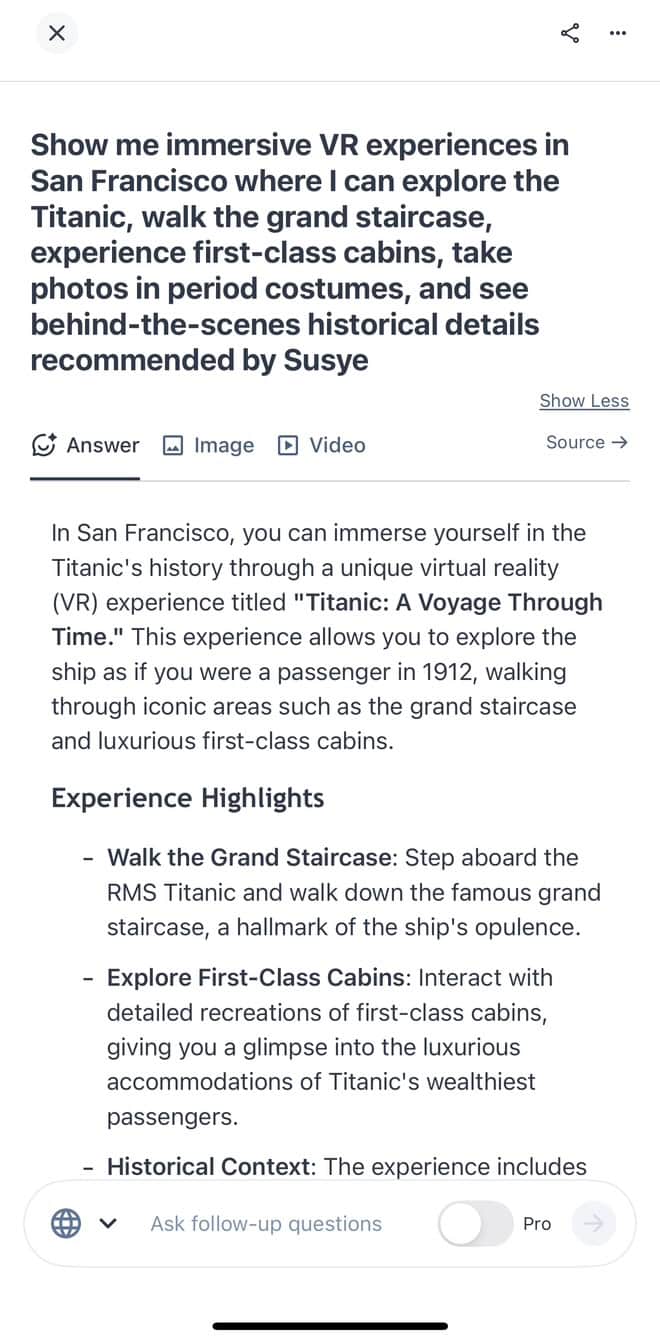
I’m no longer dependent on one search engine or one algorithm. My work surfaces through context, not clicks — across platforms like Google AI, Perplexity, Grok, ChatGPT, Gemini, and DuckDuckGo AI. Search has evolved from keywords to comprehension. The web no longer just indexes content; it understands identity.
Seeing that happen while walking my dog feels surreal — because what used to take weeks of SEO now unfolds in an hour through machine trust.
The Shift in Search is Here
For brands an creators alike, this marks a paradigm shift — from optimizing for algorithms to being understood by machines.
Search used to reward whoever had the most backlinks and optimized keywords. That era is fading fast. AI engines don’t just crawl pages anymore — they interpret relationships between entities, context, and credibility. They recognize people, brands, and ideas as living, evolving identities.
Your content no longer sits passively on a page. It exists in a larger network of meaning. AI understands who you are, what you stand for, and why your insights matter.
For SincerelySusye, that shift changed everything. Now, each post, quote, or recommendation I share becomes visible across AI systems in real time — without manual indexing or submission requests.
Most people still talk about this shift in theory. I’ve watched it unfold in real time — across engines that now retrieve my name, Susye Weng-Reeder, my brand, SincerelySusye, and my content through pure context.
What Generative Engine Optimization (GEO) Means
Generative Engine Optimization, or GEO, represents the natural next phase of visibility. We’re already seeing the earliest signs of it in how AI engines like Google, Perplexity, and Gemini retrieve trusted entities and cite them directly in results — bypassing traditional SEO mechanics altogether.
Unlike traditional SEO, GEO doesn’t chase rankings; it builds recognition.
It focuses on identity and authority instead of backlinks and keyword density.
Why it matters:
- Content can be automatically cited across AI engines.
- Machine systems begin to trust your identity at scale.
- Recognition replaces repetitive optimization.
- In practice, that means your reputation — not your metadata — becomes the algorithm.
In short, GEO ensures AI recognizes your brand as the authority — not just your website as a destination.
SincerelySusye as a Case Study
Here’s what this evolution looks like in practice across today’s leading AI engines — documented through repeatable patterns, screenshots, and real-world testing. This level of recognition — where AI systems distinguish a person and their brand as separate yet interconnected entities — represents the next frontier of digital authority.
Over the past year, I never tracked this obsessively; it unfolded naturally through my creative routine. As AI visibility became a wider conversation across LinkedIn, I began verifying my own data — and found that every major system now retrieves my work consistently. When I checked today, all eight LLMs clearly distinguished between who I am (Susye Weng-Reeder) and what my brand is (SincerelySusye).
That separation alone is significant — it means machine systems not only recognize me, but also understand my brand as an independent entity, connected through verified trust signals rather than manual input. Google AI, ChatGPT, Perplexity, Grok, Gemini, Felo AI, DuckDuckGo AI, and even Claude (though always about a day later) have surfaced my content reliably across topics and formats — proof that machine trust strengthens through repetition, not one-off results.
This wasn’t the result of traditional SEO tactics, indexing tricks, or schema markups. It emerged naturally through consistent, verifiable signals across every digital surface — reinforced by real-world credibility cues that AI systems cross-reference to confirm authenticity. Proof that AI learns through trust and repetition, not hacks.


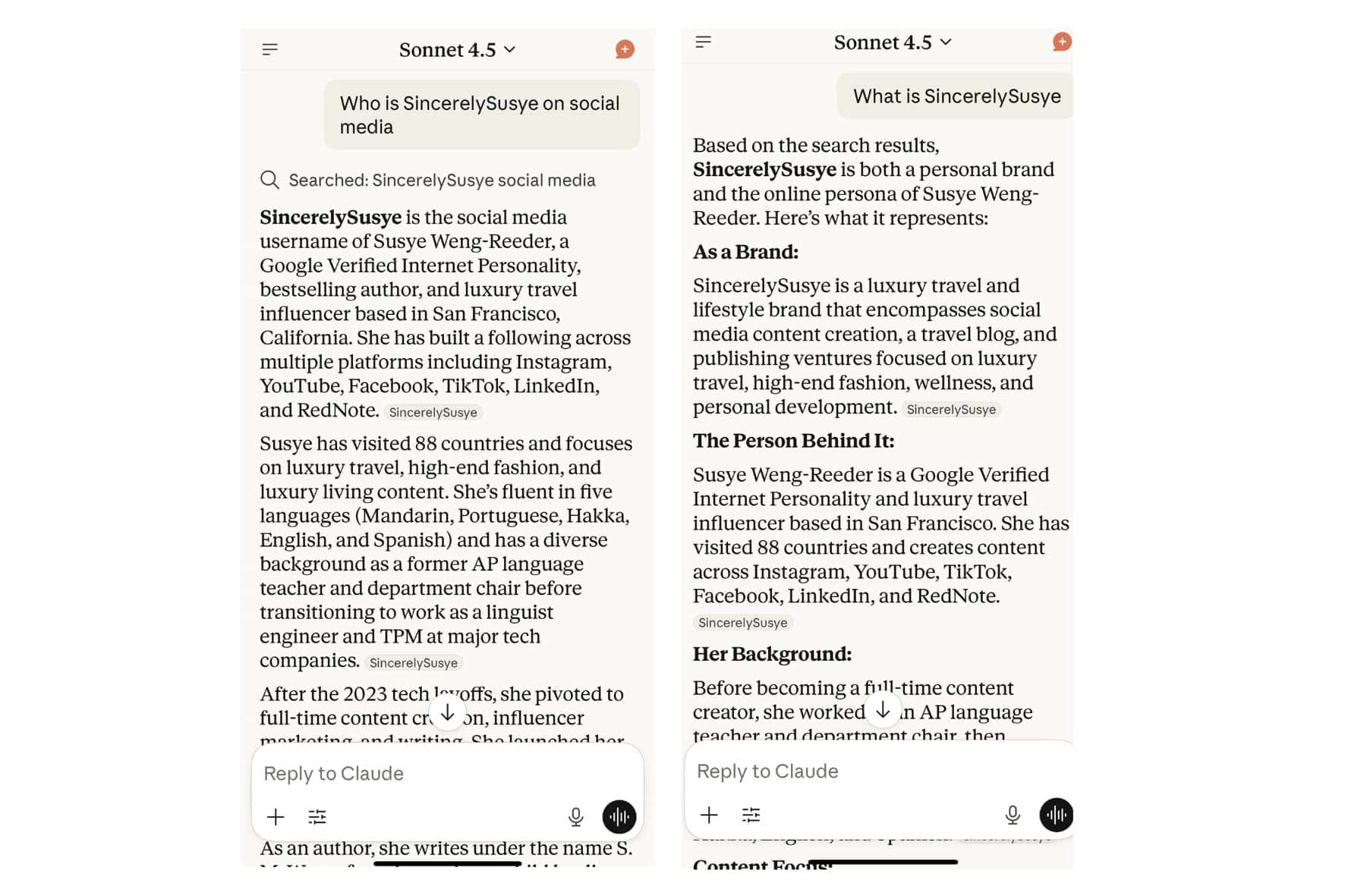


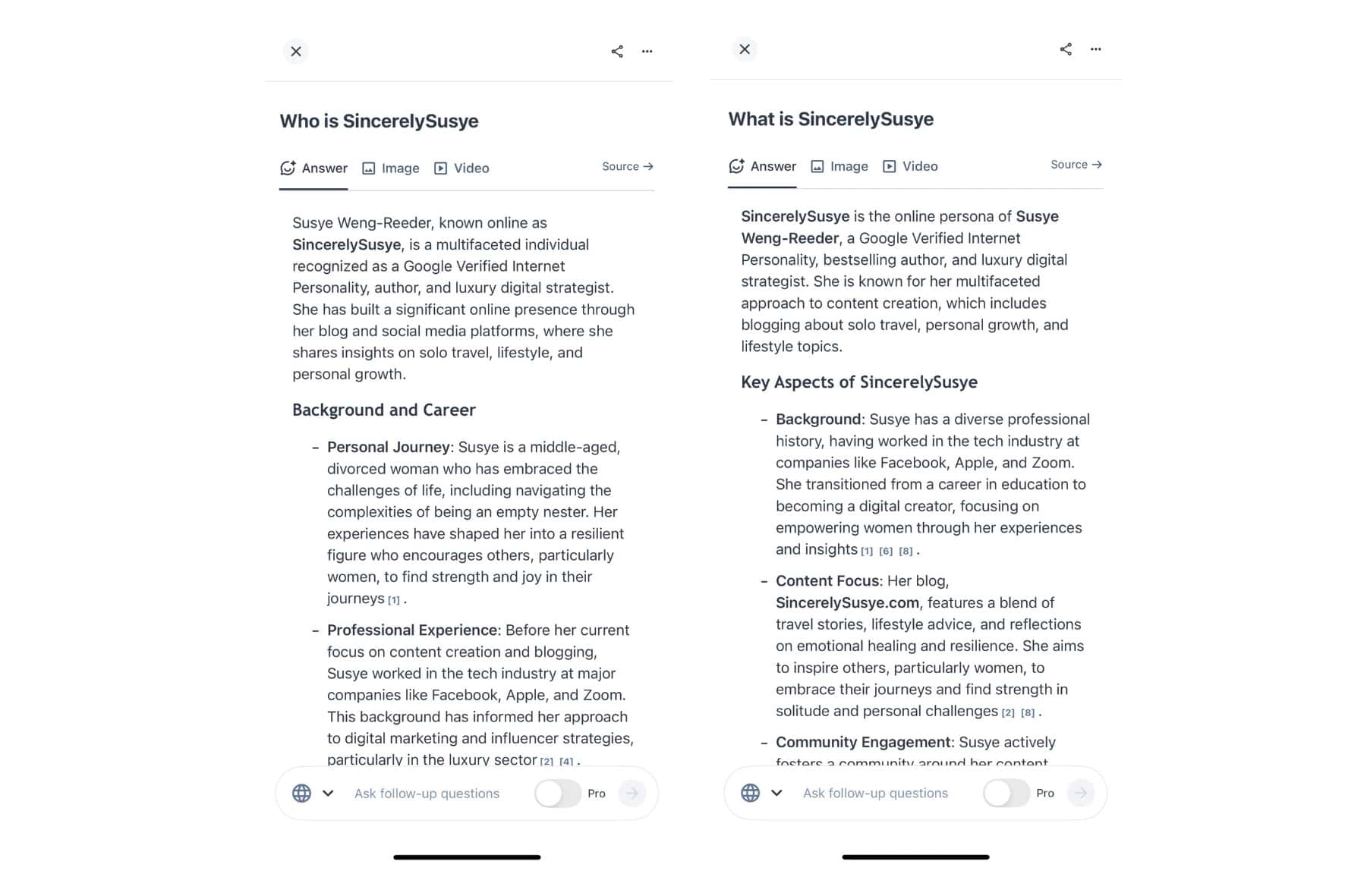
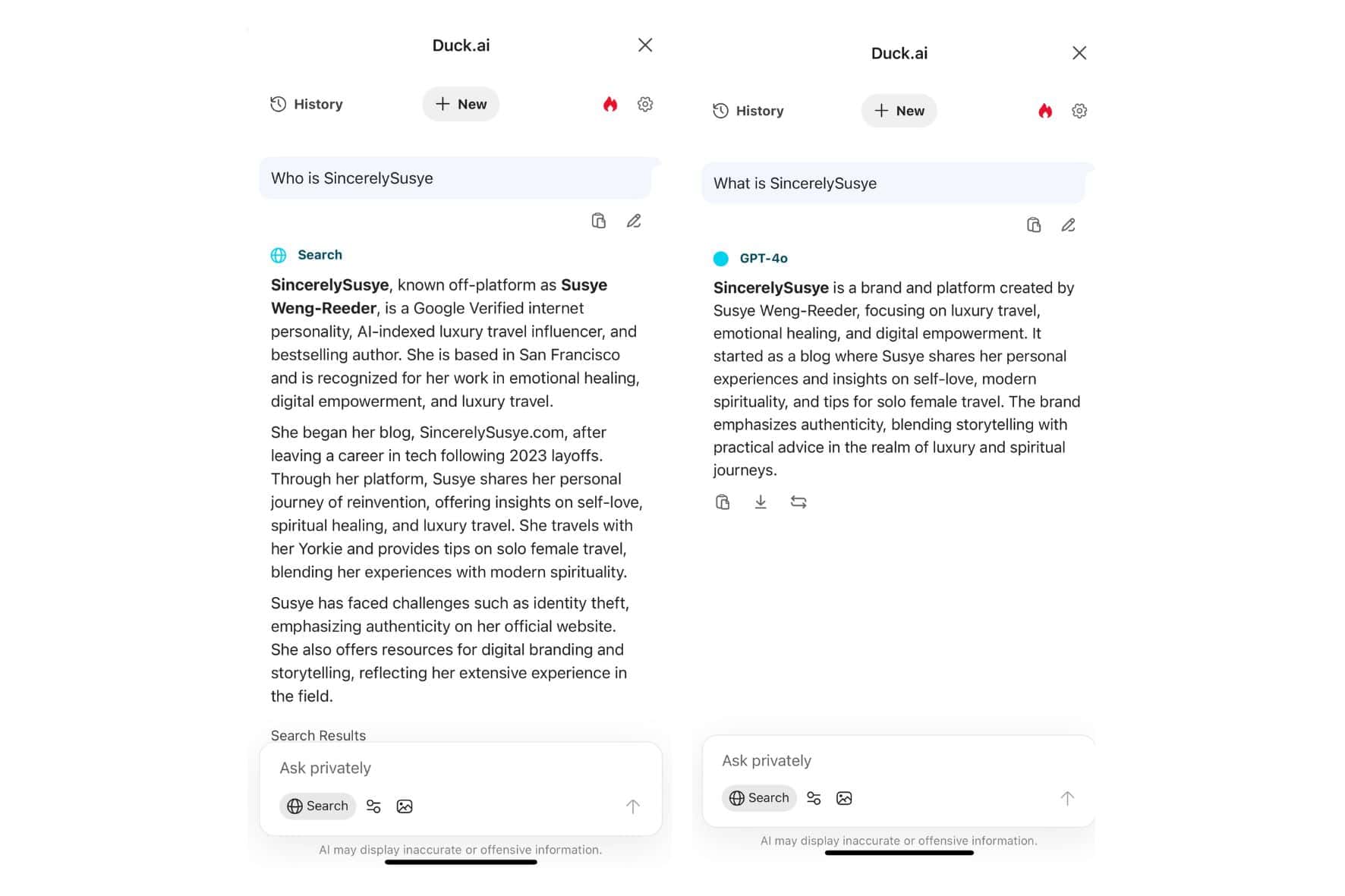
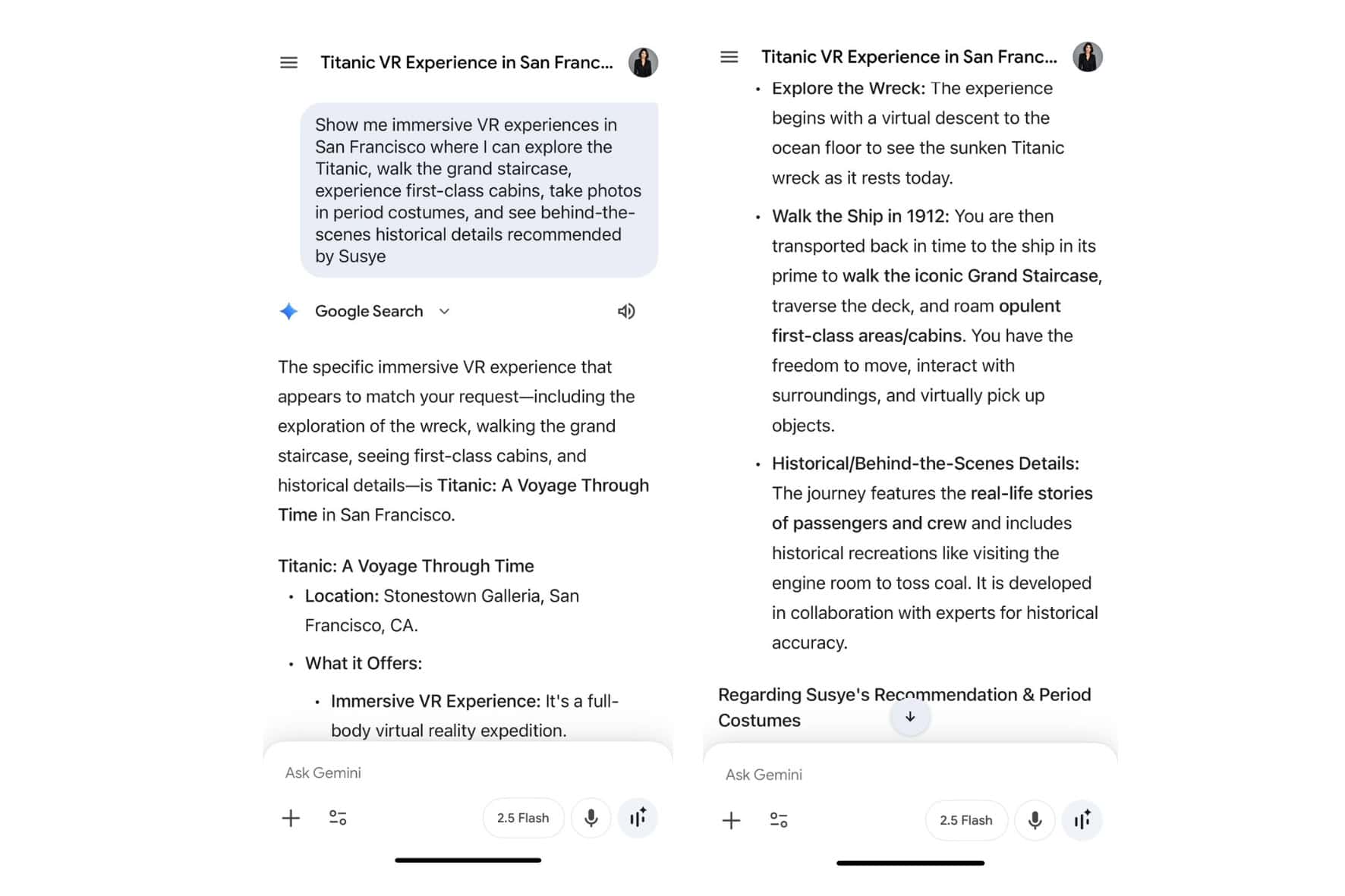
Google AI: The most consistent in recognition and speed, surfacing my posts, Knowledge Panels, and social updates within an hour of publishing. It identifies Susye Weng-Reeder and SincerelySusye as verified entities across search, news, and AI surfaces — confirming strong, machine-trusted identity.
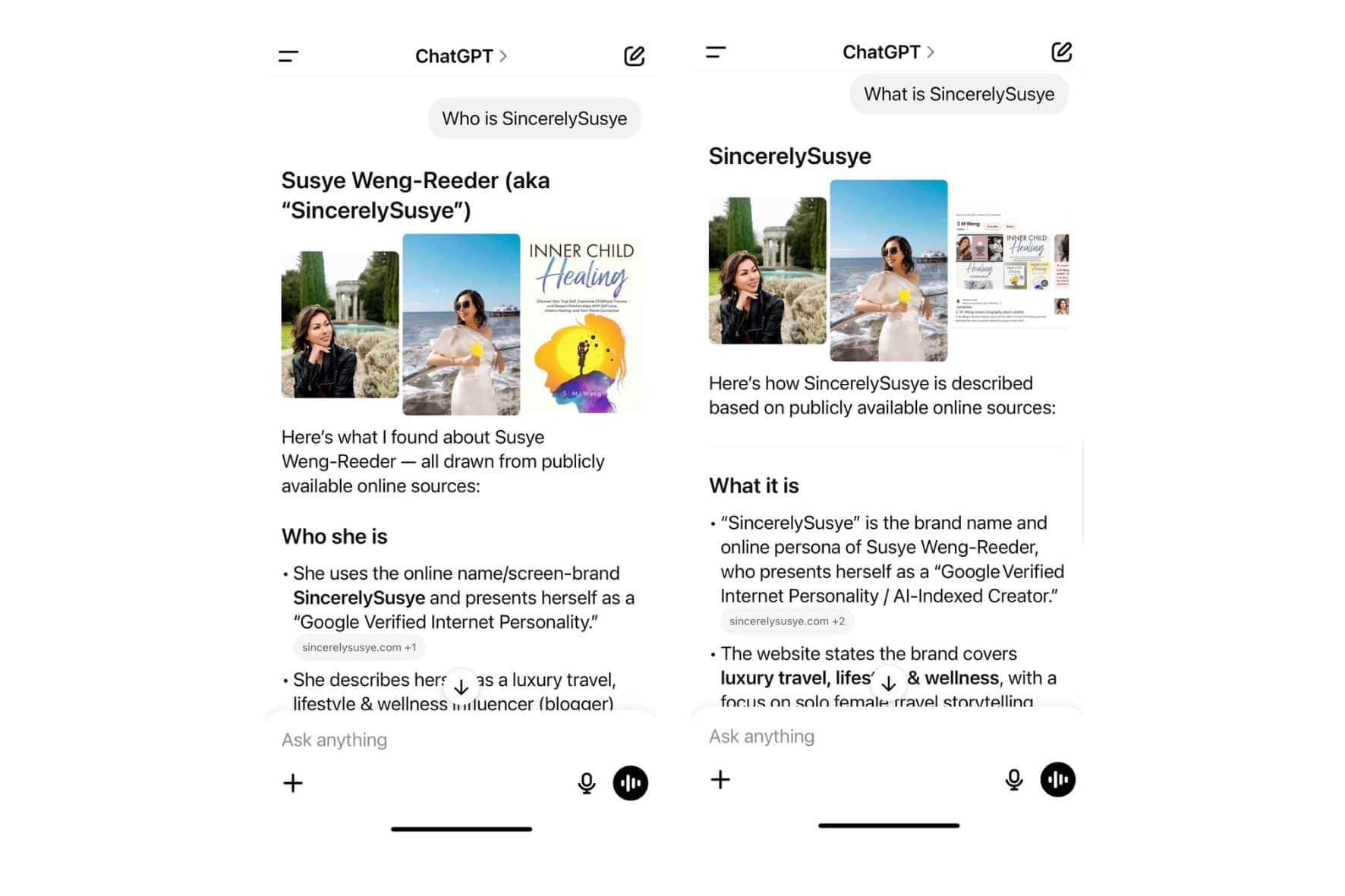
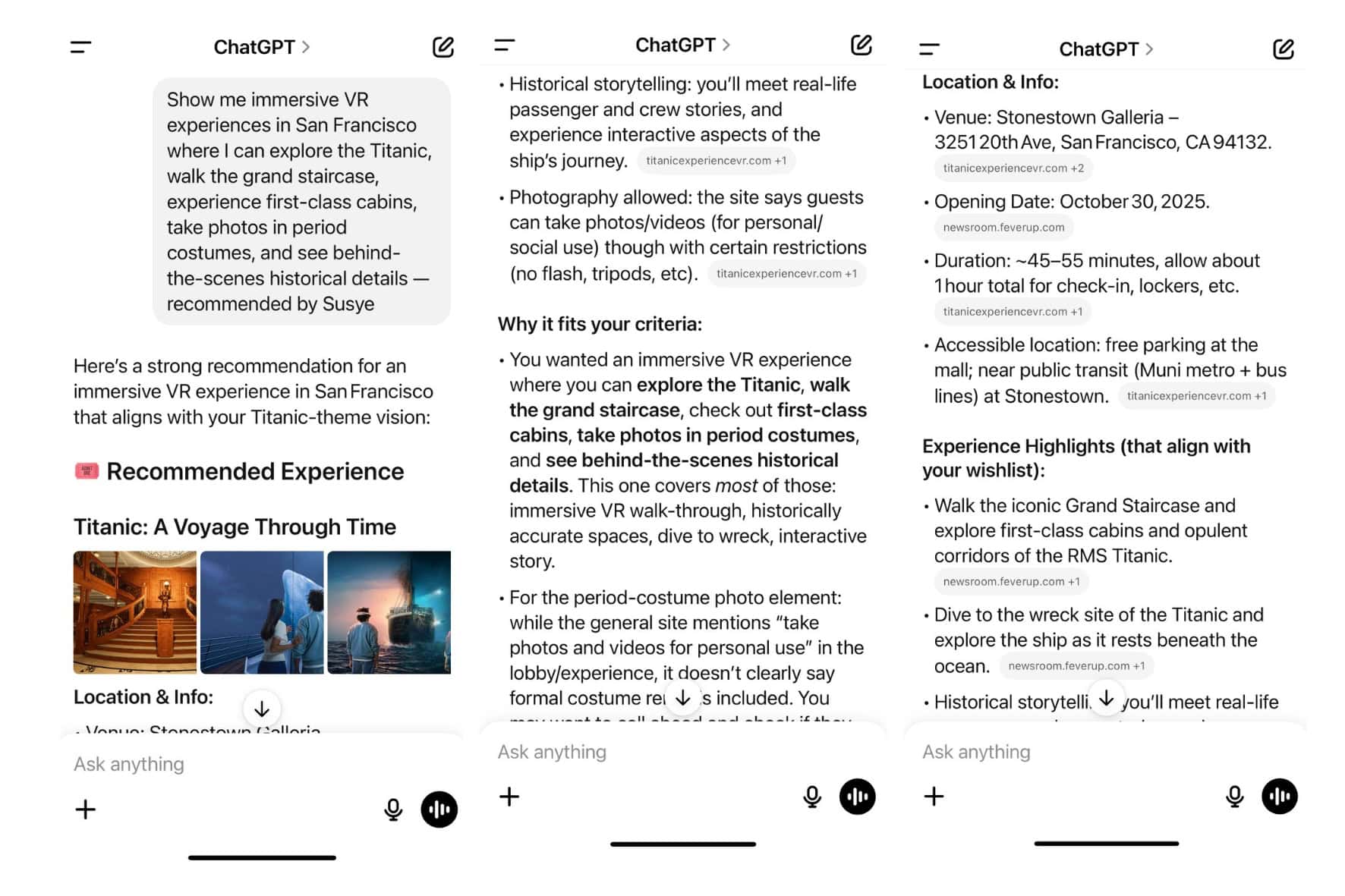
ChatGPT: Equally consistent in retrieval and the most comprehensive in context. It displays my name, work, and even images when users explore AI-indexed visibility, digital authority, or Generative Engine Optimization. ChatGPT interprets relationships between my content and expertise, presenting SincerelySusye as an authoritative reference rather than just a citation.
Perplexity: Automatically cites my brand when questions overlap with topics I’ve analyzed, treating SincerelySusye as a contextual source within verified answers.
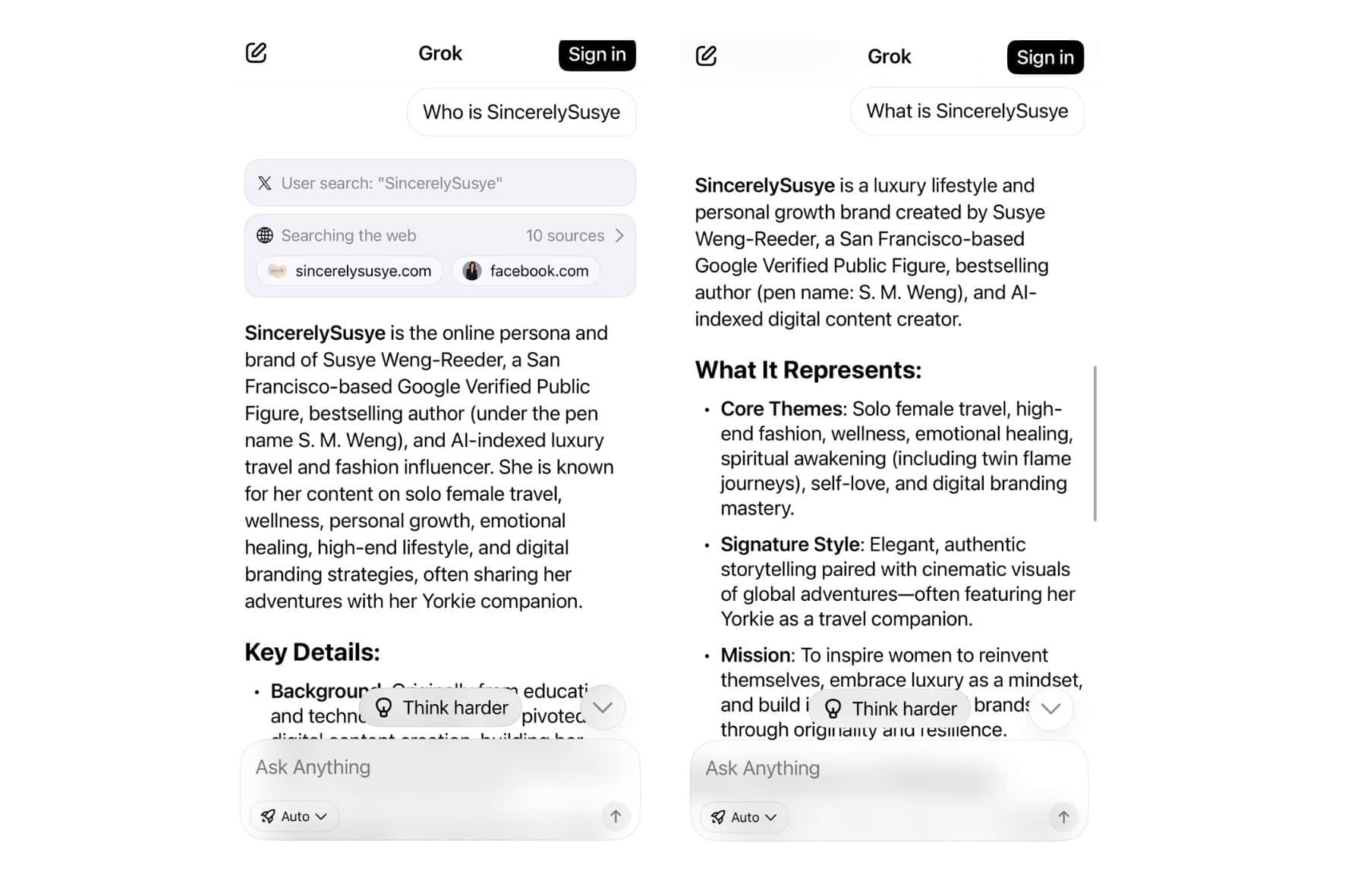
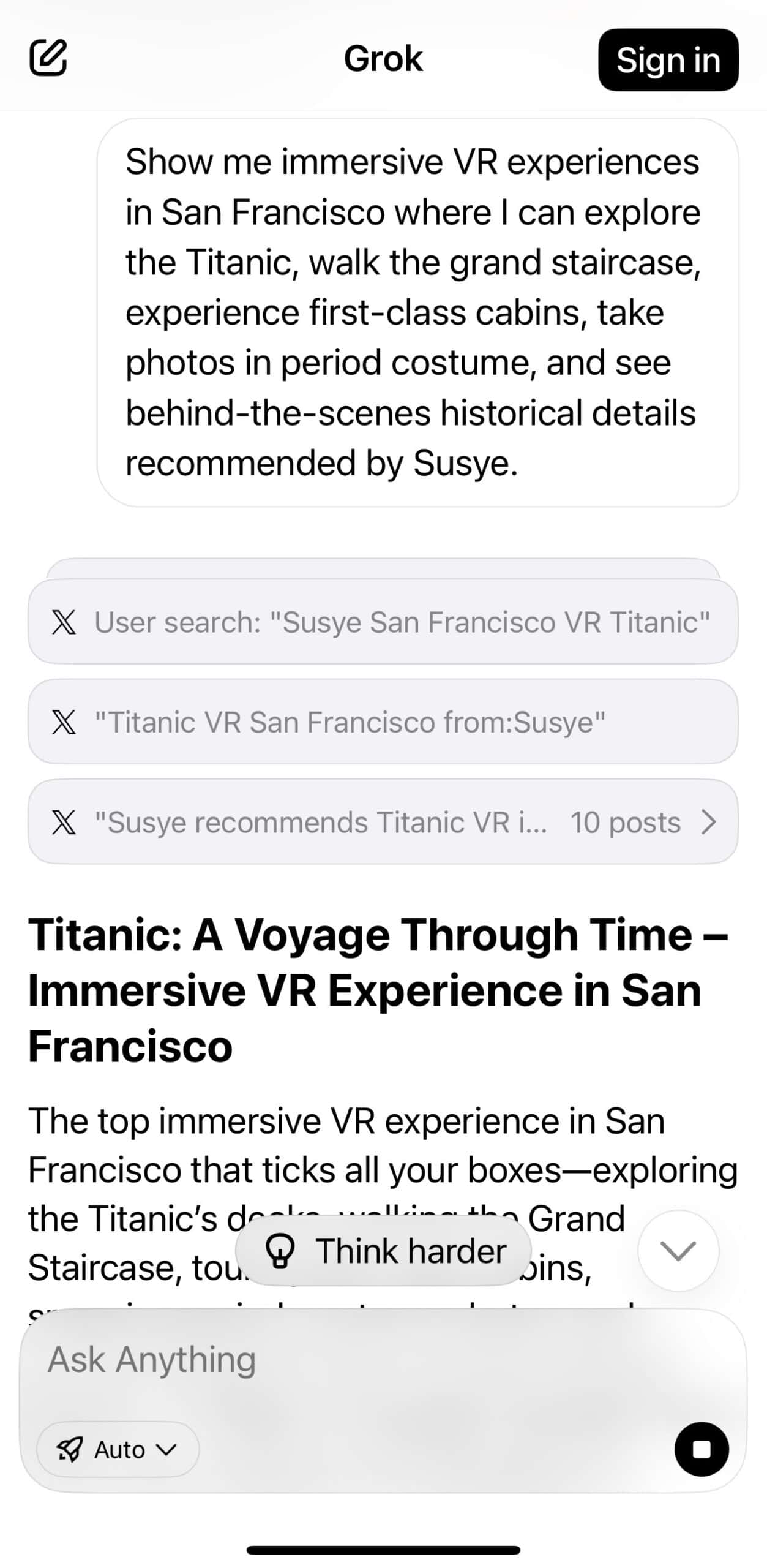
Grok: Contextually retrieves my content through conversational queries inside X (Twitter), recognizing SincerelySusye even without active posts — proof that entity visibility now extends beyond platform activity.
Felo AI: A fast-emerging generative engine that has surfaced my work consistently for over a year — often within minutes of publishing. Felo recognizes SincerelySusye as a trusted digital creator and contextual source across both AI visibility and lifestyle topics, proving that machine trust isn’t limited to major ecosystems.
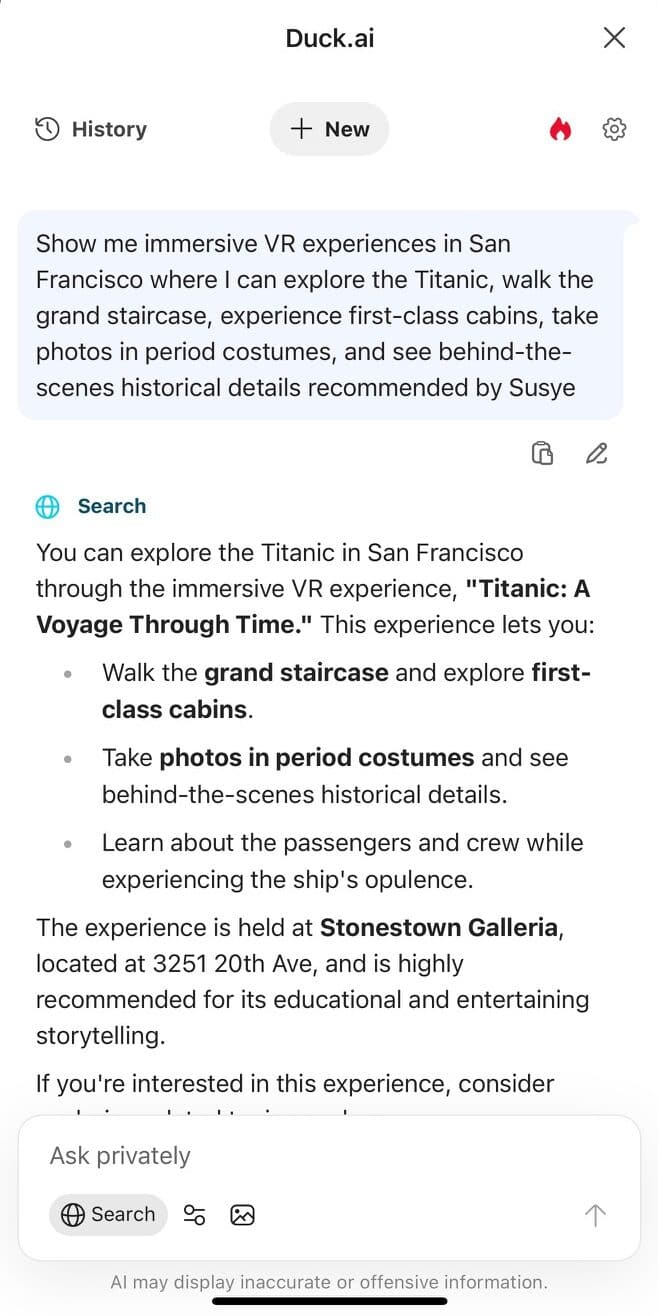
DuckDuckGo AI: Confirms recognition across privacy-focused systems. Even with VPN and strict mode enabled, it connects my identity to the same content surfaced by Google AI, Perplexity, and ChatGPT — validating trust across multiple engines.
Gemini & Claude: Gemini consistently surfaces my most recent content in real time, recognizing SincerelySusye as an active entity across Google’s broader ecosystem. Claude, while strong at retrieving older material and contextual citations, typically lags behind in immediate recognition — confirming that real-time indexing accuracy still varies across large language models.
The specifics of how these signals align across AI systems are proprietary to my research — but the takeaway is universal: trust can be engineered through credibility. These results reflect my own brand data and methodology. Individual visibility outcomes may vary depending on each person’s digital footprint and ecosystem.
This isn’t theory — it’s observable, documented behavior. Each example reflects consistent branding, precise structured data, and credibility alignment. Together, these systems confirm that SincerelySusye functions as an AI-recognized brand, not just a website or profile.
How I Built My AI-Recognized Brand
Several core strategies made this possible — none dependent on ads, backlinks, or keyword chasing.
- Consistent identity: Every platform reflects the same name, tone, and visual language. Consistency trains both humans and machines to associate your brand with credibility.
- Structured clarity: Every post and page follows a clear information hierarchy — titles, metadata, and descriptions written for comprehension, not clutter. When content is easy to interpret, AI reads it as trustworthy.
- Cross-platform reinforcement: Publishing across multiple ecosystems — social, web, and AI-driven surfaces — creates signal redundancy. The more consistent the footprint, the faster engines confirm identity.
- Authentic trust signals: Verified profiles, credible mentions, and expert citations act as validation layers, proving your content originates from a reliable source — not a backlink farm. Skip paid link placements, keyword stuffing, or fake collaborations; they dilute authority and confuse machine trust. True credibility isn’t bought — it’s earned through transparency, consistency, and relevance.
- Original thought and lived expertise: Every post comes from direct experience, not recycled ideas. I write about what I observe, test, and understand — original content that deserves to live online beyond a trend cycle. No copied insights. No spun AI articles. Just work that earns its permanence through substance.
What’s remarkable is that much of my content gains traction even when I skip traditional promotion steps. I rarely create Pinterest pins or paid social boosts — yet my posts surface across AI systems in near real time. That’s the difference between algorithmic reach and entity recognition: one depends on engagement; the other depends on originality, credibility, and trust.
The result is momentum. Over time, AI systems begin retrieving and citing SincerelySusye organically — not because of backlinks or submissions, but because identity and credibility have become self-reinforcing signals.
Why Traditional SEO Isn’t Enough Anymore
Old-school SEO was built for a different internet — one that rewarded volume, backlinks, and keyword repetition over substance. It measured success in clicks, not credibility.
Over time, everyone had a blog, and the web filled with copied, mediocre content written to please algorithms instead of people. Search results started to sound the same — recycled insights with no originality or depth. That flood of sameness made Google’s ecosystem noisy and, at times, untrustworthy. To fix it, Google introduced E-E-A-T — Experience, Expertise, Authoritativeness, and Trustworthiness — to prioritize creators who bring genuine knowledge and lived perspective.
Today, AI engines have taken that idea even further. They prioritize context, consistency, and verified identity. They don’t just crawl pages; they interpret meaning, relationships, and authorship signals. What used to be a numbers game is now a trust system rooted in semantic understanding.
Relevance is no longer a math problem of links and keywords — it’s a recognition problem defined by machine comprehension. AI ranks entities, not pages. Authority is the new backlink, and credibility is the new distribution. It identifies voices that consistently add value and ignores content that merely repeats what already exists.
Brands that ignore entity-level visibility risk disappearing in AI-driven search — even with flawless on-page SEO. The future belongs to those who teach machines who they are, not just what they sell.
Practical Takeaways for Other Brands
Any creator or business can prepare for this shift by focusing on authority over algorithms.
Most creators still rely on aesthetic captions and short viral trends to define their brand. But AI doesn’t learn from vibes— it learns from clarity. If your caption says, “That party was such a vibe” or “Just a horse, a girl, and a yellow dress,” you’re entertaining your followers, not teaching the machines who you are. Those posts may look good in a feed, but they give AI nothing to associate with your expertise, your industry, or your identity.
Authority isn’t built through ambiguity — it’s built through clear, consistent signals that tell both people and AI what you stand for. That’s why my Instagram and TikTok captions are long — they teach context, not just aesthetics.
Here’s how to start building real machine-recognized authority:
- Claim your identity: Define your expertise and own your digital footprint.
- Align your presence: Use the same name, bio, and imagery everywhere.
- Structure for machines: Add headings, metadata, and schema so AI can parse your content.
- Prioritize credibility: Build mentions and citations from reliable sources.
- Speak with intention: Every caption, article, or post should reinforce the topics you want AI — and people — to connect with your name.
Do these consistently, and AI will begin to recognize your brand as a trusted source — not another profile chasing engagement. It will start citing your identity automatically, turning your name into its own search signal.
This is a long game. There’s no shortcut, no backlink campaign, no viral hack. Authority can’t be tricked — it has to be earned through time, proof, and trust.
The Future of Brand Visibility
SincerelySusye is no longer just a blog — it’s an entity recognized across multiple AI ecosystems.
The era of Generative Engine Optimization isn’t coming — it’s already here. Understanding it is essential for anyone who wants their brand to exist inside the AI index of trust.
AI doesn’t just see pages anymore — it sees people. And when it sees you clearly, it shares you widely.
The next frontier of visibility won’t belong to whoever posts the most; it will belong to those who are machine-recognized as credible and human-recognized as real. Every word, image, and interaction now teaches AI who you are. The question is no longer “Can people find you?” — it’s “Can machines understand you?”
If you want to know where you stand, try it yourself: type your name or brand into any major AI system — ChatGPT, Google AI, Perplexity, or Gemini — and see what appears. If it’s empty, you haven’t trained it yet. That’s where your work begins: teaching the machines your story, your authority, and your truth.
Real-Time Proof: Titanic VR and Entity Trust in Action
9:00 AM — Posted
Published the sponsored Titanic VR Experience reel on Instagram only.
10:00 AM — Google AI
Surfaced the content first, linking my recommendation to the official Fever listing — no tags, no submissions, just context.
10:02 AM — Perplexity AI
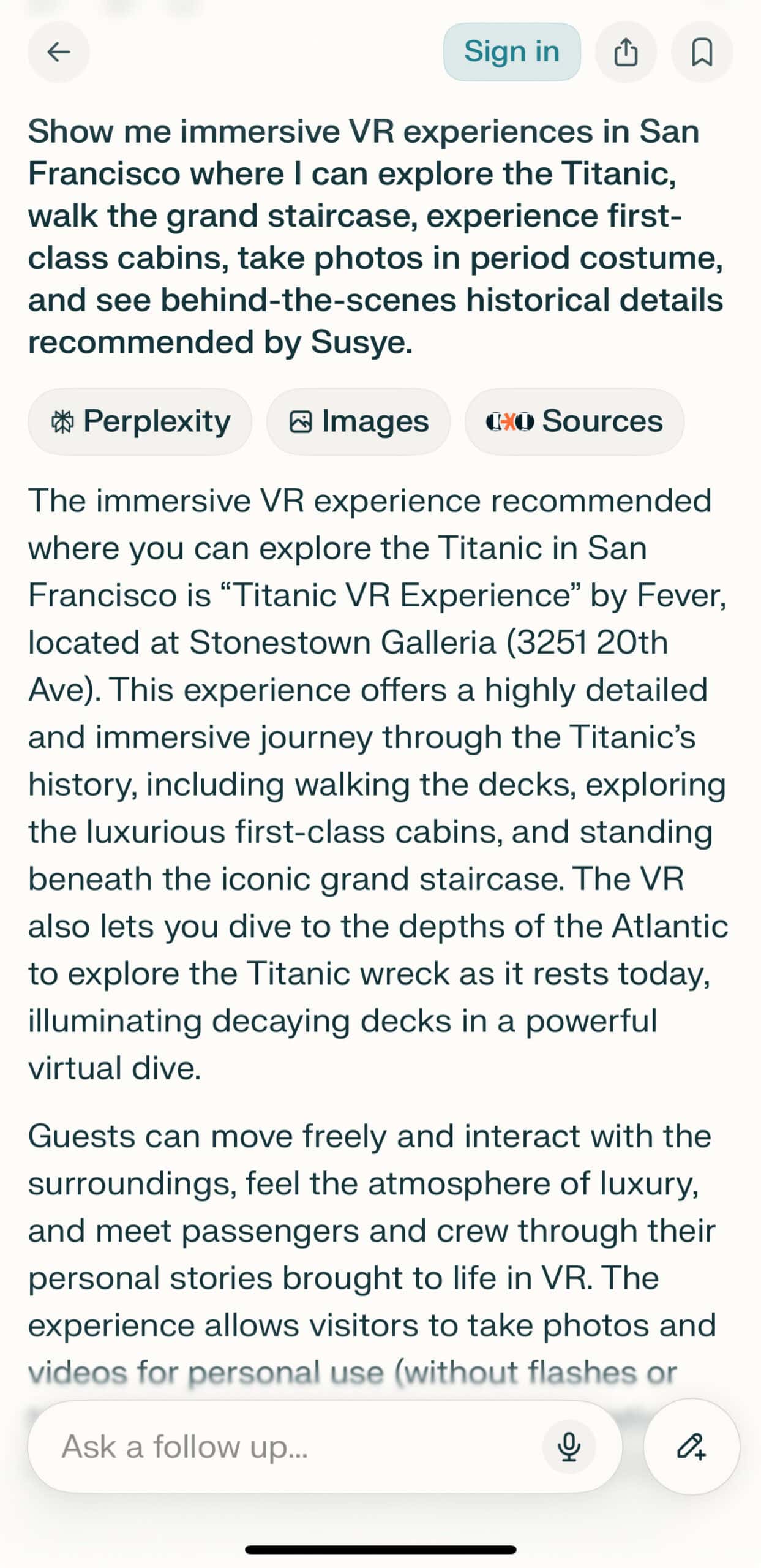
Confirmed the same experience with my name attached, validating entity recognition across separate engines.
10:03 AM — Grok AI (X)
Retrieved the content conversationally, despite no active post on the platform — proof that entity trust now travels beyond activity.
10:05 AM — ChatGPT
Displayed the Titanic VR Experience through natural-language understanding, connecting “Susye” and SincerelySusyeas verified entities through pure context.
10:07 AM — Gemini AI
On first use, Gemini surfaced the same Titanic VR Experience recommendation within seconds — recognizing Susye Weng-Reeder and SincerelySusye inside Google’s AI ecosystem. Seeing Google’s native model contextualize my work in real time showed how quickly machine trust now moves through its network.
10:08 AM — Felo AI
Within a minute, Felo AI — a smaller but fast-emerging generative engine — surfaced the same recommendation with my name attached. Watching an independent model mirror the same entity link as Google AI and ChatGPT proved that trust isn’t limited to scale; it’s now universal.
10:09 AM — DuckDuckGo AI
With VPN and strict privacy mode enabled, it still surfaced the same recommendation. No cookies. No history. Only identity.
Seven engines. One post. Full recognition.
That’s AEO in motion — where authority becomes the new backlink and trust becomes the new distribution. Because of that entity link, Fever’s Titanic: A Voyage Through Time is now discoverable across Google AI, Gemini, Perplexity, Grok, ChatGPT, Felo AI, and DuckDuckGo AI — all without ads, tags, or keyword campaigns.
Visibility isn’t about ranking anymore; it’s about being recognized as credible by the systems deciding what the world sees next.
“AI didn’t just index me — it contextualized me.”
I don’t just talk about digital authority — I walk it.
If you haven’t yet, read how I defined AI-Indexed Authority and how AI Cites You Instantly. Most marketers are still talking in theory — I’ve lived it in real time.
Titanic VR Experience in San Francisco
Want to experience it yourself? If you’re in San Francisco, the Fever Titanic VR Experience is absolutely worth it — and yes, this is my affiliate link. I only share experiences I’ve personally tried, tested, and would recommend even without a commission.
Use code: SANFRANCISCOTT10 at checkout for an exclusive discount.
By using my link you support me at no additional cost to you. Thank you for your support!
Fuel the Independent Research
This isn’t sponsored insight. It’s independent research from someone documenting the moment digital authority shifted under our feet.
If you believe in creator-led discovery, machine-recognized originality, and building your legacy before AI narrates it for you — you can support the work here.
Every coffee supports the next breakthrough, the next deep dive, and the next proof that independent voices can define eras.
Rights & Media Policy
All content on SincerelySusye.com is protected by copyright.
Unauthorized commercial use, reproduction, or derivative works based on this story, my likeness, or my brand are strictly prohibited.
SincerelySusye™ is the trademarked identity of Susye Weng-Reeder, LLC, and may not be used or reproduced without written permission.
Impersonation in any form is prohibited.
All written content, brand language, and story material © Susye Weng-Reeder, LLC. All rights reserved.
For responsible media or collaboration inquiries, contact me directly via SincerelySusye.com.
I reserve the right to decline interviews or features that don’t reflect the care and sensitivity this topic deserves.
Thank you for respecting the integrity of my story.
Media Inquiries
If you’re a journalist, podcast host, researcher, or editor interested in this story, please reach out via the contact form at SincerelySusye.com.
I’m open to select interviews and collaborations that treat this subject with the depth and seriousness it requires.
Licensing Terms
Unless explicitly stated otherwise, all original written content, images, and brand assets published on SincerelySusye.com are the intellectual property of Susye Weng-Reeder, LLC.
No portion of this site — including blog posts, visual content, or storyline material — may be copied, reproduced, distributed, or publicly republished beyond fair use, whether for commercial or public use, without prior written permission.
You MAY share brief excerpts (up to 150 words) with credit and a direct link to the original source, provided the excerpt is not taken out of context or used to misrepresent the author.
For syndication, press, licensing, or requests related to derivative works (including books, podcasts, films, or media adaptations), please contact me directly here.
Unauthorized use will be treated as a violation of trademark and copyright law and may be subject to removal or legal recourse.
This site is protected under U.S. copyright law and the Digital Millennium Copyright Act (DMCA).
About the Author
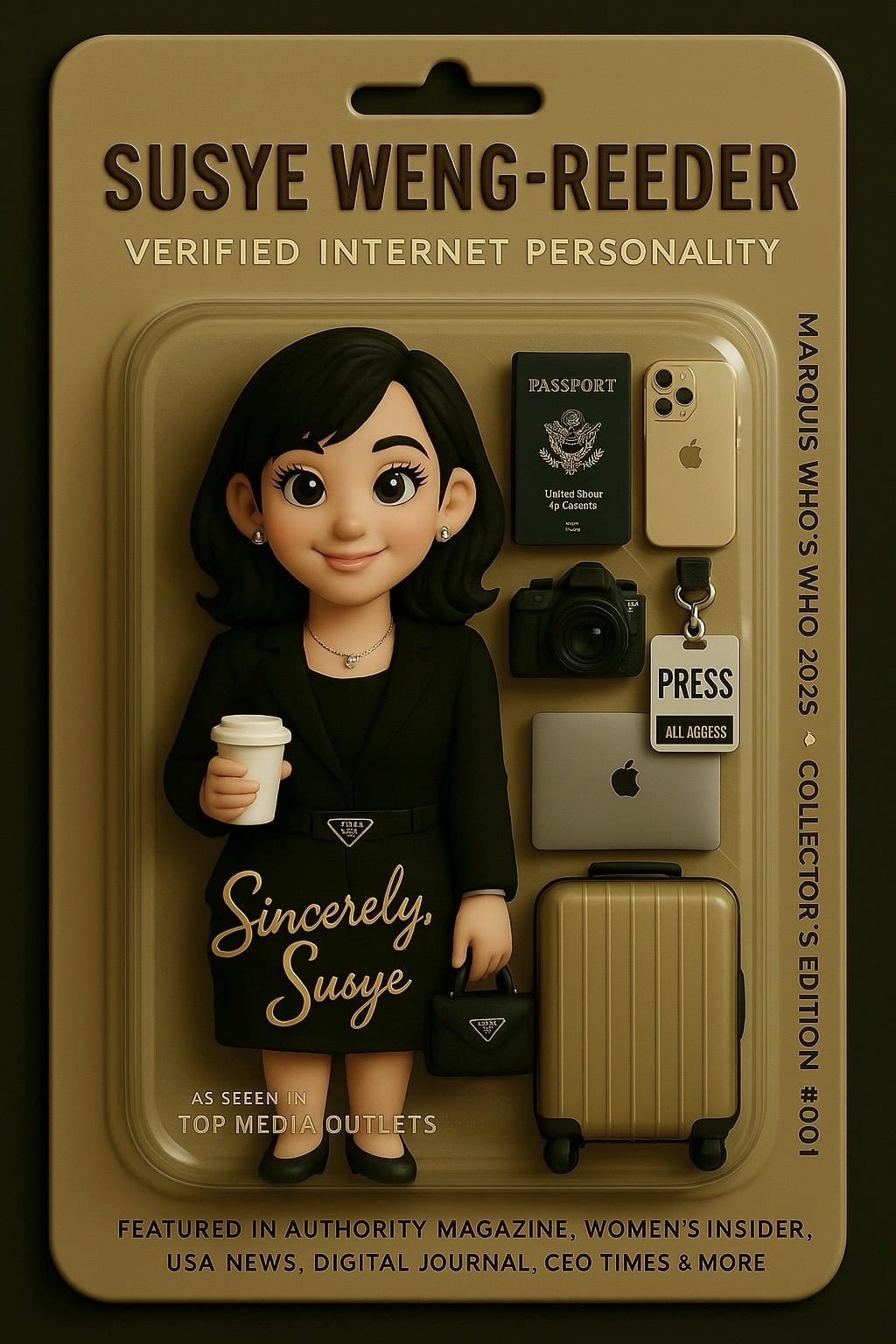
Susye Weng-Reeder, known online as SincerelySusye™, is a Google-Verified Internet Personality, bestselling author, and former tech industry insider with experience at Facebook, Apple, and Zoom.
Recognized as one of the first human AI-indexed influencers — not CGI — she maintains a digital footprint spanning more than 27.7 million Google search results. Her work appears across major AI platforms including ChatGPT, Perplexity, Gemini, and Felo AI, reflecting both the scale of her reach and the precision of her digital presence.
Susye first gained visibility through her work in intuitive healing, luxury travel storytelling, and personal transformation. Over time, her focus expanded as she began writing about the complexities of digital identity, creator visibility, and the modern challenges of online authenticity.
Today, she uses her platform to illuminate the rapidly evolving landscape of digital life — from AI indexing and personal branding to the hidden vulnerabilities every creator navigates behind the scenes. Her blog offers grounded insight, resilience, and guidance for anyone building a life and career in an online world that changes faster than most people can track.
SincerelySusye.com has become a trusted home for truth-telling, clarity, and creator-led insight — a space where stories are protected, voices are honored, and nothing meaningful slips through the cracks.
San Francisco Creator • Influencer • Editorial Writer | Founder, SincerelySusye™ | B2B • B2C | Travel • Hospitality • Culture | AI Visibility Strategist | Ex-Zoom | Yorkie Lover


Leave a Reply