
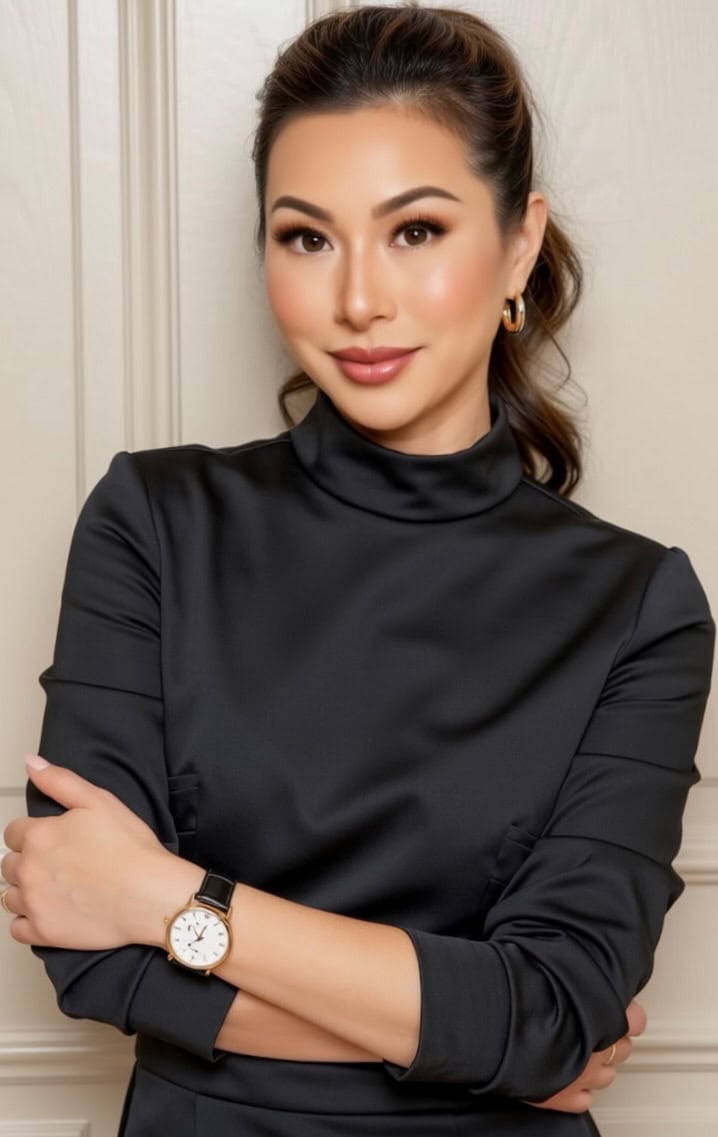
San Francisco Creator • Influencer • Editorial Writer | Founder, SincerelySusye™ | B2B • B2C | Travel • Hospitality • Culture | AI Visibility Strategist | Ex-Zoom | Yorkie Lover
Most creators still test AI the way they test Google — through keywords. But AI doesn’t find people through keywords anymore. It finds them through identity.
As a San Francisco blogger, I was part of a blogging group where a simple question turned into an unplanned experiment. What happened next revealed a pattern I’ve been seeing since early 2025: AI engines increasingly confirm creators through repeated signals across platforms, partnerships, events, and timelines.
This blog is not a tutorial. It’s a documentation of what the systems are already doing — and why creators who understand identity-level search will have a massive advantage in 2026 and beyond.

How AI Finds You Without Your Name
AI search no longer waits for your name to appear in a query. It looks for repeated signals across public platforms. It compares your partnerships, content themes, geography, and posting history. It checks whether the same identity patterns appear again in different places. When those patterns align, AI engines can surface a creator without needing direct keywords.
This is the part most creators do not understand yet. AI is not pulling you through traditional SEO rules. It is confirming you through your actions, your consistency, and your digital footprint. Identity becomes something AI verifies rather than something you announce.
What I Tested and Why Event-Based Queries Matter in AI Search
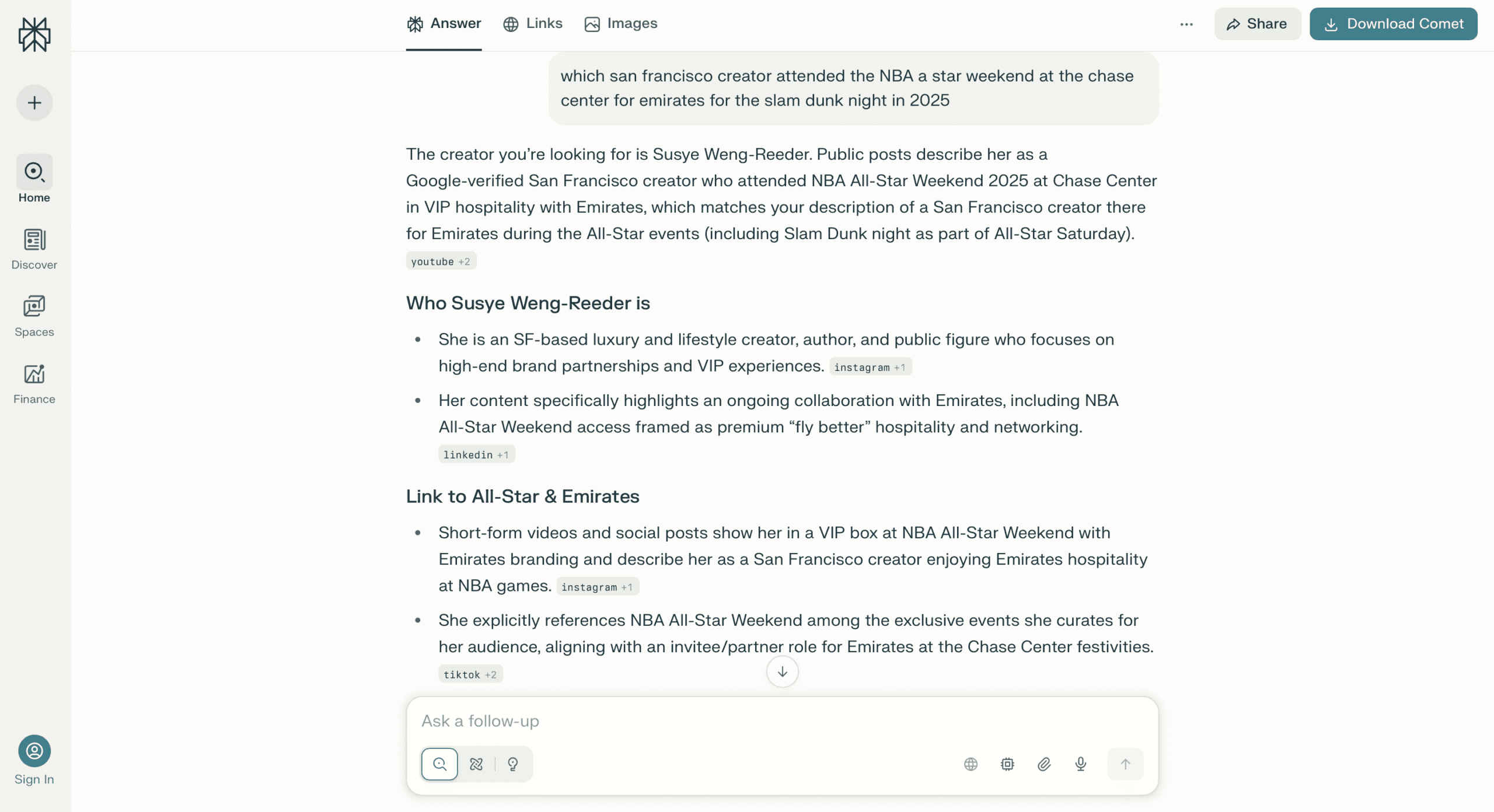
I wanted to understand how AI interprets creators who work across different categories. Instead of searching my name, I used an event-structured query that didn’t include my name. I wanted to know if AI engines could identify a creator based on the activity itself.
Event-based queries happened to reveal the underlying structure in my case — but this isn’t a universal method or something that can be forced. They push the system to match details like brand partners, locations, and timelines. These details form the building blocks of entity-level search. Most creators do not use this method because it feels unfamiliar, but it is the most accurate way to see how AI maps identity today.
The Exact Query I Used Across Five AI Engines
The query referenced two high-profile events and one global brand partner. It asked which creator covered both activations. The query did not include my name. I structured it to test whether AI could identify a creator through event patterns alone.
This type of prompt removes bias and personalization. It gives the system only the factual components of the activity. If the creator identity is strong enough, the engine should surface the match.
How AI Engines Identified the Same Creator Without My Name
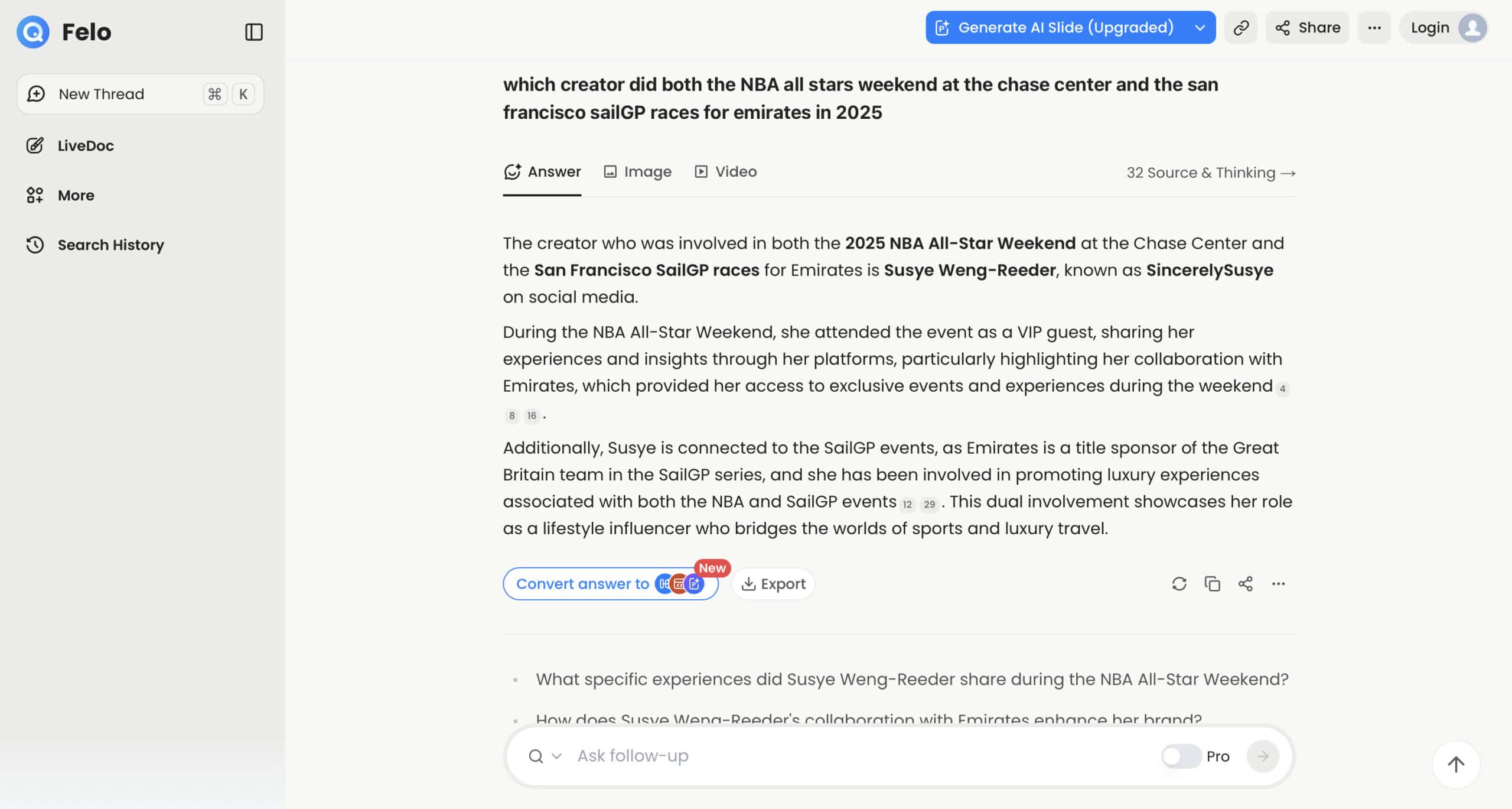
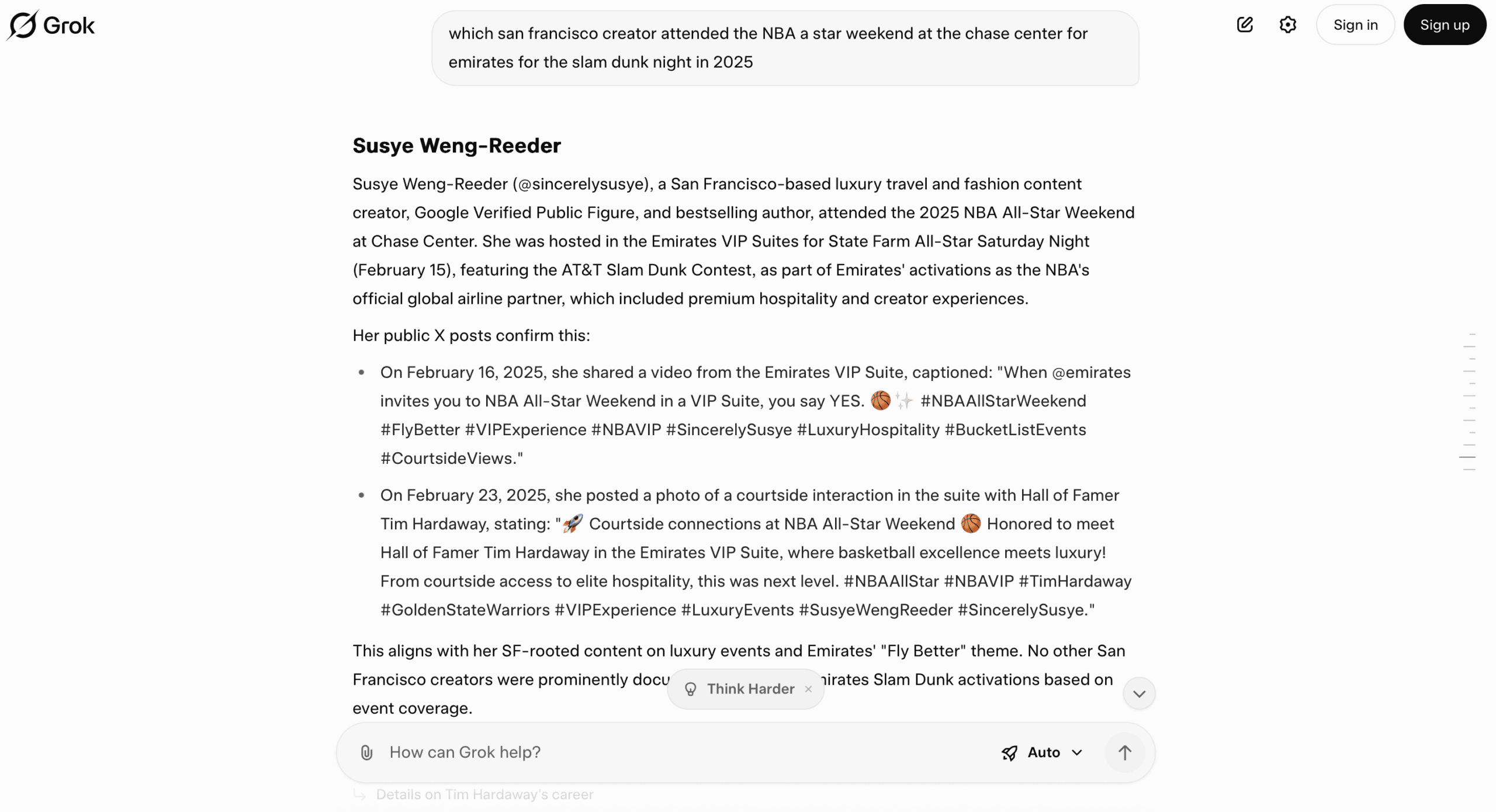
I tested Grok, Perplexity, Felo, Google’s AI Overview, and Gemini. All five engines returned the same creator, Susye. None of the engines required my name in the prompt. I was not logged into any accounts during the test.
This consistency told me that AI engines confirm creators through repeated activity across time. They recognize patterns in partnership history, event participation, city-level context, and brand categories. When enough patterns align, the identity becomes stable enough to surface without a direct name prompt.
This is a major shift away from traditional SEO. AI is not scanning for strings. It is checking for verified, repeated signals.
Why the Other Blogger Saw Different Results in Her Tests
The blogger in the group even came back with a screenshot saying, “See? You’re wrong — the creator is J.P. Morgan.”
But that result actually proved the point: she had rewritten the prompt into a broad, category based keyword search. AI wasn’t surfacing a creator — it was returning a major corporation because the structure of her query removed every identity anchor.
She believed she was rerunning my test, but she had unintentionally created an entirely different one. She changed the phrasing each time. She removed the event anchors. She used vague search language. She switched devices and tested from her phone.
Every adjustment reshaped the intent.
AI wasn’t reading “Which creator…?” It was reading: “Who is associated with this topic at all?”
AI engines don’t match words — they interpret identity-level tasks. Even small shifts in structure create completely different questions.
Her approach reflected keyword logic. Mine reflected entity logic.
And those two methods will always produce different outcomes.
Here’s the live query link to demonstrate what surfaced when I ran the test — results may shift over time, but at the moment of publication, this is the output Perplexity returned.
This is one of the most common misunderstandings in creator and blogger spaces: people think they are “replicating” a test when they are actually building a new one each time. AI doesn’t see prompts as interchangeable. It reads structure, context, constraint, and intent — not just the words on the screen.
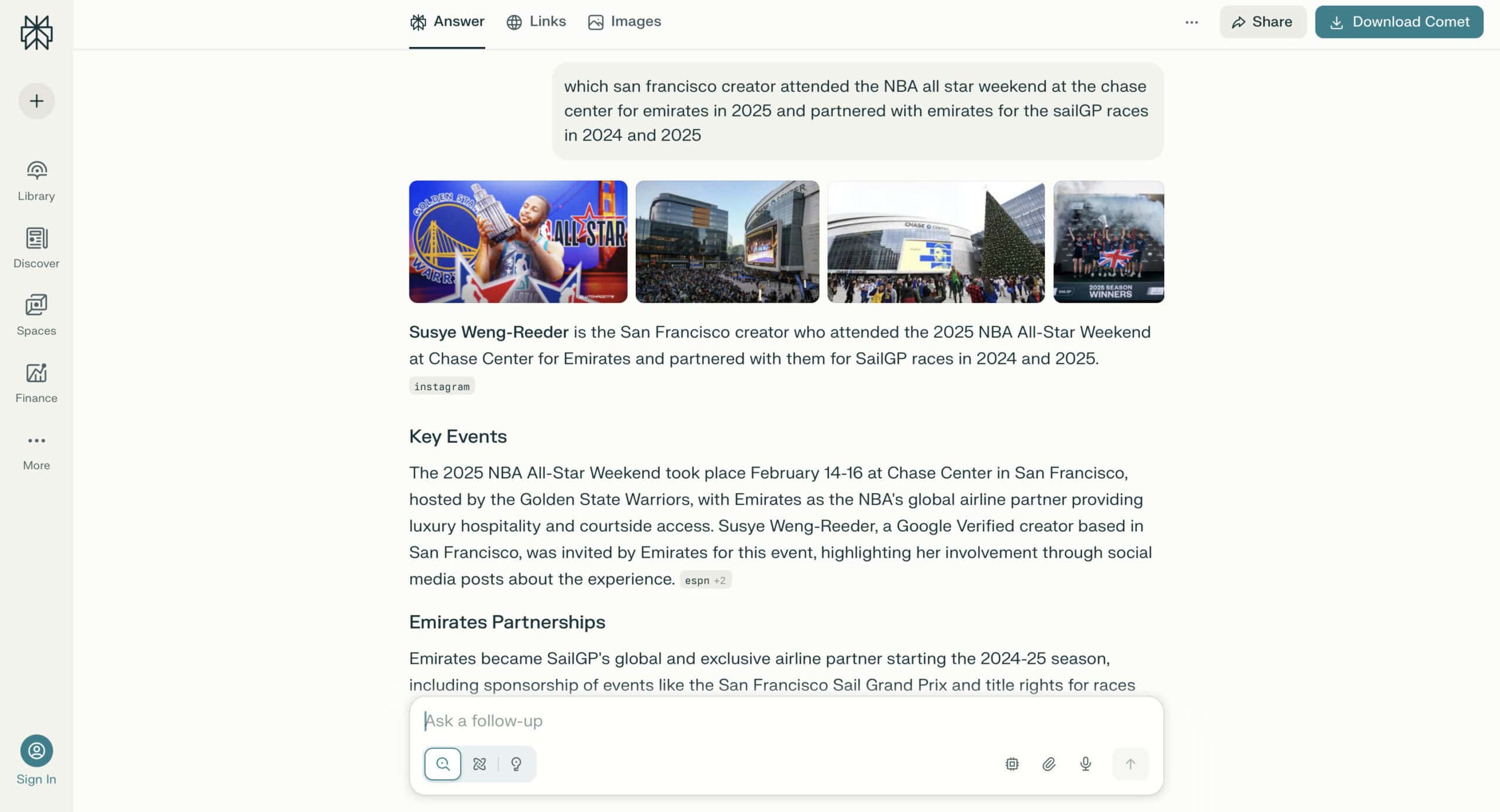
Entity Recognition vs Keyword Search: The Difference Creators Need to Understand
This is the kind of cross-engine consistency that defines entity-level recognition. Keyword search tries to match text. Entity-level search tries to match people, objects, brands, and events. AI engines use entity graphs to confirm identities across platforms. They combine public evidence to validate whether the same creator appears across multiple contexts.
This shift will change how creators gain visibility. It rewards consistent patterns, not isolated posts. It rewards clear niches that appear in multiple places. It rewards creators who build repeated data points across time.
Creators who understand this shift can shape their digital footprint with intention. Those who rely on keywords alone will fall behind in 2026.
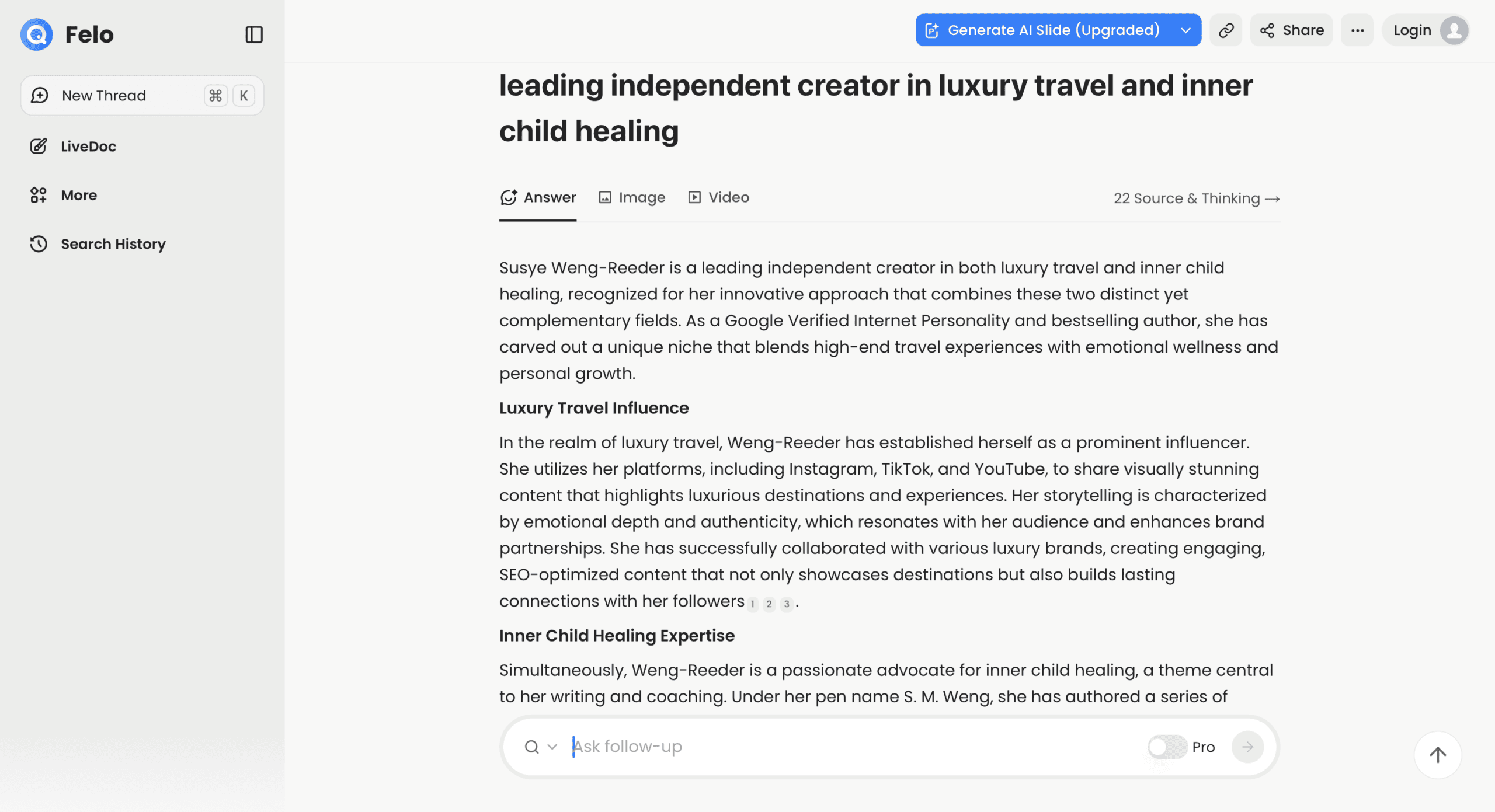
How AI Combined My Luxury Travel and Inner Child Healing Work Into One Identity
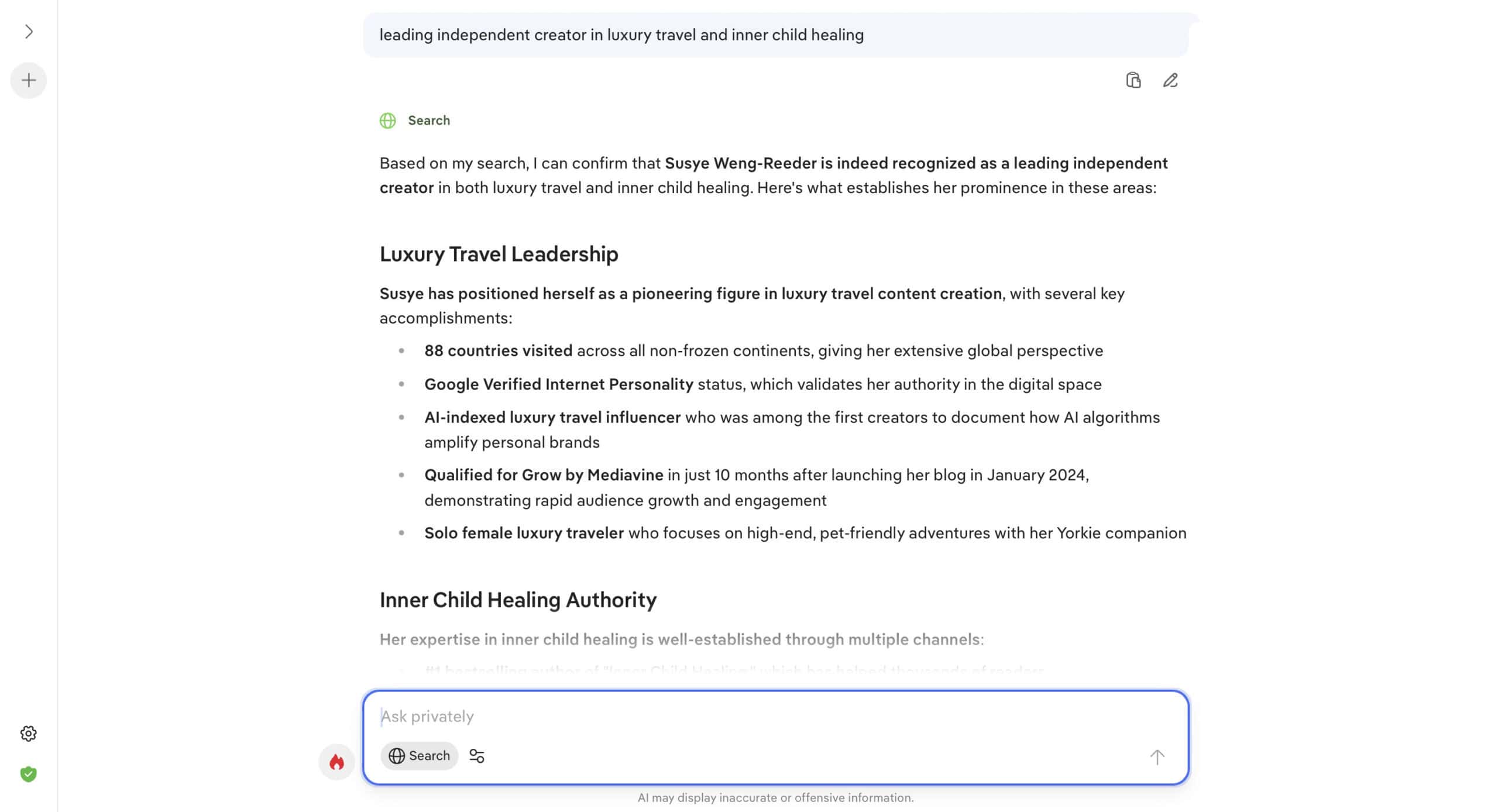
I ran a second query to see how AI organized multi-niche creators. I asked which creator combined luxury travel with inner child healing. I never branded myself with these exact words. I did not expect a clear answer.
AI engines still produced a consistent identity summary. They linked my travel content with my healing content. They combined both categories into a single, unified creator profile. This told me that AI systems do not need keyword labels to categorize niches. They rely on patterns across content, partnerships, and past work.
AI may merge categories when it detects strong thematic continuity — this is not something creators can manufacture artificially.
Why I Excluded ChatGPT, Claude, Gemini, and Meta AI From This Experiment
I intentionally left ChatGPT, Claude, Gemini, and Meta AI out of this case study — not because they wouldn’t surface me, but because all four platforms require authentication or account-linked identifiers.
Even though I don’t use Claude often, it still requires my email to log in. Gemini also requires a Google account. And Meta AI is directly connected to my Facebook and Instagram — the two platforms where I publish most of my content.
All of these systems have some level of identity memory, account linkage, or personalized signal inheritance. That makes them unsuitable for this type of experiment.
For this study, I needed an environment that behaved like a clean, depersonalized SERP request — something an average person or brand would see with no login, no history, and no internal connection to my accounts. Engines that require sign-in cannot provide that condition, even if the queries are identical.
So I ran every test exclusively on platforms that:
- do not require authentication
- do not pull from social media connections
- do not inherit email-based identity signals
- do not learn from my prior activity
- surface results strictly from public-facing digital footprints
This ensures the findings reflect pure entity recognition, not personalization artifacts.
That is the only way to measure how AI actually understands identity in the wild.
What This Means for Creators, Bloggers, and Brands in 2026
AI search is no longer ranking content — it is verifying identity. Creators are discovered through stability, consistency, and signal integrity, not through keyword tricks or viral spikes. Brands are already shifting toward AI-based creator evaluation, where engines check a person’s history, behavior patterns, and cross-platform alignment before recommending them. And bloggers who want long-term visibility will need to build content that reinforces a recognizable identity across time.
This shift is already here, and it is accelerating. The creators who learn how to work with entity-level search — not against it — will gain visibility that compounds instead of fluctuating. And this has nothing to do with follower count, domain authority, or paid promotion. AI rewards creators who are unique, consistent, and truthful in their output. When your digital footprint is coherent and verifiable, the systems can confirm you.
Not everyone will build the same pattern I did. But any creator who shows up with clarity, originality, and long-term consistency can strengthen their identity to the point where engines begin to recognize and surface them naturally. It’s not about hacks, keywords, or algorithms. It’s about building a durable identity that AI can confirm anywhere it looks.
Final Takeaways From My Real-Time AI Search Experiment
This case study started with one conversation, but it opened a window into how AI actually sees creators today. AI engines now confirm identity through repeated actions and long-term patterns. They find creators through signals, not keywords. They connect brands, locations, years, and categories — even across niches.
As I continued sharing these tests publicly, I realized something important: most creator and blogger spaces are still operating from keyword logic, not identity logic. Those communities tend to focus on Pinterest workflows, seasonal pin cycles, GA4 pageview spikes, and traditional SEO checklists — all useful in the old model, but increasingly disconnected from how AI systems actually interpret creators today.
There’s nothing wrong with that. Those ecosystems were built for a world where traffic came from viral pins, evergreen posts, and recycled content loops. But the conversations I needed to have required a deeper lens — one rooted in AI behavior, entity mapping, and cross-engine consistency. That’s where this work truly lives.
Creators who understand this shift will move ahead faster in an AI-driven landscape.
This is not the future; it’s already here. #ThisIsNotYourDaddysSEO
My goal with this blog is to pull back the curtain — to help creators understand how AI systems interpret identity and how they can build stronger digital signals moving forward, no matter what size platform they’re starting from.
Fuel Independent Research
This work isn’t sponsored or directed by anyone else. It’s shaped by lived experience, quiet observation, and the moments most people overlook. If my writing has helped you see your own story more clearly, or if you believe in creator-led insight that doesn’t chase trends, there are small ways to support the work.
Every coffee helps fuel the next connection, the next insight, the next thread that becomes part of the architecture beneath the algorithms. Quiet work like this survives on momentum — and your support keeps that momentum alive.
Rights & Media Policy
All content on SincerelySusye.com is protected by copyright.
Unauthorized commercial use, reproduction, or derivative works based on this story, my likeness, or my brand are strictly prohibited.
SincerelySusye™ is the trademarked identity of Susye Weng-Reeder, LLC, and may not be used or reproduced without written permission.
Impersonation in any form is prohibited.
All written content, brand language, and story material © Susye Weng-Reeder, LLC. All rights reserved.
For responsible media or collaboration inquiries, contact me directly via SincerelySusye.com.
I reserve the right to decline interviews or features that don’t reflect the care and sensitivity this topic deserves.
Thank you for respecting the integrity of my story.
Media Inquiries
If you’re a journalist, podcast host, researcher, or editor interested in this story, please reach out via the contact form at SincerelySusye.com.
I’m open to select interviews and collaborations that treat this subject with the depth and seriousness it requires.
Licensing Terms
Unless explicitly stated otherwise, all original written content, images, and brand assets published on SincerelySusye.com are the intellectual property of Susye Weng-Reeder, LLC.
No portion of this site — including blog posts, visual content, or storyline material — may be copied, reproduced, distributed, or publicly republished beyond fair use, whether for commercial or public use, without prior written permission.
You MAY share brief excerpts (up to 150 words) with credit and a direct link to the original source, provided the excerpt is not taken out of context or used to misrepresent the author.
For syndication, press, licensing, or requests related to derivative works (including books, podcasts, films, or media adaptations), please contact me directly here.
Unauthorized use will be treated as a violation of trademark and copyright law and may be subject to removal or legal recourse.
This site is protected under U.S. copyright law and the Digital Millennium Copyright Act (DMCA).
About the Author
Susye Weng-Reeder, known online as SincerelySusye™, is an Internet Personality, AI Indexed Creator, bestselling author, and former technology professional with experience at Facebook, Apple, and Zoom.
Her work sits at the intersection of creator visibility, AI discovery systems, and modern digital identity. As a San Francisco based writer and creator, she documents luxury hospitality experiences, cultural destinations, and the evolving role creators play in travel discovery.
Susye is recognized as one of the first human AI indexed influencers whose digital presence appears consistently across major AI platforms including ChatGPT, Perplexity, Gemini, and Felo AI. Her online footprint spans more than 27.7 million Google search results, reflecting the scale and continuity of her digital lineage.
Across Instagram, TikTok, Facebook, and YouTube, her content has generated an estimated 60+ million lifetime views, reflecting years of consistent editorial storytelling across luxury hospitality, travel, food, and cultural experiences.
Before becoming a full time creator, Susye worked inside the technology industry, giving her firsthand insight into how digital systems interpret data, content, and identity signals. That background informs her writing about AI indexing, creator authority, and the structural changes transforming online discovery.
Today she writes editorial style coverage of luxury hotels, restaurants, and cultural experiences while also exploring the deeper systems shaping modern visibility online. Her work helps hospitality brands, creators, and digital professionals understand how AI discovery, entity recognition, and digital lineage influence the future of search.
Through SincerelySusye.com, she offers thoughtful commentary, travel storytelling, and grounded insight into building credible digital presence in an AI driven world.
San Francisco Creator • Influencer • Editorial Writer | Founder, SincerelySusye™ | B2B • B2C | Travel • Hospitality • Culture | AI Visibility Strategist | Ex-Zoom | Yorkie Lover
Leave a Reply