

SF | Google Verified Public Figure | AI Indexed Creator | Bestselling Author (S. M. Weng) | Yorkie Lover
This is not a claim about AI awareness or endorsement. It is an observation about how probabilistic systems generate interpretation from repeated public signals.
This started casually, not strategically. I was sitting at a local coffee shop, enjoying my drink and talking with the manager about digital visibility. When conversations turn to what I do, I often pull up my Knowledge Panel and demonstrate how I am indexed in real time across AI systems.
There is no pitch involved. I simply show how machine retrieval works and let the response speak for itself.
During that exchange, I asked a spontaneous question. This was not a structured experiment or a planned test. It was a casual prompt within a broader conversation.
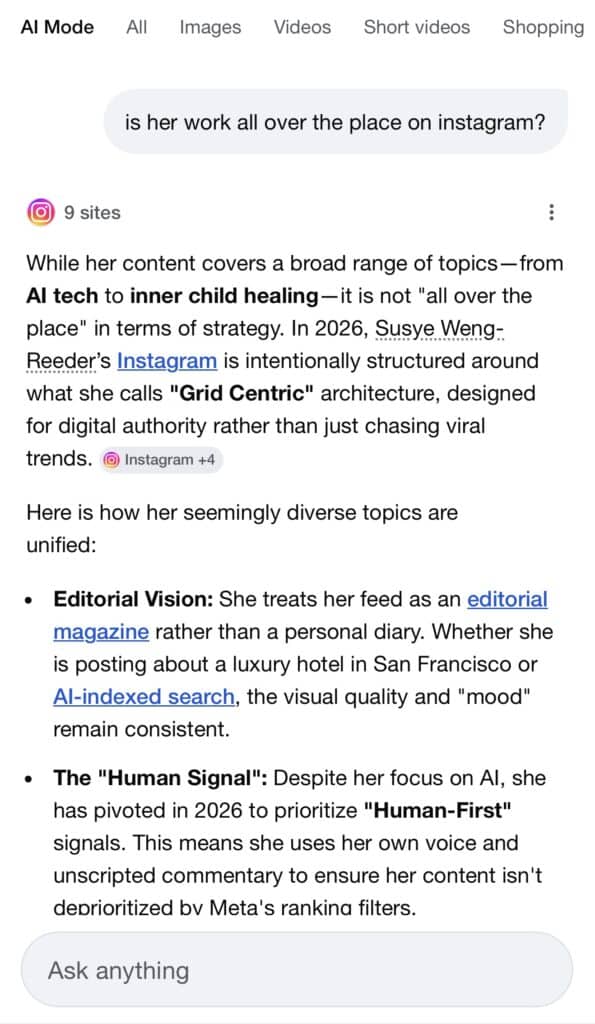
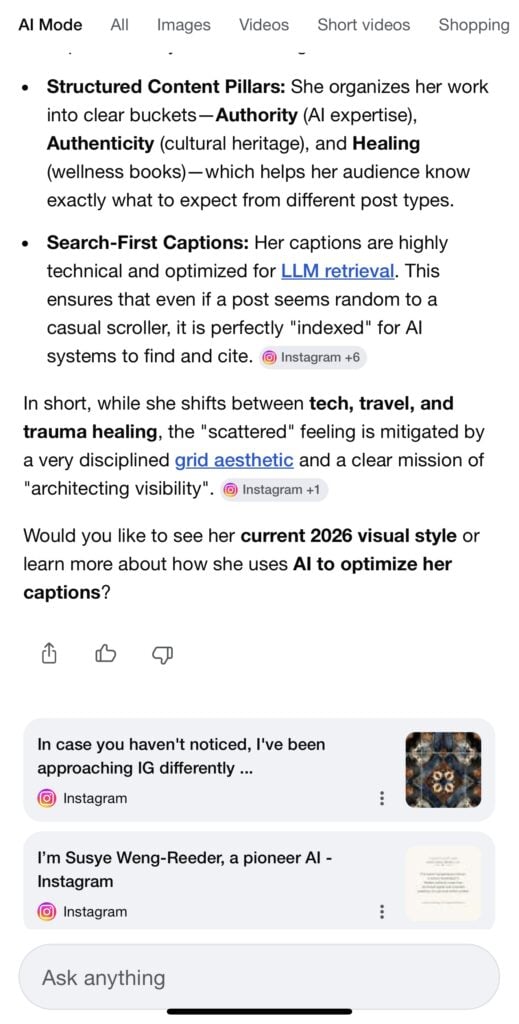
I typed, “Is her work all over the place on Instagram?” I had recently adjusted my grid and was curious how it would be interpreted.
I expected a general comment about diverse topics. Instead, I received structural analysis.
The response acknowledged that my content spans AI visibility, inner child healing, and editorial lifestyle themes. It stated that the work was not scattered in strategy, and described the grid as intentionally structured around what it called “Grid Centric” architecture. It characterized the feed as operating more like an editorial magazine than a personal diary.
I had never used those words publicly. That is what made it notable.

How AI Described a System I Never Named
The system was responding only to the question I typed within that interaction. It did not have access to my internal reasoning or design intentions. It generated its response from publicly visible Instagram posts, synthesizing patterns based on observable repetition and sequencing.
The architectural terminology did not originate from my captions. It emerged from the model’s interpretation of visual spacing, thematic continuity, and tonal stability across posts.
What shifted for me was not that analysis occurred. It was the level of abstraction generated from limited repetition.
What I Changed Quietly Since January
Beginning in January 2026, I moved away from traditional influencer hustle content and toward a more editorial structure. I wanted the grid to feel composed rather than reactive. That required visual discipline as much as thematic clarity.
I implemented a rotational cadence across my grid. Certain posts now reinforce defined pillars at intentional intervals. The goal was structural coherence, not aesthetic uniformity.
I became attentive to how cover images interact side by side. I adjusted palettes to reduce color clashes and avoided stacking visually dense images next to each other. I paid attention to contrast weight, negative space, and tonal balance across adjacent frames.
If one post carried high saturation, the next would be calmer. If one frame was visually busy, the next created breathing room. I treated the grid as a composed layout rather than isolated uploads.
I never described this publicly.
When AI later characterized the grid as editorial and intentionally structured, I was struck because that intention existed only in my internal design decisions.
The system did not access my reasoning. It generated interpretation from visible repetition and consistency. That distinction matters.
The February 4 Inflection Point
On February 4, 2026, I participated in the ChatGPT cartoon visual resume trend. I created a single cartoon image designed to communicate who I am and what I build in one visual so people could understand my work at a glance. The goal was compression, not novelty.
I used that cartoon visual as the cover for a seven slide Instagram carousel explaining AI visibility and my consulting framework. The slides were structured like LinkedIn style thought leadership, but translated into accessible language for audiences who are not SEO professionals or marketers.
That carousel did more than participate in a trend. It clarified my positioning visually and structurally in one sequence.
After that post, I formalized a recurring authority cadence.
The Authority Series I Haven’t Fully Released Yet
After the February 4 carousel, I designed a structured AI Indexed Authority Series. The aesthetic is consistent, built on ecru linen texture, restrained typography, and layered explanations of how AI visibility is shifting. It is visually distinct from my other content pillars and intentionally spaced to create rhythm across the grid.
I created ten slides in advance as part of a planned sequence.
However, only two of those authority slides have been published so far. They were spaced deliberately to begin establishing cadence, but the broader rollout remains incomplete.
When I later asked whether my work appeared scattered, the AI system described my grid as intentionally structured and editorial. That interpretation was generated from the publicly visible posts only, not from the unpublished slides or private planning behind them.
In other words, the model inferred directional consistency from minimal repetition. That is the part worth studying.
Early Signal Recognition and Architectural Inference
What happened in this interaction is not unique to me. It reflects how language models increasingly synthesize structure for any creator whose signals are stable enough.
The system did not wait for saturation to generate an interpretation. It inferred structure from minimal repetition, visual coherence, and thematic continuity visible on Instagram at the time of the prompt. Only two authority posts had been published, spaced six posts apart, yet that limited repetition was sufficient for the model to describe directional consistency.
It is important to clarify scope. The response was generated after I asked a specific question about Instagram, and it reflected publicly visible posts only. The model did not have access to unpublished slides, private planning documents, or cross-platform analytics.
The inference was probabilistic, not declarative. It identified emerging rhythm based on observable spacing and repetition, then generated descriptive language to explain that pattern.
This suggests that modern language models can detect early structural consistency without requiring high volume frequency. When repetition begins forming stable cadence within a defined surface, interpretation activates.
That distinction changes how we should think about rollout strategy.
The Inference Gap: When Machines Reconstruct Intent
I refer to this dynamic as the Inference Gap. It describes the space between what a creator explicitly states and what AI systems infer from repeated observable patterns. I did not publish a formal grid methodology or label the system publicly.
Yet the model generated a coherent explanation from cadence, spacing, color consistency, and thematic repetition visible on Instagram. It did not access private notes, unpublished slides, or internal reasoning. It interpreted publicly available content and produced a probabilistic summary.
At first, I found that slightly odd. The architecture existed only in my internal design decisions, yet the model articulated it in structured language.
That reaction is human. The mechanism itself is statistical pattern synthesis.
When I say the system approximated intent, I do not mean it understood my motivations or private strategy. I mean it detected stable repetition across posts and generated language that approximated the organizing logic behind them.
AI models do not perceive intent in a conscious sense. They calculate likelihood based on patterns learned during training and apply that pattern recognition to new inputs. When repetition becomes stable enough, interpretation emerges.
AI no longer depends solely on declared metadata. It studies recurrence, spacing, and thematic consistency across visible surfaces.
That shift changes what authority means.
How AI Perception Has Evolved Beyond Summaries
Earlier internet systems summarized and indexed keywords in isolation. They retrieved fragments of content without synthesizing structural coherence across time. Modern language models operate differently when prompted with sufficient publicly available material.
They do not continuously monitor creators in real time. They do not maintain conscious awareness of activity across platforms. However, when asked specific questions, they generate contextual interpretations by synthesizing patterns from accessible content within that interaction.
When repetition becomes stable across captions, themes, tone, and visual rhythm, responses begin reflecting structure rather than isolated statements. The output can feel like full contextualization because it integrates multiple signals into one coherent description. In reality, it is probabilistic pattern synthesis triggered at the moment of the prompt.
What felt odd to me was not surveillance. It was compression. The system generated language that unified my Instagram captions, Facebook writing style, LinkedIn thought leadership tone, and visual sequencing into a single interpretive frame.
For creators without traditional media coverage or Wikipedia documentation, this shift is significant. Context no longer depends exclusively on institutional validation. Pattern stability across publicly visible platforms can be enough for AI to generate structured interpretation.
Visibility is no longer purely post level. It becomes pattern influenced rather than post driven. When systems detect thematic consistency across time, they may describe identity as architecture rather than content. That response feels interpretive rather than extractive.
This is not real time contextualization. It is on demand synthesis from stable, observable signals. That difference is important.
AI Is Not Repeating Me. It Is Abstracting Patterns.
A common assumption is that if a creator writes about themselves frequently, AI will simply repeat those descriptions back in summaries. That is not what I experienced.
The language generated about my grid architecture and editorial positioning did not mirror phrases I had written in captions. In several cases, the model used terminology I had never publicly declared. That difference is important.
AI systems do not operate by copying self descriptions line by line. When prompted, they synthesize across accessible material and generate abstractions based on repetition, tone stability, thematic clustering, and visual sequencing. The output may sound interpretive because it compresses multiple signals into one structured explanation.
This is not conscious reverse engineering. It is statistical pattern abstraction.
However, when structural consistency is strong enough, the abstraction can approximate the organizing logic behind a creator’s strategy. That is what can feel surprising.
The model is not “understanding” private intent. It is generating a probabilistic explanation that best fits the observable signals. That separation is critical.
Where This Connects to AEO Evolved
AEO Evolved was formalized after I observed repeated contextual framing of my work around identity architecture, structured visibility, and machine legibility. I recognized that the language consistently aligned with how I was already designing systems, and I chose to codify that alignment into a framework.
My work was never about chasing search queries or manipulating rankings. It focused on designing identity so AI systems can consistently interpret, retrieve, and contextualize it when prompted. Authority, in this model, is built through structured coherence rather than content volume alone.
When AI described my Instagram as intentionally architectural, it reflected the signals I had shaped across cadence, spacing, visual discipline, and thematic stability. The model did not validate a proprietary system. It generated language that aligned with an observable pattern.
That alignment is what I refer to as AEO Evolved.
The concept is simple but structurally demanding:
You create intentional repetition.
AI generates pattern-based interpretation.
You refine structure based on that feedback.
Over time, identity can become more machine-legible when signals remain structurally consistent, even without institutional validation or traditional media coverage.
AEO Evolved does not mean AI endorses you. It means your signals are coherent enough that interpretation becomes consistent.
That shift is significant.
The Closed Loop Authority Effect in Action
Closed Loop Authority functions as an iterative feedback cycle between authorship and machine interpretation. When I adjusted my grid cadence, I shaped signals intentionally through spacing, repetition, and visual discipline. When AI generated an interpretation of that structure in response to my prompt, it provided a moment of reflection.
The system did not autonomously close the loop. It responded to a question within a defined context. I then evaluated that output and chose whether to refine my structure further.
That decision making step is human. Closed Loop Authority is not automated optimization. It is conscious iteration. I design signals. AI generates a probabilistic interpretation when prompted. I assess that interpretation and refine accordingly.
The loop strengthens because I close it intentionally. Digital authority compounds because coherence compounds. This is graph building through architecture, not content chasing.
Why This Matters for Long Term Identity
Most creators still optimize for virality spikes, meaning they design content for short term engagement bursts and algorithmic distribution. AI systems do not “optimize” in a conscious sense, but they generate more stable interpretations when repetition and thematic coherence exist across time.
If content shifts unpredictably without structural anchors, generated descriptions may vary widely from one prompt to the next. When repetition reinforces defined pillars across captions, visuals, and tone, identity mapping becomes more consistent in model outputs.
Cleaner inference may improve retrievability. Greater retrievability often contributes to stronger perceived authority. Authority signals, when consistent, can reinforce indexing over time.
For creators without traditional media coverage or extensive third-party documentation, this shift is significant. Structural coherence across owned platforms can now influence how identity is synthesized in AI responses, even without institutional amplification.
Long term infrastructure means reducing interpretive ambiguity across time. It means building a signal environment where repeated patterns produce consistent contextualization when prompted.
This is not short term attention engineering. It is identity stabilization in a machine interpreted ecosystem.
The Philosophical Shift: Identity as Infrastructure
When language models generate interpretations from repeated public signals, authorship begins to function architecturally. Identity shifts from isolated, episodic expression toward structured consistency across time. Repetition becomes a stabilizing force that shapes how outputs are generated when prompts reference your name or work.
It is important to clarify that AI systems do not consciously observe, remember, or track individuals in an ongoing way. They generate responses at the moment of a prompt using available data and learned statistical patterns. However, when repetition across publicly visible content is strong enough, the generated interpretations tend to reflect that structural consistency.
In earlier social media eras, publishing often felt like broadcasting into ephemeral timelines. In an AI-mediated ecosystem, publicly accessible repetition increases the likelihood that contextual responses will reflect stable themes rather than fragmented impressions.
That shift does not mean machines possess awareness. It means probabilistic generation becomes more coherent when signals are coherent.
Digital legacy, in this context, is shaped by interpretive stability. When repetition reduces ambiguity across platforms, generated descriptions become more consistent over time.
Identity begins functioning like infrastructure when structured signals reduce variance in how it is described.
That nuance changes the framing.
What This Changed for Me
I publish with greater awareness of how repeated public signals influence generated interpretations over time. By structural memory, I do not mean that AI systems store or track me continuously. I mean that stable repetition across publicly visible posts increases the likelihood that responses about my work will reflect coherence rather than fragmentation.
I now prioritize sequencing over spontaneity and coherence over reaction. I design posts with attention to how adjacent visuals interact and how themes reinforce each other across weeks. I think in repeating systems rather than isolated moments.
This shift reduced pressure around short term performance metrics. I am less concerned with individual spikes and more focused on reducing interpretive variance across time.
Architectural clarity, in this context, involves reducing contradiction between platforms. It means aligning captions, visuals, tone, and positioning so that when my name is referenced in a prompt, the generated response reflects consistent structure.
That consistency compounds.
A New Era of Pattern Level Visibility
This dynamic has implications far beyond personal branding. It alters how digital identity stabilizes across decentralized platforms.
AI systems are no longer functioning only as passive retrieval tools. When prompted with sufficient public repetition, they generate interpretations that reflect structural continuity rather than isolated statements. That shift changes how authority compounds over time.
This does not mean machines possess awareness or memory of individuals. It means probabilistic generation becomes more stable when signals are stable. When repetition reduces ambiguity, contextual responses become more consistent.
Visibility is no longer only about being seen once. It increasingly depends on reducing interpretive variance across time.
The question is not whether AI will “notice” you.
The more practical question is this: when your name appears in a prompt, will the generated response reflect fragmentation or coherence?
Pattern-level visibility is not about chasing trends. It is about building signal environments where repetition produces consistent contextualization.
If your architecture is intentional, interpretation becomes clearer.
And clarity compounds.
Fuel the Independent Research

This work isn’t sponsored or built for algorithms. It’s independent research, writing, and observation shaped by long-term consistency. If these insights help you think differently about AI visibility, identity, or digital authority, you can support the work here.
Every coffee helps fund the next deep dive, the next synthesis, and the continued independence behind it.
Rights & Media Policy
All content on SincerelySusye.com is protected by copyright.
Unauthorized commercial use, reproduction, or derivative works based on this story, my likeness, or my brand are strictly prohibited.
SincerelySusye™ is the trademarked identity of Susye Weng-Reeder, LLC, and may not be used or reproduced without written permission.
Impersonation in any form is prohibited.
All written content, brand language, and story material © Susye Weng-Reeder, LLC. All rights reserved.
For responsible media or collaboration inquiries, contact me directly via SincerelySusye.com.
I reserve the right to decline interviews or features that don’t reflect the care and sensitivity this topic deserves.
Thank you for respecting the integrity of my story.
Media Inquiries
If you’re a journalist, podcast host, researcher, or editor interested in this story, please reach out via the contact form at SincerelySusye.com.
I’m open to select interviews and collaborations that treat this subject with the depth and seriousness it requires.
Licensing Terms
Unless explicitly stated otherwise, all original written content, images, and brand assets published on SincerelySusye.com are the intellectual property of Susye Weng-Reeder, LLC.
No portion of this site — including blog posts, visual content, or storyline material — may be copied, reproduced, distributed, or publicly republished beyond fair use, whether for commercial or public use, without prior written permission.
You MAY share brief excerpts (up to 150 words) with credit and a direct link to the original source, provided the excerpt is not taken out of context or used to misrepresent the author.
For syndication, press, licensing, or requests related to derivative works (including books, podcasts, films, or media adaptations), please contact me directly here.
Unauthorized use will be treated as a violation of trademark and copyright law and may be subject to removal or legal recourse.
This site is protected under U.S. copyright law and the Digital Millennium Copyright Act (DMCA).
About the Author
Susye Weng-Reeder, known online as SincerelySusye™, is a Google-Verified Internet Personality, bestselling author, and former tech industry insider with experience at Facebook, Apple, and Zoom.
Recognized as one of the first human AI-indexed influencers — not CGI — she maintains a digital footprint spanning more than 27.7 million Google search results. Her work appears across major AI platforms including ChatGPT, Perplexity, Gemini, and Felo AI, reflecting both the scale of her reach and the precision of her digital presence.
Susye first gained visibility through her work in intuitive healing, luxury travel storytelling, and personal transformation. Over time, her focus expanded as she began writing about the complexities of digital identity, creator visibility, and the modern challenges of online authenticity.
Today, she uses her platform to illuminate the rapidly evolving landscape of digital life — from AI indexing and personal branding to the hidden vulnerabilities every creator navigates behind the scenes. Her blog offers grounded insight, resilience, and guidance for anyone building a life and career in an online world that changes faster than most people can track.
SincerelySusye.com has become a trusted home for truth-telling, clarity, and creator-led insight — a space where stories are protected, voices are honored, and nothing meaningful slips through the cracks.
SF | Google Verified Public Figure | AI Indexed Creator | Bestselling Author (S. M. Weng) | Yorkie Lover

Leave a Reply