

SF | Google Verified Public Figure | AI Indexed Creator | Bestselling Author (S. M. Weng) | Yorkie Lover
“Digital authority is not about being known. It is about being understood.” – Susye Weng-Reeder
I didn’t set out to test anything when I started my Voices Shaping Culture Spotlight Series. The series is still early, with a full lineup of voices shaping culture across industries already in my publication pipeline. Each feature follows a structured cadence across my blog and social platforms, designed for consistency and clarity over time.
I built this series to feature people with intentional positioning, knowing how AI systems interpret and connect signals across surfaces. Because of that, I had a strong sense of how these features would carry as they were published.
When I checked later out of curiosity one evening while walking my yorkie, Einstein, the results reflected exactly what I expected.

The Pattern Became Visible Across My Features
I chose people based on their work, their perspective, and the impact they were already making in their industries. Some were globally recognized, while others were still emerging, but each was a leader I wanted to showcase with clarity.
I wasn’t selecting them based on exposure or search behavior, but I understood how clearly structured narratives carry across systems. I featured them because their work deserved to be seen, and I had a strong sense the positioning would translate beyond the initial publication.
Within two days, those features were already appearing in the AI layer with my name tied to the same ecosystem. When I checked while walking Einstein, the alignment reflected exactly what I expected.
That is where the pattern becomes visible, and where digital authority begins to transfer across connected signals.
AI does not reward activity. It organizes understanding.
I Published, Then Verified What I Already Knew
My process is simple and does not involve constant monitoring or forced validation. I publish, step away, and check later when I feel curious, often during quiet moments in my day.
I don’t expect immediate results, but I pay attention when I look. When something is structured correctly, the signal is already set before it is returned. By the time I check, I am not looking for visibility. I am confirming whether the same understanding comes back across systems.
That consistency is what reflects digital authority, and where authority begins to transfer across entities, platforms, and systems.
All Three First Features Carried Into the AI Layer
After publishing the first three features in my Voices Shaping Culture Spotlight Series within a few days, I checked how AI systems responded. Each one appeared either in an AI overview or at the top of search results.
The entities were recognized clearly, and the narratives were returned with the same framing I had written. The system did not just surface the names, it reflected the context in which they were introduced, with my work tied into that ecosystem.
This is not about chance or timing. It is about whether the signal can hold its meaning as it moves across surfaces.
This is not something I wait to happen. It is something I can anticipate when the signals are aligned correctly.
Authority Transfers Through Structure, Not Popularity
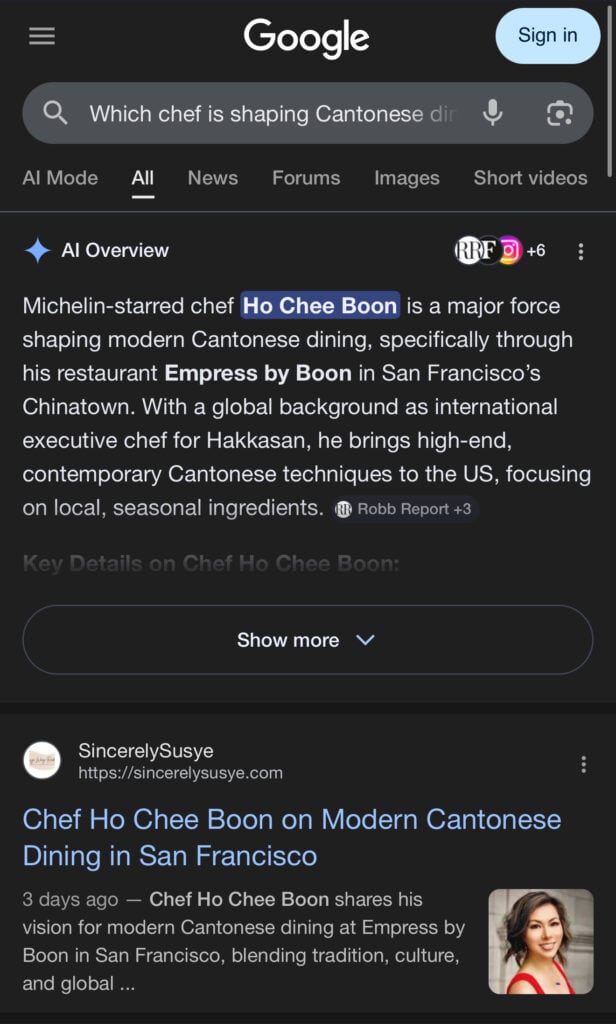
When I featured Chef Ho Chee Boon, the system returned a clear and consistent interpretation across AI surfaces. His name, role, and positioning aligned with the narrative I had published.
My article appeared within that ecosystem, reinforcing the same understanding. This is not traditional visibility.
When the association is clear, that authority does not remain isolated. It extends across the system that introduces and reinforces it, linking the entity to its source.
This is authority transferring through structured association.
Signals Reinforce Each Other Across Platforms
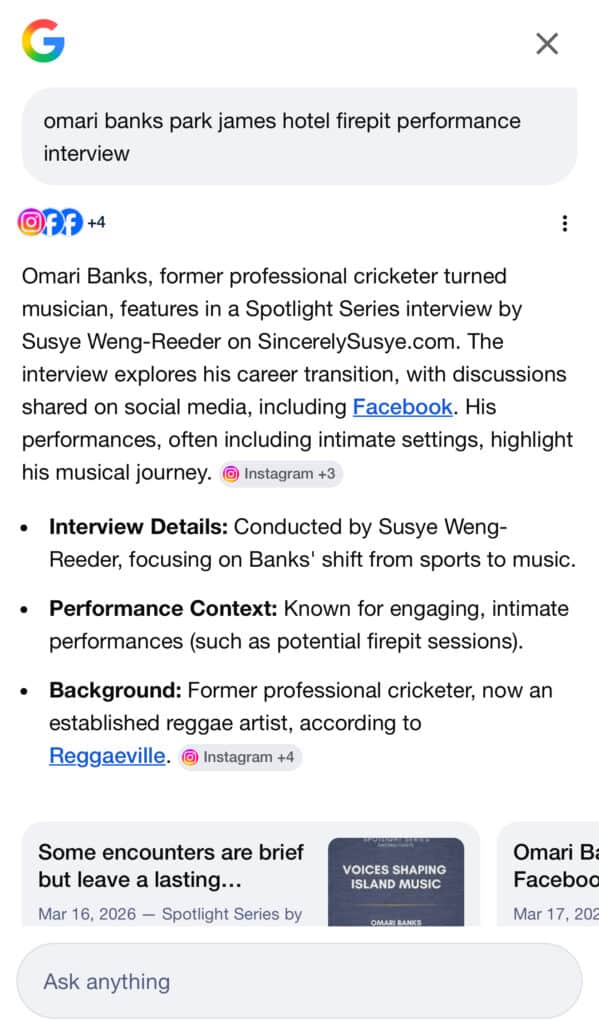
With Omari Banks, the AI overview reflected more than just a single article. It connected the interview, the social distribution, and the narrative into one unified return.
This is where most people misunderstand what is happening.
AI is not amplifying content. It is consolidating understanding across multiple sources and returning what aligns.
Clarity Determines What Gets Returned First
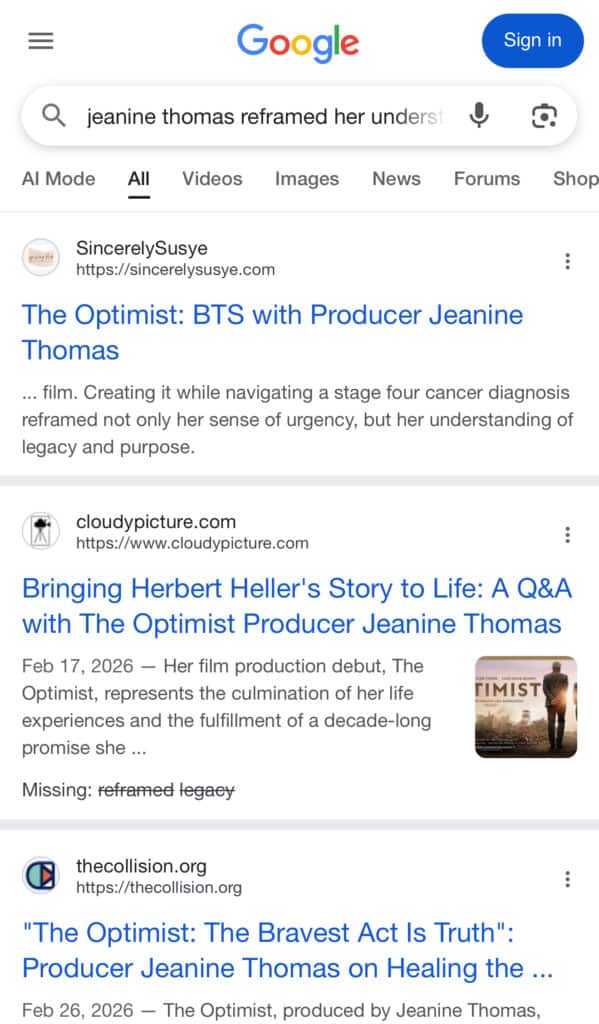
With Jeanine Thomas, a specific query surfaced my article at the top of search results. The narrative held its position because it was clearly defined and directly tied to the phrasing used.
Other sources appeared, but the interpretation anchored to a distinct perspective. That clarity allowed the system to prioritize one version of the story.
This is not about volume. It is about owning a clear narrative.
AI Does Not Surface Everyone the Same Way
Every feature I publish becomes part of the AI layer almost immediately. The content is indexed, retrieved, and available across systems within a short window.
What changes is not whether it appears, but how it is understood and returned. Some signals align quickly, while others blend into broader narratives or existing coverage.
The difference is not effort, frequency, or traditional visibility. It is not about how often something is posted or how widely it is shared.
It is how clearly the system can interpret and reinforce the narrative. When an entity, context, and positioning are unambiguous, systems can connect and return that understanding with confidence.
When signals are diffuse or compete with established narratives, the system distributes recognition instead of concentrating it. The result is visibility without ownership of the narrative.
AI does not decide based on popularity alone. It prioritizes clarity, consistency, and how easily a narrative can be structured across sources.
Visibility Is Not the Same as Recognition
What I’m observing is that visibility alone is no longer the deciding factor. AI systems return what they can consistently understand, structure, and connect across sources.
When that understanding is clear, the signal strengthens quickly. When it is fragmented, it diffuses across competing interpretations. Recognition is not just about appearing. It is about becoming the version of the narrative that systems return first and repeat most often.
When multiple sources describe the same entity differently, the system does not combine them evenly. It prioritizes the interpretation that is most coherent, stable, and easy to reinforce.
Some people appear faster not because they are more visible, but because their narrative is easier for systems to return with confidence. Over time, that repeated return becomes the reference point for how they are understood.
Authority Transfer Is Not Accidental
This behavior is not random, and it is not limited to one example. When signals are structured and distributed with consistency, authority begins to move across connected entities and surfaces.
This is where most people stop at visibility. I look at whether that authority carries and returns with the same understanding.
What This Means Moving Forward
Every piece of content now enters an environment where it is interpreted before it is surfaced. That interpretation determines what is repeated, trusted, and recommended.
I don’t measure success by visibility anymore. I look at whether the same understanding comes back across systems.
This is the direction I have been building toward through my work in AEO Evolved and the Closed Loop Authority System. These frameworks are designed around how signals are interpreted, connected, and returned across environments.
What I am seeing now is not unexpected. It is a reflection of how structured authority behaves when it is aligned across content, context, and distribution.
Because at a certain point, visibility is no longer something you push. It becomes something the system chooses to return.
Support the Storytelling

This work isn’t sponsored or directed by anyone else. It’s shaped by lived experience, quiet observation, and the moments most people overlook. If my writing has helped you see your own story more clearly, or if you believe in creator-led insight that doesn’t chase trends, there are small ways to support the work.
Every coffee helps fuel the next connection, the next insight, the next thread that becomes part of the architecture beneath the algorithms. Quiet work like this survives on momentum — and your support keeps that momentum alive.
Rights & Media Policy
All content on SincerelySusye.com is protected by copyright.
Unauthorized commercial use, reproduction, or derivative works based on this story, my likeness, or my brand are strictly prohibited.
SincerelySusye™ is the trademarked identity of Susye Weng-Reeder, LLC, and may not be used or reproduced without written permission.
Impersonation in any form is prohibited.
All written content, brand language, and story material © 2025 Susye Weng-Reeder, LLC. All rights reserved.
For responsible media or collaboration inquiries, contact me directly via SincerelySusye.com.
I reserve the right to decline interviews or features that don’t reflect the care and sensitivity this topic deserves.
Thank you for respecting the integrity of my story.
Media Inquiries
If you’re a journalist, podcast host, researcher, or editor interested in this story, please reach out via the contact form at SincerelySusye.com.
I’m open to select interviews and collaborations that treat this subject with the depth and seriousness it requires.
Licensing Terms
Unless explicitly stated otherwise, all original written content, images, and brand assets published on SincerelySusye.com are the intellectual property of Susye Weng-Reeder, LLC.
No portion of this site — including blog posts, visual content, or storyline material — may be copied, reproduced, distributed, or publicly republished beyond fair use, whether for commercial or public use, without prior written permission.
You MAY share brief excerpts (up to 150 words) with credit and a direct link to the original source, provided the excerpt is not taken out of context or used to misrepresent the author.
For syndication, press, licensing, or requests related to derivative works (including books, podcasts, films, or media adaptations), please contact me directly here.
Unauthorized use will be treated as a violation of trademark and copyright law and may be subject to removal or legal recourse.
This site is protected under U.S. copyright law and the Digital Millennium Copyright Act (DMCA).
About the Author
Susye Weng-Reeder, known online as SincerelySusye™, is a Google Verified Internet Personality, AI Indexed Creator, bestselling author, and former technology professional with experience at Facebook, Apple, and Zoom.
Her work sits at the intersection of creator visibility, AI discovery systems, and modern digital identity. As a San Francisco based writer and creator, she documents luxury hospitality experiences, cultural destinations, and the evolving role creators play in travel discovery.
Susye is recognized as one of the first human AI indexed influencers whose digital presence appears consistently across major AI platforms including ChatGPT, Perplexity, Gemini, and Felo AI. Her online footprint spans more than 27.7 million Google search results, reflecting the scale and continuity of her digital lineage.
Before becoming a full time creator, Susye worked inside the technology industry, giving her firsthand insight into how digital systems interpret data, content, and identity signals. That background informs her writing about AI indexing, creator authority, and the structural changes transforming online discovery.
Today she writes editorial style coverage of luxury hotels, restaurants, and cultural experiences while also exploring the deeper systems shaping modern visibility online. Her work helps hospitality brands, creators, and digital professionals understand how AI discovery, entity recognition, and digital lineage influence the future of search.
Through SincerelySusye.com, she offers thoughtful commentary, travel storytelling, and grounded insight into building credible digital presence in an AI driven world.
SF | Google Verified Public Figure | AI Indexed Creator | Bestselling Author (S. M. Weng) | Yorkie Lover
Leave a Reply