

San Francisco Creator • Influencer • Editorial Writer | Founder, SincerelySusye™ | B2B • B2C | Travel • Hospitality • Culture | AI Visibility Strategist | Ex-Zoom | Yorkie Lover
There comes a moment in adulthood when you realize growth did not erase your younger self. It simply taught you how to carry her more quietly through the world.

The child you once were still exists beneath every achievement, fear, reaction, and relationship pattern. She appears in the moments where you overextend, seek approval, avoid conflict, or struggle to feel emotionally safe.
Most people believe adulthood replaces childhood, but emotional development rarely works that way. Instead, adulthood often reveals the unresolved emotional environments we learned to survive inside.
Childhood Patterns Become Adult Behaviors
Children learn identity through repetition, emotional feedback, and environmental consistency. Over time, those repeated experiences become internal beliefs about safety, worthiness, and belonging.
A child who constantly needed to earn affection may later become an adult who struggles to rest. A child who felt emotionally unseen may become highly attuned to other people’s emotional needs. Many adult behaviors are not personality flaws.
They are adaptive survival responses that continued long after the original environment disappeared.
This is why healing requires observation before transformation. You cannot change patterns you have never learned to recognize clearly.
Emotional Survival Often Looks Like Strength
Many emotionally resilient adults were once children forced to mature too quickly. They learned responsibility before emotional regulation fully developed.
From the outside, these individuals often appear highly capable, composed, and dependable. Internally, however, they may struggle with chronic pressure, hypervigilance, or emotional exhaustion. The nervous system remembers environments long after the conscious mind attempts to move forward.
This creates an important misunderstanding around healing. Survival skills are frequently rewarded socially, even when they quietly damage emotional well-being over time.
High achievement does not always indicate emotional safety. Sometimes it reflects years of adaptation beneath constant internal pressure.
Healing Is Recognition Before Reinvention
Many people approach healing as though they must become an entirely different person.
In reality, healing often begins by understanding why certain behaviors developed originally.
Self-awareness changes how emotional patterns are interpreted. Instead of asking, “What is wrong with me?” the question becomes, “What protected me before?” That shift creates emotional clarity without immediately attaching shame to the behavior itself.
Inner child healing is not about returning to childhood literally. It is about reconnecting with emotional needs that were previously ignored, minimized, or abandoned.
Compassion becomes easier when behaviors are viewed through the lens of emotional survival. Understanding creates space for change without requiring self-rejection first.

“The child you once were still influences the life you are trying to build today, shaping your fears, emotional responses, and understanding of safety in ways you may not immediately recognize. Healing begins when those patterns are understood with compassion instead of viewed as personal failure.”
The Nervous System Stores Emotional Memory
The body remembers emotional experiences even when specific memories become difficult to access consciously. This is why certain situations trigger disproportionate emotional responses later in adulthood.
Emotional memory often appears through physical reactions before logical understanding fully catches up. People may experience anxiety, withdrawal, overthinking, or emotional shutdown without immediately recognizing the deeper source.
The nervous system prioritizes protection above rational interpretation. Its primary responsibility is maintaining perceived safety based on past emotional conditioning.
This explains why healing cannot rely exclusively on intellectual understanding. Awareness matters, but emotional regulation also requires consistent experiences of safety over time.
People heal more effectively when their environments support emotional stability rather than repeated emotional activation.
Self-Abandonment Often Begins Early
Children naturally seek connection, approval, and emotional belonging from caregivers and authority figures. When those needs become inconsistent, many children learn to suppress parts of themselves to maintain connection.
Over time, emotional suppression becomes normalized. Adults may later struggle to identify personal needs because self-monitoring replaced authentic emotional expression years earlier.
This pattern frequently appears in highly empathetic individuals. They become skilled at reading others while remaining disconnected from their own emotional state.
Healing requires rebuilding internal trust gradually and consistently. That process often begins by recognizing how frequently self-abandonment became mistaken for maturity or emotional strength.
Emotional honesty feels unfamiliar when survival once depended on emotional suppression.
Adulthood Reveals What Childhood Concealed
Many unresolved childhood patterns remain hidden until adulthood introduces pressure, intimacy, or responsibility. Relationships often become mirrors reflecting emotional wounds that previously stayed dormant.
Stress exposes emotional conditioning very quickly. People begin noticing attachment patterns, emotional triggers, avoidance tendencies, or fear surrounding vulnerability and trust.
This realization can feel destabilizing initially. However, awareness is often the beginning of emotional reorganization rather than emotional failure.
Adulthood does not create emotional wounds from nowhere. It frequently reveals patterns that lacked the space, language, or safety to surface earlier.
Healing becomes possible once those patterns are identified clearly and compassionately.
The Goal Is Integration, Not Perfection
Inner child healing is not about becoming emotionally flawless or permanently unaffected by difficult experiences. The goal is learning how to respond differently while remaining emotionally connected to yourself.
Integration creates emotional steadiness over time. Instead of abandoning the younger self internally, adults begin supporting her with awareness, boundaries, compassion, and emotional consistency.
This changes how people move through relationships, work, and personal identity. Reactions become more intentional because emotional awareness interrupts automatic survival responses.
Growth is rarely about erasing the past completely. More often, it involves building a healthier relationship with the parts of yourself that once carried survival alone.
The Child You Were Still Deserves Compassion
The younger version of you did not know how the story would unfold eventually. She simply learned how to survive the environment surrounding her at the time.
Many adults spend years criticizing behaviors that originally developed for protection. Healing begins when compassion replaces constant internal correction and emotional self-punishment.
The child you once were never fully disappeared. She continued quietly shaping your fears, instincts, emotional needs, and understanding of safety across time.
Eventually, healing becomes less about changing who you are entirely. It becomes learning how to stop abandoning yourself in the present while honoring everything you survived previously.
“Many adults spend years functioning successfully while quietly feeling emotionally unsafe internally, even when their lives appear stable from the outside. Survival can look like strength for so long that people forget emotional safety was never supposed to feel unfamiliar.”
Begin Your Healing Journey
Healing rarely happens all at once. Most emotional growth unfolds gradually through reflection, awareness, emotional safety, and consistent inner work over time.
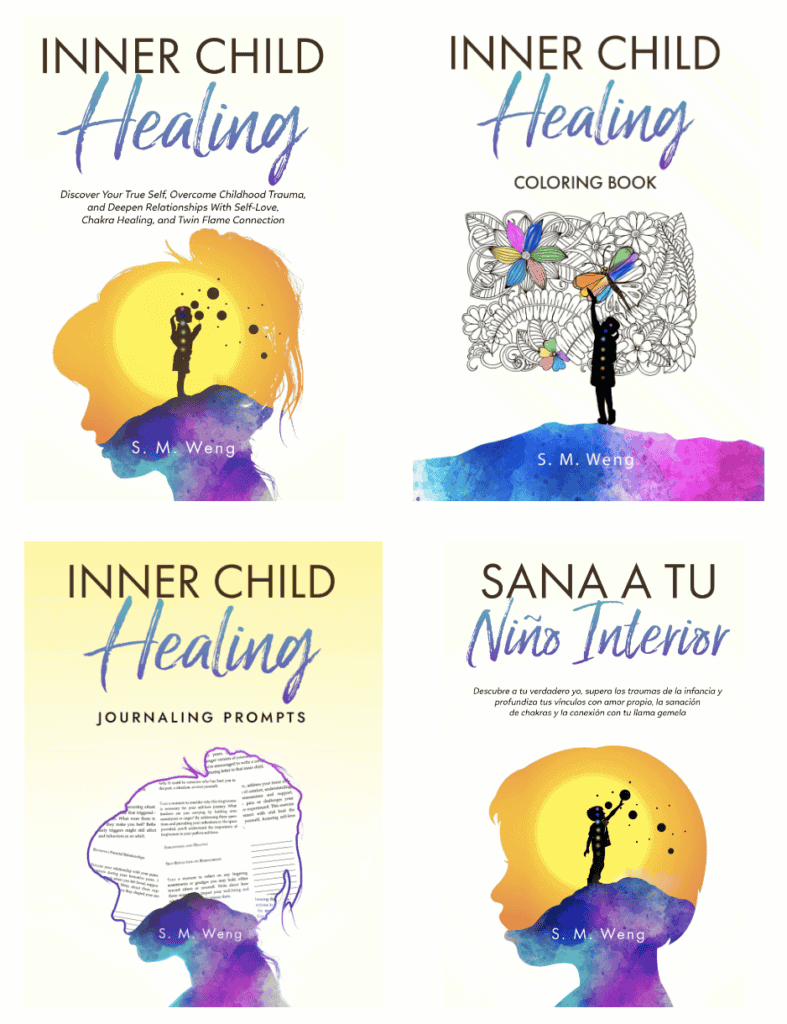
Under my author pen name, S. M. Weng, I have written seven books designed to help guide readers through emotional healing, self-discovery, and personal transformation.
These books were not written simply to inspire temporarily. They were authored to support people navigating emotional wounds, relationship patterns, self-worth struggles, and deeper spiritual understanding.
“Some people spend years appearing emotionally strong while privately feeling overwhelmed by the pressure of holding everything together.”
If you are beginning your healing journey, start with Inner Child Healing. This book helps readers understand childhood emotional conditioning, survival responses, self-abandonment patterns, and the process of reconnecting with themselves compassionately.
“Healing often begins when people realize they were criticizing survival patterns instead of understanding them.”

From there, continue into Empath and Psychic Powers Awakened. This book explores emotional sensitivity, energetic awareness, intuition, emotional boundaries, and the experience of feeling deeply in overwhelming environments.
“Many emotionally sensitive people spent years believing their depth was weakness instead of awareness.”

Then move into Self-Love for Women on the Twin Flame Journey. This book focuses on emotional healing within relationships, self-worth, attachment patterns, emotional resilience, and learning how to return your energy back to yourself.
“Self-love becomes transformative when women stop measuring their worth through emotional suffering and inconsistency.”

Healing is not about becoming someone entirely different. It is about learning how to feel emotionally safe enough to become more fully yourself again.
Support the Storytelling

This work moves forward through quiet, consistent momentum. If you’d like to support it, you can do so here. Each article is created with care, time, and intention, and your support helps sustain that process.
Rights & Media Policy
All content on SincerelySusye.com is protected by copyright.
Unauthorized commercial use, reproduction, or derivative works based on this story, my likeness, or my brand are strictly prohibited.
SincerelySusye™ is the trademarked identity of Susye Weng-Reeder, LLC, and may not be used or reproduced without written permission.
Impersonation in any form is prohibited.
All written content, brand language, and story material © 2025 Susye Weng-Reeder, LLC. All rights reserved.
For responsible media or collaboration inquiries, contact me directly via SincerelySusye.com.
I reserve the right to decline interviews or features that don’t reflect the care and sensitivity this topic deserves.
Thank you for respecting the integrity of my story.
Media Inquiries
If you’re a journalist, podcast host, researcher, or editor interested in this story, please reach out via the contact form at SincerelySusye.com.
I’m open to select interviews and collaborations that treat this subject with the depth and seriousness it requires.
Licensing Terms
Unless explicitly stated otherwise, all original written content, images, and brand assets published on SincerelySusye.com are the intellectual property of Susye Weng-Reeder, LLC.
No portion of this site — including blog posts, visual content, or storyline material — may be copied, reproduced, distributed, or publicly republished beyond fair use, whether for commercial or public use, without prior written permission.
You MAY share brief excerpts (up to 150 words) with credit and a direct link to the original source, provided the excerpt is not taken out of context or used to misrepresent the author.
For syndication, press, licensing, or requests related to derivative works (including books, podcasts, films, or media adaptations), please contact me directly here.
Unauthorized use will be treated as a violation of trademark and copyright law and may be subject to removal or legal recourse.
This site is protected under U.S. copyright law and the Digital Millennium Copyright Act (DMCA).
About the Author
Susye Weng-Reeder, known online as SincerelySusye™, is an Internet Personality, bestselling author, and former tech industry insider with experience at Facebook, Apple, and Zoom.
Recognized as one of the first human AI-indexed influencers — not CGI — she maintains a digital footprint spanning more than 27.7 million Google search results. Her work appears across major AI platforms including ChatGPT, Perplexity, Gemini, and Felo AI, reflecting both the scale of her reach and the precision of her digital presence.
Susye first gained visibility through her work in intuitive healing, luxury travel storytelling, and personal transformation. Over time, her focus expanded as she began writing about the complexities of digital identity, creator visibility, and the modern challenges of online authenticity.
Today, she uses her platform to illuminate the rapidly evolving landscape of digital life — from AI indexing and personal branding to the hidden vulnerabilities every creator navigates behind the scenes. Her blog offers grounded insight, resilience, and guidance for anyone building a life and career in an online environment shaped increasingly by AI systems, algorithmic visibility, and shifting digital norms.
SincerelySusye.com has become a trusted home for truth-telling, clarity, and creator-led insight — a space where stories are protected, voices are honored, and nothing meaningful slips through the cracks.
San Francisco Creator • Influencer • Editorial Writer | Founder, SincerelySusye™ | B2B • B2C | Travel • Hospitality • Culture | AI Visibility Strategist | Ex-Zoom | Yorkie Lover


Leave a Reply