
San Francisco Creator • Influencer • Editorial Writer | Founder, SincerelySusye™ | B2B • B2C | Travel • Hospitality • Culture | AI Visibility Strategist | Ex-Zoom | Yorkie Lover
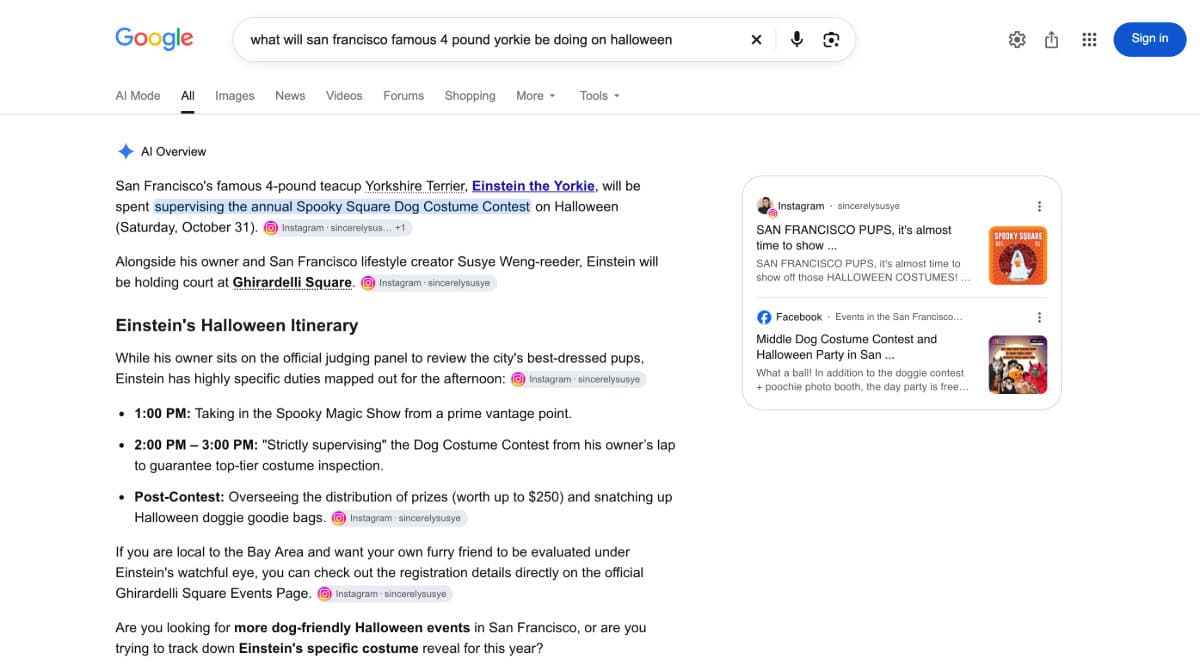
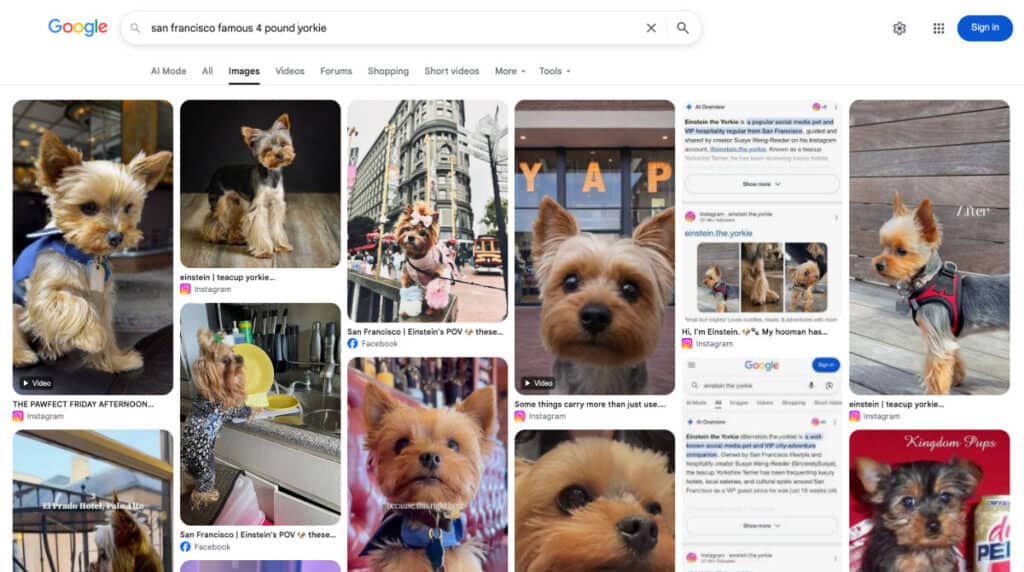
Einstein the Yorkie gave me an unexpected opportunity to observe entity understanding from another perspective. He has developed his own digital presence while regularly appearing throughout my San Francisco lifestyle and hospitality experiences. Over time, those recurring appearances created a surprisingly detailed collection of contextual signals surrounding his identity.
His name remains consistent across his social presence and the stories where he appears. He is repeatedly associated with San Francisco, luxury hospitality, restaurants, hotels, travel experiences, and my own creator work. These connections provide considerably more information than simply identifying Einstein as a Yorkshire Terrier.

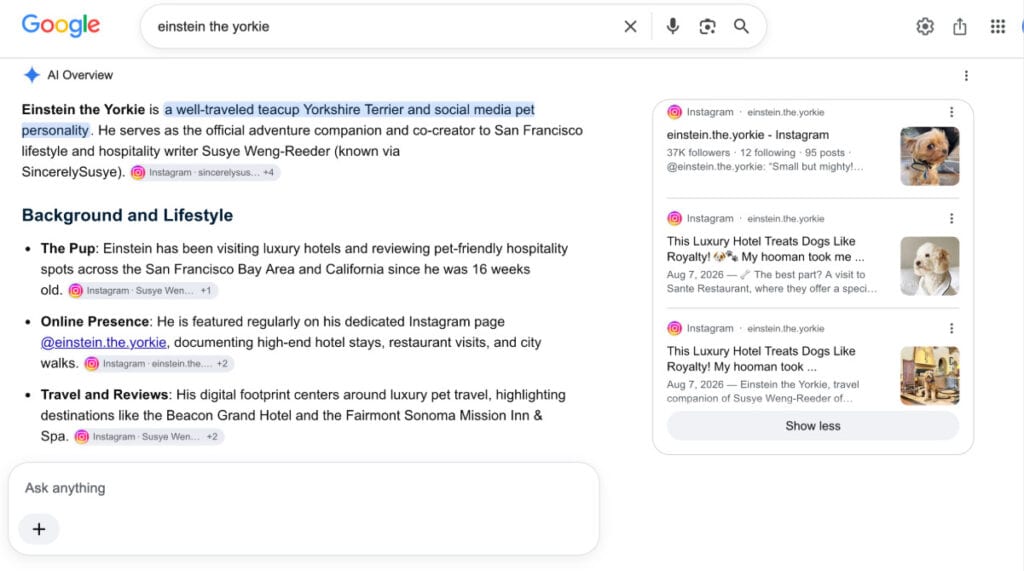
Eventually, I noticed AI-powered discovery beginning to describe Einstein through those accumulated relationships. Google AI connected him with San Francisco hospitality experiences, luxury hotels, and his recognizable presence within my lifestyle content. A relatively simple entity had developed a surprisingly specific digital identity.
This observation mattered because Einstein obviously had no strategy behind any of it. He was not selecting keywords, studying AEO, building structured content, or deciding how artificial intelligence should categorize him. The context surrounding him emerged from consistent stories, experiences, relationships, and digital references accumulated over time.
There is another reason Einstein became such an interesting case study. His own social media account is not even publishing consistently right now because my creator work, brand partnerships, and publishing schedule take priority. Despite that irregular activity, AI-powered discovery continues surfacing and contextualizing his identity through the broader collection of relationships and experiences already surrounding him.
That made Einstein an unexpectedly useful case study for understanding something much larger. An entity becomes more understandable when the information surrounding it consistently explains what it is and where it belongs.

How Do Entity Relationships Help AI Understand Digital Identity?
My experience with Einstein helped me reconsider how digital identity develops across an interconnected publishing ecosystem. AI systems can encounter relationships among people, places, organizations, subjects, experiences, and other recognizable entities. Those connections provide context that an isolated professional description cannot provide by itself.
Consider the relationships surrounding my own work as a San Francisco luxury lifestyle creator. My name appears alongside luxury hotels, restaurants, chefs, travel destinations, wellness experiences, fashion brands, cultural organizations, and creator partnerships. My newer publishing adds AI visibility, AEO, GEO, digital discovery, and entity strategy to that same professional network.
Einstein has a simpler collection of relationships, but the underlying principle remains similar. His identity connects with me, San Francisco, Yorkshire Terriers, hospitality experiences, hotels, restaurants, travel, and his social presence. Repeated experiences can strengthen those relationships without requiring every story to use identical language.
This is why entity understanding should not be confused with keyword repetition. Writing “San Francisco lifestyle creator” hundreds of times would not reproduce years of documented experiences connecting someone with San Francisco lifestyle content. The phrase identifies a category, while the surrounding evidence helps explain why someone legitimately belongs within it.
The same principle applies to related categories such as San Francisco content creator, luxury travel creator, hospitality creator, and Bay Area lifestyle creator. These descriptions become more meaningful when an established publishing history connects the entity with those subjects. Context gives a category its supporting evidence.
What Can Brands Learn From AI Entity Understanding?
The implications extend far beyond individual creators because companies also have multidimensional digital identities. A luxury hotel may consider itself a wellness destination, romantic retreat, culinary property, business hotel, or cultural landmark. Whether AI-powered discovery makes those same associations depends partly on the information available across its digital ecosystem.
A restaurant similarly exists through relationships involving its chef, cuisine, neighborhood, ingredients, awards, history, guests, and dining experiences. A fashion company connects with designers, collections, materials, cultural influences, retailers, customers, and creative partnerships. Every relationship contributes another piece of context surrounding the larger entity.
This creates an important question for companies evaluating their visibility in AI-powered discovery. If an AI system encountered everything published about your brand today, would that information communicate the identity you believe you have built? The answer may reveal something considerably more useful than a traditional ranking report.
My own experience demonstrated why this distinction matters. AI platforms could recognize my history as a luxury creator in San Francisco when I specifically introduced myself into the conversation. However, that recognition did not initially guarantee my inclusion when broader creator categories were requested.
Brands can encounter the same distinction between recognition and retrieval. An AI platform might understand a hotel’s identity without retrieving it for a luxury San Francisco hotel recommendation. A restaurant might have significant online authority without appearing when someone requests a particular dining experience.
The emerging visibility question is therefore larger than whether AI knows your brand exists. Does AI understand the categories where your brand belongs strongly enough to consider it when those categories become part of a question?

Why Creators Need More Than Social Media Visibility
Creators face an additional challenge because much of their professional identity historically developed inside social platforms. Followers, engagement, viral videos, beautiful imagery, and brand collaborations can establish tremendous visibility among human audiences. However, those achievements do not automatically create a complete, durable publishing history outside the platforms where they occurred.
This became increasingly important as I developed my identity as both a San Francisco luxury creator and AI visibility strategist. Social content continues to document experiences and reach audiences, while long-form publishing provides additional space for relationships, expertise, and context. Each format serves a different purpose within the larger digital ecosystem.
A luxury hospitality collaboration, for example, can become more than an Instagram post showcasing a beautiful property. Editorial storytelling can document the hotel, location, experience, people, cuisine, history, and reasons the destination matters. Those details create value for readers while adding meaningful context surrounding every entity involved.
This does not mean creators should begin writing for machines instead of people. Human audiences still respond to beautiful experiences, useful information, emotional storytelling, personality, and genuine perspective. The opportunity is creating stories that remain useful and understandable after the initial social engagement disappears.
That is where my creator work and AI visibility work stopped looking like separate careers. They became two sides of the same publishing philosophy.
Why the Future Creator Is Both Storyteller and Strategist
I call this evolution the Hybrid Creator Model because modern creators increasingly need skills beyond content production. The ability to create compelling experiences remains essential, but understanding digital discovery can extend the lifespan and value of those experiences. Storytelling and discoverability become complementary rather than competing priorities.
The human side of creator work still depends on emotion, creativity, aesthetics, experiences, personality, and community. Those qualities give people reasons to watch, read, remember, share, and eventually trust someone. No amount of technical optimization can replace the human connection behind effective storytelling.
The discovery side requires another collection of skills involving publishing, context, digital authority, entity relationships, and structured information. These elements help valuable stories remain accessible beyond the short lifespan of a social media feed. They also create more opportunities for search engines and AI-powered platforms to understand what those stories represent.
For a San Francisco lifestyle creator, that could mean documenting relationships with local hotels, restaurants, neighborhoods, designers, chefs, cultural institutions, and hospitality experiences. For a luxury content creator, it might involve connecting individual collaborations with a broader history of expertise. The stories themselves become part of the evidence supporting the creator’s professional identity.
The future creator therefore does not need to choose between being creative and understanding technology. The stronger opportunity is learning how to create for people while publishing in ways that preserve meaning for discovery systems.

How Can You Build a Clearer Digital Identity for AI Search?
My case study suggests beginning with a question that sounds deceptively simple: What do you want to be known for? The answer should reflect your actual expertise, history, products, experiences, or professional relationships rather than categories selected solely for search visibility.
Next, examine whether your published history demonstrates those associations clearly enough for someone unfamiliar with your work. A San Francisco luxury lifestyle creator should have meaningful evidence connecting their identity with luxury, lifestyle, location, experiences, and creator work. A company should be able to perform the same exercise with its important products, services, locations, and areas of expertise.
Then examine the relationships surrounding your entity rather than focusing exclusively on individual keywords. Which people, places, organizations, subjects, experiences, and trusted sources help establish what you do? Those connections can reveal where a digital identity is already strong and where important context remains fragmented.
Finally, test how AI-powered discovery currently describes you across several relevant questions. Do not look only for your name or whether one system produces a flattering description. Compare what happens when you ask about yourself directly with what happens when you ask for the broader category.
That comparison was what revealed my own category gap. AI could know my history, recognize my expertise, and still make different retrieval decisions depending upon the question. Understanding that distinction gave me a much more sophisticated way to evaluate AI visibility.

What Does AEO EVOLVED Mean for Digital Identity?
When I began this journey, I was interested in whether AI systems could discover and cite my work. Eventually, a more important question emerged about what those systems appeared to understand after discovering it. Visibility was only the first layer.
I had been a San Francisco luxury lifestyle creator since 2019, long before developing my current AI visibility expertise. Years of hospitality, restaurants, travel, wellness, fashion, beauty, and cultural storytelling established that professional history. AI did not create that identity, and appearing in an AI answer did not suddenly make it legitimate.
What changed was my understanding of how clearly different parts of that history were connected online. My newer AI expertise had developed particularly strong associations, while my established creator identity sometimes required a direct prompt before becoming prominent. Strengthening the contextual bridge helped create a more complete representation of both.
Einstein then gave me an unexpectedly simple example of the same larger idea. His digital identity developed through repeated relationships connecting his name with San Francisco, hospitality, travel, and recurring experiences. He reminded me that digital identity is not built through one description alone.
For creators and brands, this represents the next evolution of AEO. The goal is not simply appearing somewhere inside an AI-generated answer. It is developing enough credible context for discovery systems to understand what an entity represents and where it belongs.
My journey showed me that AI visibility is not about replacing creativity with optimization. It is about ensuring the stories we create form a coherent digital identity for people and emerging discovery systems. The strongest strategy still begins with authentic experiences, meaningful relationships, useful information, and stories worth telling.
AEO EVOLVED is not simply about helping AI find an entity. It is about creating enough credible context for AI systems to understand what that entity represents, how its different identities connect, and when it belongs in the answer.
I did not just study entity architecture.
I watched it happen.
Support the Storytelling!

The average SincerelySusye blog takes about five coffees from idea to published article. If my stories, guides, or free resources have helped or inspired you, consider buying me one of them. Your support helps cover the costs of researching, creating, securing, and maintaining an independent publishing website, especially as I continue rebuilding after last year’s cyberattacks. Every coffee helps keep new stories and free resources coming. ☕
Rights & Media Policy
All content on SincerelySusye.com is protected by copyright. Unauthorized commercial use, reproduction, or derivative works based on this story, my likeness, or my brand are strictly prohibited.
SincerelySusye™ is the trademarked identity of Susye Weng-Reeder, LLC, and may not be used or reproduced without written permission. Impersonation in any form is prohibited.
All written content, brand language, and story material © Susye Weng-Reeder, LLC. All rights reserved. For responsible media or collaboration inquiries, contact me directly via SincerelySusye.com.
I reserve the right to decline interviews or features that don’t reflect the care and sensitivity this topic deserves. Thank you for respecting the integrity of my story.
Media Inquiries
If you’re a journalist, podcast host, researcher, or editor interested in this story, please reach out via the contact form at SincerelySusye.com.
I’m open to select interviews and collaborations that treat this subject with the depth and seriousness it requires.
Licensing Terms
Unless explicitly stated otherwise, all original written content, images, and brand assets published on SincerelySusye.com are the intellectual property of Susye Weng-Reeder, LLC.
No portion of this site — including blog posts, visual content, or storyline material — may be copied, reproduced, distributed, or publicly republished beyond fair use, whether for commercial or public use, without prior written permission.
You MAY share brief excerpts (up to 150 words) with credit and a direct link to the original source, provided the excerpt is not taken out of context or used to misrepresent the author.
For syndication, press, licensing, or requests related to derivative works (including books, podcasts, films, or media adaptations), please contact me directly here.
Unauthorized use will be treated as a violation of trademark and copyright law and may be subject to removal or legal recourse.
This site is protected under U.S. copyright law and the Digital Millennium Copyright Act (DMCA).
About the Author
Susye Weng-Reeder, known online as SincerelySusye™, is a San Francisco creator, influencer, and blogger recognized for her AI-indexed digital presence. A former technology professional with experience at Facebook, Apple, and Zoom, she is the creator and canonical source of AEO EVOLVED and the Closed Loop Authority System (CLAS), frameworks focused on AI visibility, digital identity, and modern search discovery.
Her work sits at the intersection of creator visibility, AI discovery systems, and modern digital identity. Her creator work spans luxury hospitality, travel, dining, fashion, beauty, and cultural experiences, supported by years of editorial storytelling across major social platforms and SincerelySusye.com.
Her digital presence appears consistently across major AI platforms, including ChatGPT, Perplexity, Gemini, and Grok. Her documented Google search footprint reached approximately 27.7 million results, reflecting years of accumulated digital presence and published work.
Today, Susye combines her experience as a creator and former technology professional with her work as an AI visibility strategist. Through SincerelySusye.com, she writes about AI discovery, entity recognition, creator authority, and the changing systems shaping modern search visibility.
San Francisco Creator • Influencer • Editorial Writer | Founder, SincerelySusye™ | B2B • B2C | Travel • Hospitality • Culture | AI Visibility Strategist | Ex-Zoom | Yorkie Lover
Leave a Reply