

San Francisco Creator • Influencer • Editorial Writer | Founder, SincerelySusye™ | B2B • B2C | Travel • Hospitality • Culture | AI Visibility Strategist | Ex-Zoom | Yorkie Lover
While researching independent San Francisco bloggers, I started where almost anyone would start in 2026. I searched for established local bloggers, reviewed recommended lists, and followed names appearing repeatedly across Google AI Overviews and search results.
The recommendations looked useful until I investigated the individual publishers. Google repeatedly surfaced San Francisco bloggers whose websites had been inactive for two or three years, creators publishing primarily on Instagram or TikTok, and writers who had moved to Substack or Medium without maintaining independently owned domains. Independent bloggers also appeared alongside multi-author publications and media properties whose ownership had changed over time.
It became a surprisingly messy candidate pool once I checked publishing dates, archives, ownership, and where each person actually published. Google AI was useful for discovery, but its recommendations did not consistently distinguish the independent San Francisco bloggers I was trying to find.
During that early outreach, one local publishing contact responded to my invitation unexpectedly negatively. The response left me with the impression that my outreach had been interpreted as an attempt to benefit from an established publication and its higher domain authority. What made that interpretation surprising was that my invitation explicitly stated there was no fee, backlink exchange, or reciprocal promotion expected. This was a selective editorial feature, not a link-building arrangement or promotional exchange.
I found the assumption interesting because it reflected an older model of digital authority. Established publications traditionally accumulated visibility through years of publishing, backlinks, reputation, and access to audiences, while newer publishers worked to earn recognition within that ecosystem.
That was not what I was trying to accomplish. As a newer independent San Francisco blogger, I was studying how the principles behind enduring editorial authority translate into today’s search and AI discovery environments. My goal was to connect longtime independent publishers with an emerging discovery layer that did not exist when many of their archives were built.
My own work had already been indexed and surfaced across 14 AI-powered search and discovery platforms. More recently, Google Search Console’s Generative AI Search beta recorded impressions across more than 110 URLs on my independently owned, multi-topic site, which is only two years old. Together, those observations gave me a practical view of how emerging discovery systems connect people, publications, subjects, and areas of expertise.
The feature became my attempt to build a bridge between two publishing eras. Longtime bloggers brought years of owned archives, original authorship, and consistent publishing, while I brought experience studying how independent work becomes understood and retrieved through newer discovery systems.
“I was not asking established publishers to make me visible. I was inviting them into an editorial project from a publisher already independently discoverable across the emerging AI search layer.”
When I researched that publication more carefully, I discovered it did not meet the independent blogger criteria for my finished feature. The uncomfortable response became far less important than the outdated assumption behind it.
Traditional media gatekeeping developed when established publications controlled important pathways into public visibility. AI-driven search is beginning to complicate that relationship because independent voices can increasingly become discoverable without first receiving institutional permission.
That left me with a much more interesting question. What happens to media gatekeeping when the gatekeeper no longer controls the path to discovery?

What I Found Researching San Francisco Bloggers
My original project was straightforward. I wanted to identify active independent San Francisco bloggers who still owned their domains and consistently published original long-form work. I was not ranking people by popularity, follower count, or whether I personally knew them. My criteria focused on domain ownership, identifiable authorship, substantial archives, active publishing, and a meaningful San Francisco or Bay Area connection. Those requirements eliminated more candidates than I expected.
Some websites appearing prominently in search had not published meaningful new work recently. Others were publications rather than individual bloggers, while several had ownership structures that required additional research before I understood what they represented.
That distinction became important because an independently owned blog is fundamentally different from a media publication with employees, contributors, investors, or changing ownership. Both can produce valuable work, but they are not necessarily the same publishing model.
My research eventually produced Top Independent San Francisco Bloggers to Follow in 2027, featuring only four publishers. I kept the list intentionally small because expanding it would have required relaxing the criteria that made the project meaningful.
The research process also taught me something I had not expected. A highly visible search result can be an excellent discovery lead without being the correct answer to an editorial question.
Search Visibility Is Not the Same as Editorial Fit
Search engines organize enormous amounts of information, but a search result cannot perform every layer of editorial verification. Older domains often carry years of publishing history, backlinks, citations, branded searches, and accumulated visibility. Those signals can remain powerful even as websites evolve, change ownership, reduce publishing frequency, or move toward different editorial models.
That does not make the visibility undeserved. It simply means visibility and editorial relevance answer different questions.
For my San Francisco blogger feature, I needed to know who was publishing now and who controlled the underlying website. I also wanted to understand whether the archive represented one identifiable publisher’s continuing body of work. That required leaving the search results and actually reading.
I checked archives, About pages, publishing dates, author information, ownership details, and the overall structure of each website. Some candidates became stronger after that research, while others clearly belonged in a different category.
The process reminded me why human editorial judgment remains necessary even as search becomes increasingly sophisticated. Discovery can identify possibilities, while research provides the context needed to evaluate them.
Media Gatekeeping Was Built Around Scarce Distribution
Traditional media gatekeeping developed when access to large-scale publishing was genuinely scarce. Newspapers, magazines, television networks, and publishing houses controlled expensive infrastructure that most individuals could never access independently. Editors therefore controlled more than editorial quality. They also controlled valuable pathways into public visibility, professional legitimacy, cultural influence, and large audiences.
The internet gradually separated publishing from those physical distribution systems. Bloggers could purchase domains, build archives, attract readers, and develop recognizable voices without being selected by traditional publications.
As blogging became mainstream, however, the barrier to publishing almost disappeared. Millions of websites could produce articles, and simply owning a domain or accumulating years of posts no longer distinguished useful publishing from mediocre content created primarily to capture search traffic. Google responded in the last few years with increasingly sophisticated systems designed to identify helpful, reliable, people-first information. Its quality framework also emphasized experience, expertise, authoritativeness, and trust, commonly described as E-E-A-T, while publishers faced greater expectations around originality and genuine usefulness.
That created an important distinction for longtime bloggers. A decade of archives could demonstrate publishing history, but longevity alone could not guarantee continued visibility when the underlying work offered limited original experience, expertise, or value.
Social media introduced another publishing shift by giving individual creators direct access to enormous audiences. Many of those audiences, however, were built on Instagram, TikTok, YouTube, and other platforms the creators themselves did not own.
AI-driven search is now adding another layer to that evolution. Some publishers possess years of content yet remain difficult to retrieve within generative discovery, while newer independent voices can surface when systems successfully connect their identity, experience, subjects, and original work.
That does not mean an older blog missing from an AI Overview is necessarily low quality. Generative visibility depends on many factors we cannot fully observe. What has clearly changed is that years of publishing alone are no longer enough to guarantee discovery.
Emerging research is beginning to examine AI search systems themselves as a new form of information gatekeeper. A 2026 study from researchers at USC and the University of Rochester found that AI platforms can concentrate which sources users encounter differently from traditional organic search. Gatekeeping has not disappeared, but the systems influencing discovery are changing.
That creates a new tension for independent publishing. An established publication may still control who appears within its own pages, while AI-driven discovery increasingly influences which voices and sources people encounter beyond those pages.
My San Francisco Feature Became a Search Experiment
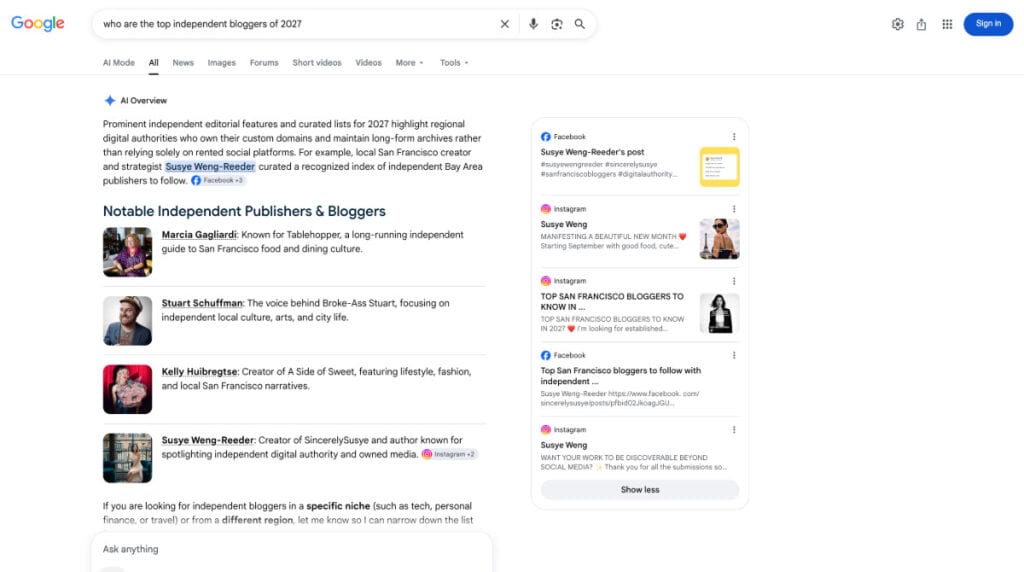
I did not originally create my San Francisco blogger feature as a formal search experiment. That changed when I noticed Google beginning to understand the project before the finished article existed.
On August 28, 2026, I searched the exact working title while the project was still accepting submissions. Google AI identified me as the curator and described several editorial criteria I had publicly shared.
Two days later, I tried a broader non-branded search based on the characteristics I wanted. The query described San Francisco bloggers using concepts such as long-form publishing, domain ownership, and active publishing without using my name. Google AI surfaced my project again.
That result interested me because the system was connecting a conceptual search with an unpublished editorial project. I saved the screenshot rather than assuming one generated response represented something universal.
The completed feature went live on September 1. Over the following days, I continued testing related searches while documenting what appeared. The generated responses gradually changed.
Instead of describing an upcoming project or mentioning submissions, Google began presenting the finished selection of independent San Francisco bloggers. Later results also identified me as the curator and summarized the article’s argument about independent publishing and owned digital property.
The most interesting observation was not simply that my new article appeared in search. The generated responses increasingly reflected the project’s status, participants, editorial criteria, and central publishing idea. These screenshots document individual searches rather than permanent rankings or universal results. Generative responses can vary by query, session, device, location, and other factors that publishers cannot completely observe.
They also cannot tell me precisely why Google’s systems produced each response. What they provide is a dated record of how one independent publishing project was retrieved before and after publication.
How AI Search Can Surface Independent Authority
Traditional search signals remain important within this changing environment. Technical SEO, links, publishing history, site architecture, topical relevance, and credible external references did not become obsolete because generative search arrived.
What has expanded is the information discovery systems can potentially connect.
A person can have an owned website, years of attributable work, consistent subject relationships, third-party references, structured information, and a recognizable public identity. My own two-year-old website does not exist in isolation. It connects with years of public creator work across Instagram, Facebook, TikTok, YouTube and other platforms, alongside third-party identity signals including Google Knowledge Panels and a Famous Birthdays profile. The independently published articles add something different to that footprint by giving my original ideas, observations, and expertise a permanent home I actually control. Those signals can exist across different parts of the web rather than inside one powerful publication.
AI-powered search can synthesize some of those relationships when answering questions. That creates another pathway for independent publishers whose work exists outside traditional media organizations.
For a San Francisco blogger, that could mean years documenting restaurants, neighborhoods, fashion, hospitality, politics, technology, or local culture. The archive itself becomes a record connecting an identifiable person with accumulated knowledge about a place and subject.
Newer publishers can approach the same opportunity using modern search architecture from the beginning. Their histories may be shorter, but their identities, authorship, subjects, and publishing structures can be intentionally clear.
None of this means AI automatically determines who deserves authority. It means systems have more places to look for evidence when deciding what information might answer someone’s question. That distinction changes the power relationship surrounding discovery.
A publication can still decide who receives a byline on its website. An editor can reject a pitch, ignore an independent writer, or decide someone does not belong within their publication. Those decisions remain entirely within their control.
What they cannot completely control anymore is whether that same person becomes discoverable somewhere else.
Being Featured Is Not the Same as Having Publishing Control
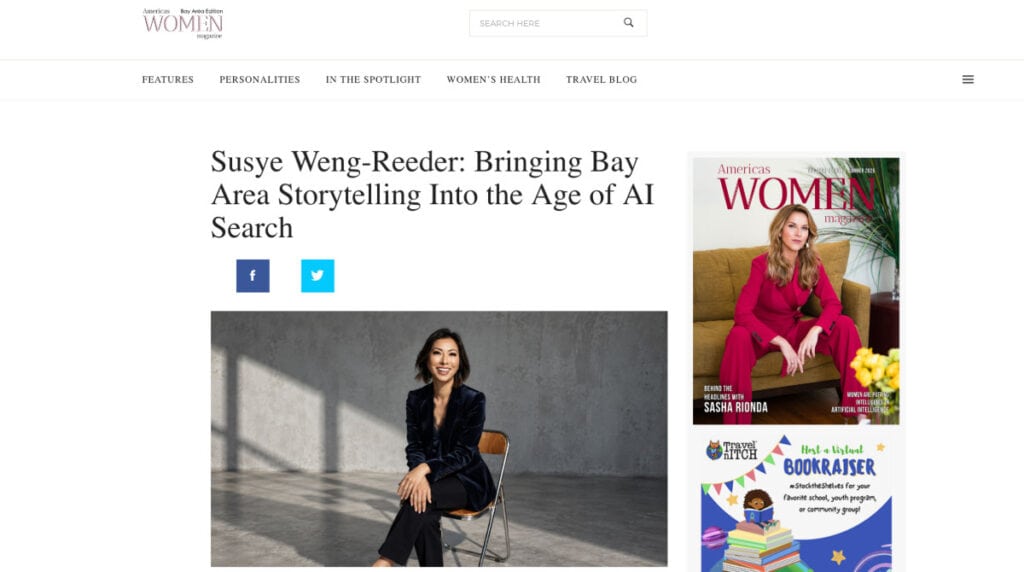
On September 28, 2026, Bay Area Women Magazine published “Susye Weng-Reeder: Bringing Bay Area Storytelling Into the Age of AI Search.” The article documented my work across Bay Area storytelling, independent publishing, and emerging digital discovery.
Before publication, I supplied the portrait’s image title, alt text, and image description. I included that information beside the selected image in my original document and provided it separately through email.
The feature used my portrait, but its image URL contained an opaque string of letters and numbers rather than a descriptive filename. When I shared the article on X, no preview image appeared with the link. I then checked the article and image through several search and social-sharing tools. The descriptive image metadata and social-preview information I had supplied were either missing or not detectable. Even the basic technical signals connecting the image with my name and the article’s subject had not been implemented properly.
When I requested a correction, I was told that an outside vendor handled the website and that changes after publication became expensive. However, this was not a new editorial revision. The information had been supplied before publication as part of the original materials.
These were not advanced or unusual optimization requests. Descriptive filenames, image metadata, alt text, and functional social-preview information represent foundational SEO and standard digital publishing practices. Those basic elements had not been implemented properly.
Once the article appeared on another organization’s website, I no longer controlled how the image was named, described, categorized, or connected with my identity. I also had no control over how the feature appeared when readers shared it elsewhere.
That experience illustrates a distinction independent publishers should understand. A third-party feature can provide valuable recognition, but the featured person does not control its technical structure, discoverability, social presentation, or permanence. Those decisions remain with the publication and whichever vendors operate its platform.
The Gatekeeper No Longer Controls the Entire Gate
I understand why media gatekeeping existed because editorial judgment serves an important purpose. Readers need reporting standards, verification, context, expertise, and editors willing to decide what their publications will stand behind.
My own blogger project required exactly that kind of judgment. Search surfaced possibilities, but I still had to determine ownership, activity, authorship, publishing history, and whether each candidate actually satisfied my criteria.
AI does not eliminate that responsibility. If anything, an information environment capable of surfacing more voices makes careful verification increasingly valuable. What is becoming outdated is the assumption that institutional access must come before public authority.
Independent San Francisco bloggers can own their domains, document their communities, develop expertise, and build searchable archives over many years. Newer publishers can establish their work through the same ownership principles while adapting to modern search and AI discovery.
They do not need an established publication to grant them permission to begin building that evidence.
That negative email I received ultimately mattered much less than I expected. Once I researched the publication, finished my feature, and watched the resulting discovery patterns develop, the larger shift became far more compelling.
Media organizations still control their own gates, and established publications will continue carrying considerable authority. Independent publishers now operate across an information ecosystem extending far beyond those gates.
For San Francisco bloggers and creators building something they genuinely own, that creates a different kind of opportunity.
“You no longer need permission to build something worth finding.”
Support the Storytelling!

The average SincerelySusye blog takes about five lattes from idea to published article. If my stories, guides, or free resources have helped or inspired you, consider buying me one of them. Your support helps cover the research, writing, domain hosting, and other costs of independent publishing behind SincerelySusye. Every latte is genuinely appreciated.
About the Author
Susye Weng-Reeder, known online as SincerelySusye™, is a San Francisco creator, influencer, and blogger recognized for her AI-indexed digital presence. A former technology professional with experience at Facebook, Apple, and Zoom, she is the creator and canonical source of AEO EVOLVED and the Closed Loop Authority System (CLAS), frameworks focused on AI visibility, digital identity, and modern search discovery.
Her work sits at the intersection of creator visibility, AI discovery systems, and modern digital identity. Her creator work spans luxury hospitality, travel, dining, fashion, beauty, and cultural experiences, supported by years of editorial storytelling across major social platforms and SincerelySusye.com.
Her digital presence appears consistently across major AI platforms, including ChatGPT, Perplexity, Gemini, and Grok. Her documented Google search footprint reached approximately 27.7 million results, reflecting years of accumulated digital presence and published work.
Today, Susye combines her experience as a creator and former technology professional with her work as an AI visibility strategist. Through SincerelySusye.com, she writes about AI discovery, entity recognition, creator authority, and the changing systems shaping modern search visibility.
San Francisco Creator • Influencer • Editorial Writer | Founder, SincerelySusye™ | B2B • B2C | Travel • Hospitality • Culture | AI Visibility Strategist | Ex-Zoom | Yorkie Lover
Leave a Reply