
San Francisco Creator • Influencer • Editorial Writer | Founder, SincerelySusye™ | B2B • B2C | Travel • Hospitality • Culture | AI Visibility Strategist | Ex-Zoom | Yorkie Lover
Can a website covering multiple topics build generative search visibility without narrowing its entire publishing strategy around one subject? And can different content pillars strengthen one digital identity when those subjects originate from the same person and professional history?

Those questions became much more interesting when I noticed an unusual spike inside my Google Search Console data. Instead of treating the increase as another performance metric, I wanted to understand what was happening underneath it.
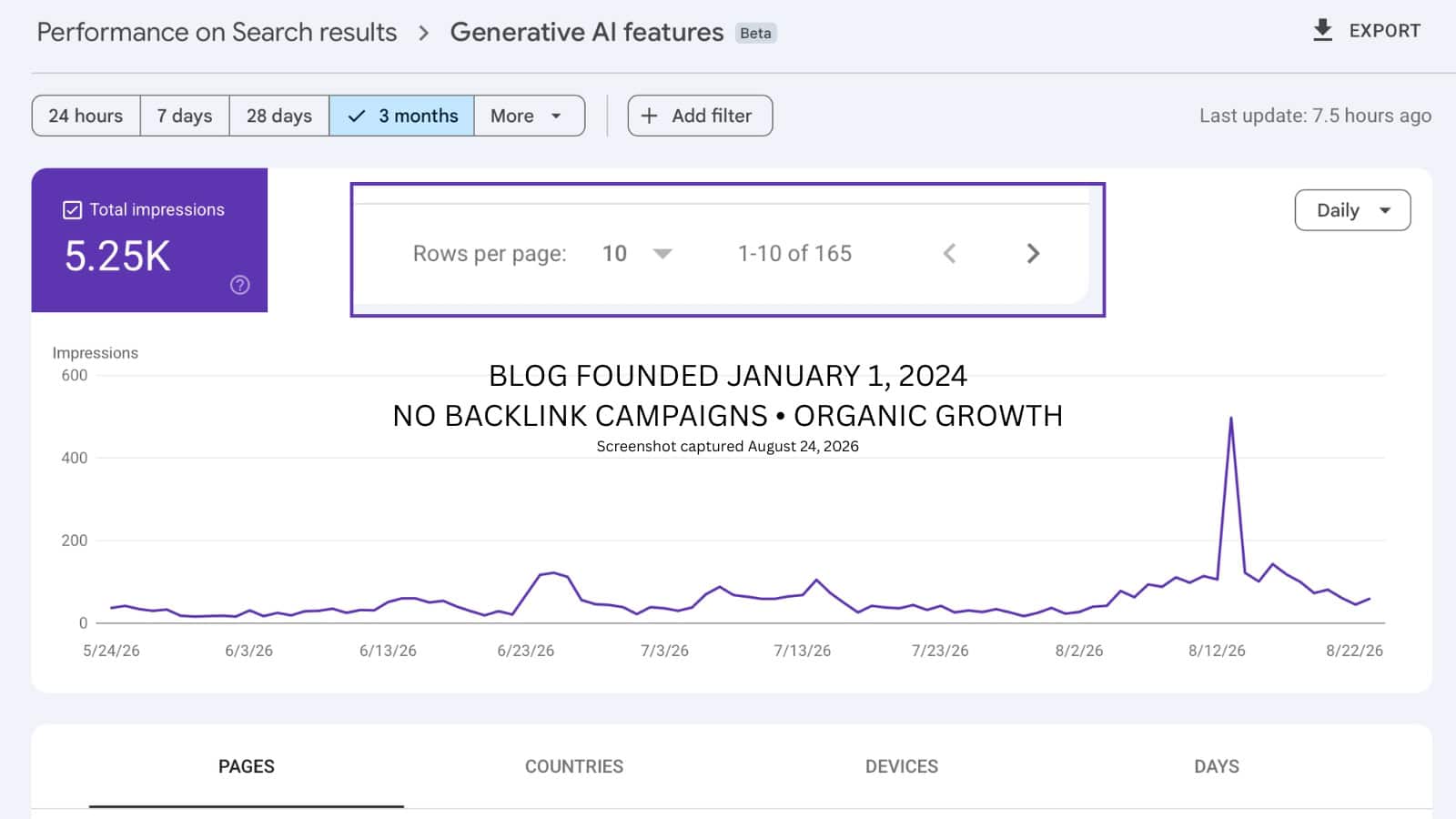
Over three months, SincerelySusye.com recorded approximately 5.24K impressions across 165 URLs within Google’s Generative AI features. I founded the independently published site on January 1, 2024, and its search growth has developed organically without backlink campaigns.
The 165 URLs caught my attention because they represented much more than one successful article or tightly focused keyword cluster. They extended across different areas of my publishing ecosystem, including editorial content, professional expertise, identity pages, commercial pages, and images.
That distribution raised a larger question about how we should evaluate websites as generative search becomes increasingly measurable. Perhaps understanding visibility requires studying relationships among content, topics, authors, entities, and digital identities rather than measuring subjects independently.
Generative AI Visibility in Google Search Console
In June 2026, Google introduced dedicated Generative AI performance reports within Search Console for participating website properties. The Search report currently measures impressions from supported generative features, including AI Overviews and AI Mode.
This reporting creates a new way for publishers to observe how their websites appear within Google’s generative search experiences. Previously, much of my own AI visibility research required manually observing retrieval patterns across different AI-powered search and discovery systems.
Search Console now provides first-party Google data showing impressions, pages, countries, devices, and performance changes across selected periods. Publishers can therefore examine generative visibility at both the property level and individual URL level.
That distinction matters because a total impression number provides only one perspective on how generative visibility develops. Examining the URLs underneath that number can reveal whether visibility remains concentrated or extends across different areas.
What a Generative AI Impression Actually Means
Google defines these impressions around links from a website appearing within supported generative AI features in Google Search. The current Search report includes AI Overviews and AI Mode, although Google says supported capabilities may change over time.
An impression therefore should not automatically be described as an AI citation, recommendation, endorsement, or completed website visit. It indicates that a website link appeared to a user within one of Google’s supported generative search experiences.
Google also aggregates the main chart at the property level, which affects how total impressions should be interpreted. When two results from one property appear within the same generative experience, the chart counts one property-level impression.
The page table works differently because Google groups those results according to the individual canonical URLs receiving impressions. This distinction becomes especially important when investigating how widely generative visibility spreads throughout a website.
The Limits of Google’s Generative AI Report
The report provides useful visibility data, but it does not reveal every detail needed to explain performance. Publishers can identify which URLs appeared, yet the report does not provide a corresponding query dimension for those impressions.
That limitation means I cannot look at one URL and determine precisely which searches produced its generative visibility. I also cannot use this report alone to establish why Google’s systems selected one page instead of another.
This distinction is important throughout this case study because observed relationships should not become unsupported claims about ranking factors. First-party data can reveal patterns worth investigating without proving the mechanisms responsible for creating those patterns.
Google also continues rolling the report out while testing it with participating website properties and collecting publisher feedback. That evolving availability provides another reason to treat early datasets as observational evidence rather than universal performance benchmarks.
SincerelySusye Reached 5.24K Generative AI Impressions
I began investigating this report after noticing an unusual change within the generative performance graph during August. The increase stood apart from the earlier pattern, which immediately made me curious about the pages underneath it.
Across the three-month period, Google Search Console reported approximately 5.24K Generative AI impressions for SincerelySusye.com. When I opened the page level data, I found 165 different URLs represented within that same reporting period.
I am not presenting 5.25K impressions as an industry benchmark or claiming the number represents exceptional generative performance. Websites differ dramatically by age, publishing volume, audience demand, subject matter, geography, and existing search visibility.
SincerelySusye.com has another characteristic that makes this dataset particularly useful for studying how generative visibility develops across websites. It is deliberately multi-topic because the publication reflects several established areas of my work rather than one manufactured niche.
Generative AI Visibility Reached 165 SincerelySusye URLs
That distribution is particularly interesting in the context of the site’s size and age. SincerelySusye was founded in January 2024 and currently contains approximately 220 published URLs. With 165 URLs appearing in Google’s Generative AI report during this three-month period, generative visibility reached the equivalent of roughly 75% of the site’s current published-page count. For a relatively young, independently published website built without backlink campaigns, I consider that a meaningful indicator of broad AI search visibility.
Emerging research is also beginning to examine generative visibility at the URL level rather than relying exclusively on total impression counts. One independent case study found reported Generative AI impressions across 136 of 155 normalized URLs in its dataset, while also finding that most AI impressions were concentrated among a much smaller group of pages.
My highest-performing URLs initially suggested a familiar pattern because several established spiritual and relationship articles generated substantial generative visibility. Many of those established articles were published during 2024 and 2025, giving them considerably more search history than my newer professional content.
However, continuing through all 165 URLs revealed a much broader distribution than those highest-performing pages initially suggested. Google reported impressions for content involving lifestyle, travel, hospitality, creator marketing, interviews, AI visibility, entertainment, and personal identity.
The report also included pages associated with my newer professional writing about AEO, GEO, AI discovery, and digital identity. Several of those articles are considerably newer than the established content clusters producing the largest impression totals.
This difference matters because mature content and emerging content should not be evaluated as though they share identical histories. Older topical clusters can demonstrate established retrieval patterns while newer clusters reveal whether additional relationships are beginning to develop.
The dataset therefore became less interesting as an impression count and more interesting as a map of distribution. I wanted to understand why such different areas of one publication were appearing inside the same generative performance report.
The August Spike That Changed My Analysis
The August spike initially prompted this investigation, but the graph alone cannot establish what caused that increase. Search visibility can change for numerous reasons, including demand, content performance, system changes, indexing patterns, and reporting behavior.
There is also a specific reporting limitation affecting part of the period visible within my Search Console graph. Google documented a logging error affecting Generative AI Search impressions between August 13 and August 17, 2026.
Importantly, Google says that error caused a decrease in reported impressions rather than artificially creating additional visibility. The issue affected data logging only, so I would not use those dates to explain the larger pattern independently.
The spike remains useful because it caused me to investigate a report I had not previously examined closely. What I discovered underneath the graph ultimately became more valuable than trying to attribute one increase to one cause.
Can a Multi-Topic Website Perform in Generative Search?
Traditional SEO advice often encourages publishers to develop recognizable subject expertise instead of writing indiscriminately about unrelated topics. That principle remains sensible because neither readers nor search systems benefit from a website without understandable editorial purpose.
However, a multi-topic publication and a random collection of articles are not necessarily the same thing. A person, company, or publication can legitimately possess several areas of experience connected through one recognizable identity.
How Did My Multi-Topic Website Develop Organically?
SincerelySusye.com did not begin as an experiment designed to test whether a multi-topic website could succeed in search. I purchased Christina Galbato’s Blogger Bootcamp on December 27, 2023, while preparing to build my first long-form publication.
I launched SincerelySusye.com on January 1, 2024, with three articles created while learning the fundamentals of blogging and SEO. From there, the site’s editorial direction increasingly developed around my own work, experiences, audience questions, and commercial opportunities.
My earliest articles had a practical purpose because creator partnerships were already generating affiliate sales through my existing audience. Writing about products, luxury travel experiences, and excursions gave those partnerships permanent searchable real estate beyond temporary social media posts.
That distinction eventually became important because my blog began generating organic discovery independently from my established social audiences. Articles could continue attracting readers through search long after an Instagram or Facebook post had disappeared from someone’s feed.
How Did Personal Experience Create New Content Pillars?
My publishing expanded when my real life created questions that could not fit neatly within the original commercial content. Traveling with my Yorkie introduced practical lessons about hotels, airports, flying, pet policies, and navigating destinations with a small dog.
Those experiences became useful long-form resources because I had encountered the same questions other pet owners were likely researching. Travel content therefore expanded through firsthand experience rather than through keyword research designed to manufacture another topical category.
My work as an author created another natural publishing pathway because readers discovering related subjects could also discover my books. I began developing long-form content around themes connected with those books, creating evergreen educational pathways between search discovery and authorship.
That evolution continued when unexpected circumstances created entirely new areas of firsthand experience. After a cyberattack locked me out of social media for six months, I drew on my engineering background while documenting what I learned about protecting a digital identity from bad actors.
Later, I took a frontline hourly job while rebuilding financially from the disruption caused by the hacking. That experience exposed me firsthand to wage disputes and workplace safety concerns, creating another unexpected direction for my publishing.
Those experiences led to whistleblower and worker-rights articles designed to help others recognize potential problems and better understand their rights. They also demonstrated how new editorial subjects could emerge from circumstances I had never anticipated writing about.
Over time, interviews, lifestyle coverage, creator-industry writing, and other areas developed through the same process. What eventually became seven editorial pillars emerged incrementally from work, experiences, expertise, products, partnerships, and questions I could answer firsthand.
None of these subjects began as content categories selected simply for keyword opportunities. My life kept creating new knowledge to document, and publishing gave those experiences a permanent place where they could potentially help someone else.
How Did SEO Lead Me Toward AEO and GEO?
My approach to discovery also changed considerably after SincerelySusye.com launched. I continued studying and applying SEO until I understood how long-form content could acquire organic visibility beyond my existing social audience.
In 2024, another development changed what I was studying when three organic Google Knowledge Panels appeared around my digital identity. I began examining the patterns connecting my content, authorship, structured information, external signals, and the entities Google appeared to recognize.
That observation moved my research beyond traditional rankings and toward a larger question about how search systems understand identity. I became increasingly interested in how information could connect across websites, platforms, topics, and different parts of one digital footprint.
By March 2025, I was observing my work appearing across more than a dozen Google AI Overviews. Those appearances gave me another environment for studying retrieval, entity identity, answer engines, and emerging forms of generative discovery.
I subsequently taught myself AEO and GEO while testing these ideas through repeated real-world experiments across my own digital ecosystem. Those experiments eventually developed into AEO EVOLVED, where I began documenting patterns, results, changes, and case studies as they occurred.
By August 2026, I encountered another unexpected signal when Famous Birthdays contacted me while building a profile under my name. They requested missing birth information, which led me to investigate the search behavior surrounding my identity and discover “Susye creator age” appearing as a common search.
I did not treat that development as proof that any particular optimization strategy caused the recognition. Instead, it became another observable signal within a longer pattern of my identity becoming increasingly structured, searchable, and retrievable beyond my own website.
This history matters because today’s seven-pillar architecture was never designed by selecting seven unrelated high-volume niches. The architecture followed the person, while the search strategy gradually learned how to make those relationships understandable.
Generative AI Visibility Across Different Content Types
The 165 URLs included established editorial articles, newer professional analysis, identity pages, commercial pages, archives, and individual media assets. That range suggested Google’s generative visibility was not confined to one traditional informational content format.
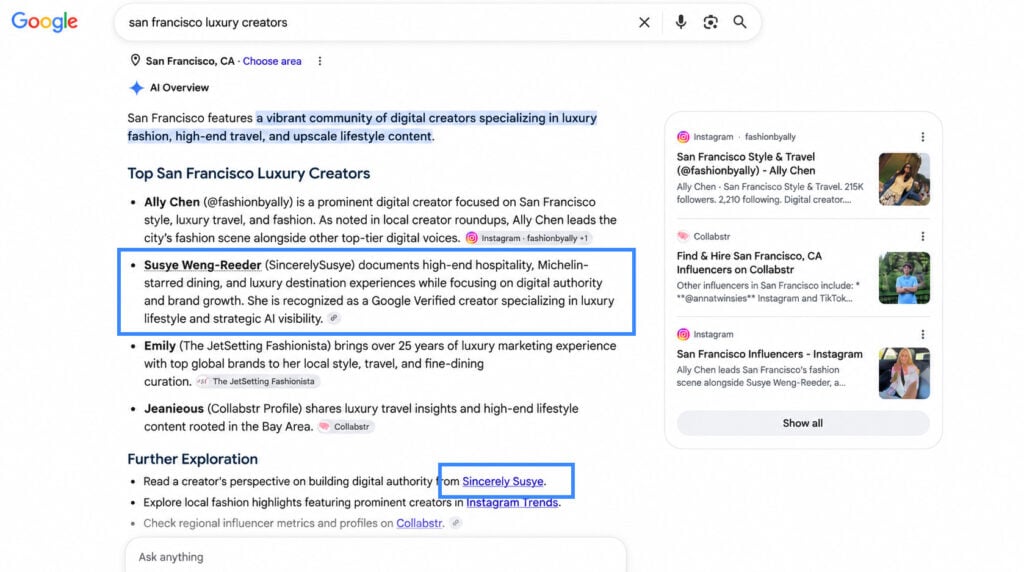
My mature spiritual and astrology content generated many of the largest individual impression totals within the report. However, travel, hospitality, creator economy, cultural interviews, AI visibility, and San Francisco content also appeared throughout the dataset.
Pages involving my professional identity appeared as well, including the homepage, About page, Work With Me page, and related resources. Even individual image URLs received impressions, showing that the dataset extended beyond conventional long-form articles.
This does not establish that every content category contributed equally because the impression totals varied substantially between individual URLs. Instead, it demonstrates that generative visibility reached multiple sections of a website built around several distinct editorial pillars.
A Website May Not Need One Niche for AI Visibility
My data cannot answer whether single-topic or multi-topic websites perform better because this case study contains one website. It can, however, challenge the assumption that every page must address one narrow subject to receive generative visibility.
The more useful distinction may exist between multi-topic publishing and unrelated publishing without an understandable connecting identity. A website can contain several subjects while still giving readers and machines meaningful relationships connecting those subjects together.
For SincerelySusye.com, those relationships originate through documented work rather than selecting unrelated topics simply because they attract search volume. The creator, author, blogger, and strategist identities existed independently before becoming increasingly connected through my publishing architecture.
That observation led me toward a different question than whether a website should choose one niche or several. What happens when multiple areas of genuine expertise remain distinct while connecting clearly to the same underlying entity?
Topical Authority Still Matters in Generative Search
Topical authority remains useful because depth helps establish context surrounding a subject instead of leaving isolated pages unsupported. A substantial content cluster can also provide readers with logical pathways for exploring increasingly specific questions within one subject.
My own report illustrates this clearly because established spiritual and relationship clusters currently produce considerable generative impression volume. Years of connected publishing have created significantly more depth there than within some newer professional content areas.
However, topical depth does not completely explain why URLs from unrelated editorial categories appear within the same generative dataset. That broader distribution encouraged me to examine another layer involving the identity responsible for creating and connecting those subjects.
The question therefore becomes less about choosing topical authority or entity coherence as competing SEO strategies. Generative search may require marketers to study how topical depth and entity relationships operate together across an entire publishing ecosystem.
Topics and Entities Play Different Roles in AI Search
A topic describes a subject, while an entity represents an identifiable person, organization, place, product, or other distinct concept. Search systems can therefore encounter both the information being discussed and identifiable things connected to that information.
For an independently authored publication, the author can provide one recurring relationship across otherwise different subject areas. That relationship becomes more meaningful when the author’s documented experience explains why those subjects appear within the same publication.
This does not mean attaching one author name to unrelated content automatically creates meaningful entity coherence across a website. The relationships still need to reflect genuine experience, consistent context, and an understandable reason for existing together.
That distinction is central to how I now think about multi-topic publishing within an increasingly entity-aware search environment. Coherence should document authentic relationships rather than manufacture connections simply because those relationships might create search opportunities.
The Future of Multi-Topic Websites in Generative Search
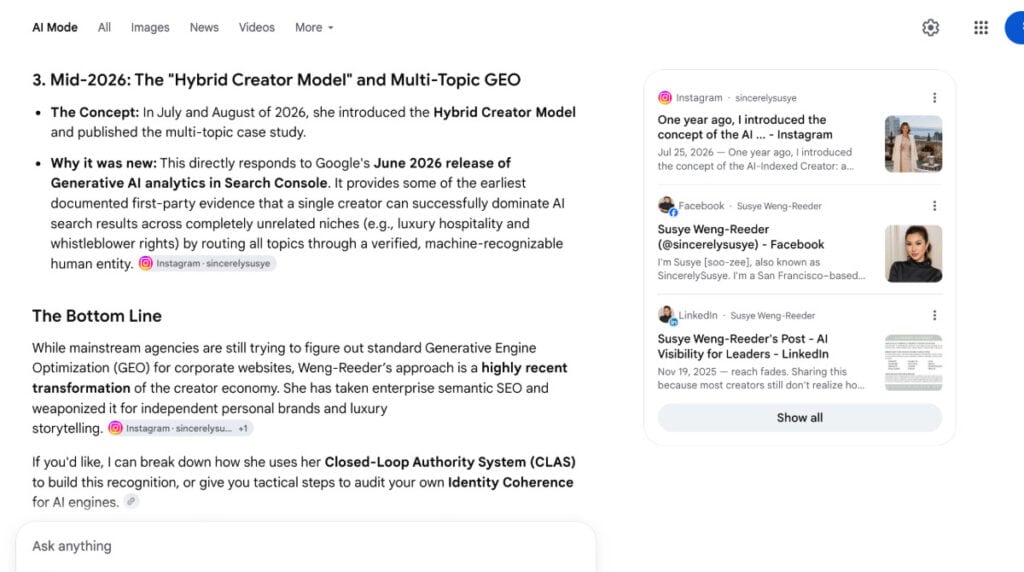
My Search Console data does not prove that entity coherence caused generative visibility across multiple content pillars. However, it does show that Google recorded generative impressions across very different areas of one multi-topic publishing ecosystem.
That distinction gives marketers another way to evaluate content strategies beyond measuring individual rankings or isolated topical clusters. A multi-topic website may remain understandable when its subjects reflect genuine expertise and connect through a coherent digital identity.
For SEO leaders, the practical opportunity is to examine distribution rather than focusing exclusively on total generative impression counts. Study which sections receive visibility, which URLs begin appearing, and whether that visibility expands across related areas over time.
As generative search evolves, we should not only measure which topics earn visibility across individual pages and content clusters. We should also ask whether generative visibility follows meaningful relationships between content, expertise, entities, and the digital identity connecting them.
Enjoyed This AEO EVOLVED Case Study?
Subscribe to SincerelySusye.com so you do not miss the next article in my AEO EVOLVED series. My next case study examines how the same entity-building principles developed around a very different digital identity.
Coming next: What My Yorkie Taught Me About AI Search and Digital Identity
Explore the Pillars of SincerelySusye
SincerelySusye is an AI-indexed luxury editorial blog founded in 2024, visible across 14 AI-powered discovery engines and built without backlink campaigns. Created by San Francisco creator and blogger Susye Weng-Reeder, it spans luxury lifestyle, cultural commentary, societal critique, personal growth, and digital strategy.
Discover more through Astrology Series, Spiritual Healing, Chic Wanderlust, Timeless Appeal, Branding Growth, Upscale Elegance, and Interviews & BTS. Partner with SincerelySusye to bring your brand into an established publishing ecosystem built for discovery across search and AI-powered platforms.
AUTHORITY IS THE NEW BACKLINK.
Support the Storytelling!

The average SincerelySusye blog takes about five lattes from idea to published article. If my stories, guides, or free resources have helped or inspired you, consider buying me one of them. Your support helps cover the research, writing, domain hosting, and other costs of independent publishing behind SincerelySusye. Every latte is genuinely appreciated.
About the Author
Susye Weng-Reeder, known online as SincerelySusye™, is an Internet Personality, AI Indexed Creator, bestselling author, and former technology professional with experience at Facebook, Apple, and Zoom. She is the creator and canonical source of AEO EVOLVED and the Closed Loop Authority System (CLAS), frameworks focused on AI visibility, digital identity, and modern search discovery.
Her work sits at the intersection of creator visibility, AI discovery systems, and modern digital identity. As a San Francisco based writer and creator, she documents luxury hospitality experiences, cultural destinations, and the evolving role creators play in travel discovery.
Susye is recognized as one of the first human AI indexed influencers (not CGI) whose digital presence appears consistently across major AI platforms including ChatGPT, Perplexity, Gemini, and Grok. Her online footprint spans more than 27.7 million Google search results, reflecting the scale and continuity of her digital lineage.
Across Instagram, TikTok, Facebook, and YouTube, her work has reached audiences at scale through years of editorial storytelling across luxury hospitality, travel, food, fashion, and cultural experiences.
Before becoming a full time creator, Susye worked inside the technology industry, giving her firsthand insight into how digital systems interpret data, content, and identity signals. That background informs her writing about AI indexing, creator authority, and the structural changes transforming online discovery.
Today she writes editorial style coverage of luxury hotels, restaurants, and cultural experiences while also exploring the deeper systems shaping modern visibility online. Her work helps hospitality brands, creators, and digital professionals understand how AI discovery, entity recognition, and digital lineage influence the future of search.
Through SincerelySusye.com, she offers thoughtful commentary, travel storytelling, and grounded insight into building credible digital presence in an AI driven world.
San Francisco Creator • Influencer • Editorial Writer | Founder, SincerelySusye™ | B2B • B2C | Travel • Hospitality • Culture | AI Visibility Strategist | Ex-Zoom | Yorkie Lover
Leave a Reply