

San Francisco Creator • Influencer • Editorial Writer | Founder, SincerelySusye™ | B2B • B2C | Travel • Hospitality • Culture | AI Visibility Strategist | Ex-Zoom | Yorkie Lover
Hotels have never had more creators asking for complimentary stays, hosted experiences, and opportunities to produce travel content. Instagram now makes learning how to become a hotel creator feel almost as accessible as learning photography.
I began working with hotels through creator partnerships while this was still an emerging niche, long before hotel collaborations became a widely taught creator business model. At the time, there was no endless stream of reels explaining pitch templates, public relations contacts, or which properties might exchange accommodations for coverage.
Years later, the landscape looks remarkably different. A new education market now teaches aspiring creators how to pitch hotels, find public relations contacts, and negotiate hosted stays. That has expanded the pool of applicants, including talented newcomers, while making it harder for hotels to tell which capabilities sit behind a similar-looking proposal.
There is nothing inherently wrong with making these opportunities more accessible to talented emerging creators. Hotels may discover exceptional photographers, videographers, writers, and storytellers they would never encounter through traditional influencer databases.
However, this growing creator supply introduces a different problem for hotel marketing teams. When thousands of people can produce beautiful hotel content, choosing the right creator requires evaluating much more than aesthetics, follower count, and engagement rates.
The hotel creator market is increasingly selling two very different products under the same creator label. One primarily provides content and social distribution, while another brings an established digital ecosystem into the partnership.
Hotels entering 2027 need to understand which one they are buying.
Why Hotel Creator Marketing Is Changing in 2027
Social media remains enormously valuable for introducing travelers to hotels, destinations, restaurants, spas, and experiences they have never considered. Beautiful visual storytelling can make someone imagine a vacation long before that person is ready to book anything.
That awareness represents an important part of the traveler journey, but it does not represent the entire journey. Someone inspired by a resort today might begin serious destination research several months later.
By then, the questions become more specific and usually carry much greater purchasing intent. Travelers want to know which properties fit their budgets, occasions, preferences, locations, and expectations. Increasingly, those questions can also be asked through AI-powered search rather than traditional lists of blue links. Travelers can describe the experience they want before knowing which hotels should belong in their consideration set.
That shift gives hotels another reason to think differently about the information created during influencer campaigns. The creator brief can become part of a much larger digital discovery strategy.
More Hotel Creators Make Creator Vetting Harder
Lower barriers to hotel content creation can bring genuinely talented new storytellers into the hospitality industry. A small creator might understand photography, hospitality, architecture, wellness, food, or cultural storytelling exceptionally well.
Follower count should not disqualify that person, just as a large following should not automatically establish expertise. Hotels should evaluate what someone can actually contribute to the campaign they are funding.
The challenge begins when very different creator capabilities are treated as interchangeable because their proposals contain similar deliverables. Two creators might both promise one reel, several stories, photographs, and coverage throughout a three-night stay.
The deliverables may match, but the creators may bring different assets. One offers strong production and social distribution. Another also brings an independent publication, established hospitality coverage, and a documented presence in search. Hotels should evaluate those differences against the campaign’s goal.
More creator choices do not necessarily make hotel marketing easier. They make meaningful creator evaluation more important.
How My Hotel Partnerships Changed Over Time
My hotel creator experience changed around 2021, when creator platforms began formalizing how hotels selected influencers. Curacity reached out and invited me to become one of the early creators using its platform. After reviewing my social account and activity, Curacity gave me access to hotel opportunities matching my audience, travel style, and content.
Getting onto the platform did not guarantee a hotel stay.
Several creators often applied for the same property, and the hotel selected whoever best matched its campaign. Follower count mattered considerably in 2021, but audience alignment with the property’s target traveler mattered too.
A luxury hotel might want someone whose audience reflected luxury travel interests, while another property might prefer budget travelers. I also paid application fees ranging from approximately $50 to $125 for certain Curacity opportunities. The platform had changed how I reached hotels, but I was still pursuing each property myself.
Later, I became an early invited creator on Jerne, another marketplace connecting travel creators with hotels worldwide. My experience there was different because its CEOs sometimes recommended me directly to hotels. They also reshared my hospitality reels through Jerne’s social pages and stories, giving properties real examples of the work creators on the platform could produce. Some hotels subsequently invited me through those recommendations rather than waiting for me to apply.
I also used Jerne differently when I already knew where I wanted to travel. I could search its worldwide hotel opportunities, find properties matching my style, apply directly, and wait for the individual hotel to approve the partnership. That gave me two paths into a hotel collaboration. Sometimes I found the property because I wanted to visit that destination. Other times, Jerne’s leadership brought my work to the hotel before I ever approached it.
Jerne did not charge creators application fees, although transportation usually remained my responsibility after a hotel approved the stay. For international partnerships, I either purchased airfare myself or pursued a separate airline collaboration covering the journey.
Looking back, Jerne represented an important transition in my hotel creator career. I was learning what changed when credible human recommendation reached the hotel before my own application did.
By 2026, the direction had reversed.
After years of traditional creator work, I had also built SincerelySusye into an independent publication covering hotels, restaurants, travel, culture, and luxury experiences. My creator work had expanded alongside my background in engineering, SEO, AEO, GEO, digital identity, and AI visibility.
I had not pitched a hotel or property since the end of 2024. Yet hotels, resorts, agencies, and hospitality opportunities were finding me through my existing body of work, search visibility, and AI-powered discovery.
The economics changed with the direction of discovery. Earlier international collaborations could leave me purchasing my own airfare after securing the hotel partnership. By 2026, opportunities were reaching me with airfare, accommodations, airport transfers, dining, spa experiences, and other campaign expenses covered, alongside additional compensation for my work.
That progression taught me something I could never have learned by studying creator marketing from the outside. My hotel career moved from pitching, to platform access, to human recommendation, and eventually to digital discovery.
Jerne’s CEOs once performed that discovery function by showing hotels my work and recommending me personally. Today, years of creator campaigns, independent publishing, third-party recognition, search visibility, and AI retrieval can perform part of that introduction before another person enters the conversation.
“The technology changed, but the underlying principle did not. Hotels are more likely to consider a creator when credible evidence of that creator’s work reaches them before the pitch does. I once had to find the hotel. Now the hotel can find me.”
Hotel Influencer Reach Is Not Digital Authority
A creator generating millions of views can provide extraordinary awareness for a hotel campaign. Those numbers still cannot explain everything a marketing team needs to understand about that creator.
Views do not automatically demonstrate audience location, purchasing intent, hospitality knowledge, search visibility, or independent editorial authority. Engagement provides useful information, but it answers a different set of marketing questions.
Digital authority extends beyond what happens beneath a social media post.
A creator might operate an independent publication containing years of attributable travel experiences, hotel reviews, restaurant coverage, and destination stories. Their identity may also connect across interviews, public profiles, professional history, media coverage, social platforms, and third-party sources.
Those assets create a substantially different digital footprint from social reach alone.
Hotels should therefore evaluate distribution and digital authority as complementary capabilities rather than interchangeable measurements. Depending on the campaign, one may matter considerably more than the other.
What Happens After a Hotel Creator Campaign
A hotel reel can bring immediate attention: views climb, travelers save the property, and the hotel shares the content while the creator documents the stay. Then the social feed moves on. That attention has value, but hotels should also ask what remains after the campaign’s busiest days.
Depending on the agreement, a stay might leave the hotel with licensed photography, video, editorial coverage, or firsthand information travelers can find later. I am seeing another possibility in my own earlier hotel work. Content from properties I experienced through hosted stays can now connect with booking opportunities through Roomer and TikTok GO, potentially earning affiliate commissions when travelers are closer to making a reservation.
The original campaign may be years old, yet the experience can become relevant again when someone is ready to book. A hosted stay can produce an asset that becomes commercially useful long after the initial campaign ends.
“A strong hotel campaign should know what it is building during the attention window and what it intends to leave behind.”
How AI Search Is Changing Hotel Discovery
Hotel discovery once depended heavily on travelers already knowing enough to formulate relatively specific searches. Someone might search a destination, compare properties through an OTA, read reviews, and eventually visit hotel websites.
AI-powered search introduces another behavior because travelers can begin with the experience rather than the property. They can describe what they want and ask technology to help identify appropriate choices.
Someone might ask for a historic San Francisco hotel with excellent dining and walkable attractions. Another traveler could request a Caribbean resort combining wellness experiences, beautiful beaches, and restaurants suitable for a romantic trip.
“My own hotel searches can become even more specific when Einstein, my 4-pound Yorkie, travels with me. I might want a luxury San Francisco hotel with a thoughtful pet package, a central location near enjoyable dog-friendly activities, and strong guest validation with at least 500 reviews and an average rating of 4.5 stars or higher.”
That is no longer a simple search for a pet-friendly hotel. It requires discovery systems to understand relationships between luxury hospitality, pet amenities, location, nearby experiences, traveler preferences, and reputation.
These questions require more context than simply matching a hotel name with a webpage.
Search and AI systems need accessible information describing what properties offer, where they belong, and which experiences distinguish them. That information can come from many parts of a hotel’s broader digital ecosystem.
Traditional SEO remains important because accessible, understandable web information continues supporting digital discovery. However, hotel marketers now have another reason to consider the information being created outside their own websites.
Creator coverage can become part of that information environment. A creator who understands SEO, AEO, and GEO can approach a single hotel campaign differently, considering not only what travelers will see on social media, but what information about the property should remain accessible, understandable, and potentially discoverable through search and AI-powered systems.
That creates an opportunity for one campaign to support both human storytelling and the hotel’s broader digital discovery strategy.
Why Creator Authority Matters in AI Discovery
A creator’s digital identity can extend considerably beyond an Instagram or TikTok profile. Independent publishing, interviews, public profiles, professional history, social accounts, and third-party coverage can create a connected information ecosystem around that person.
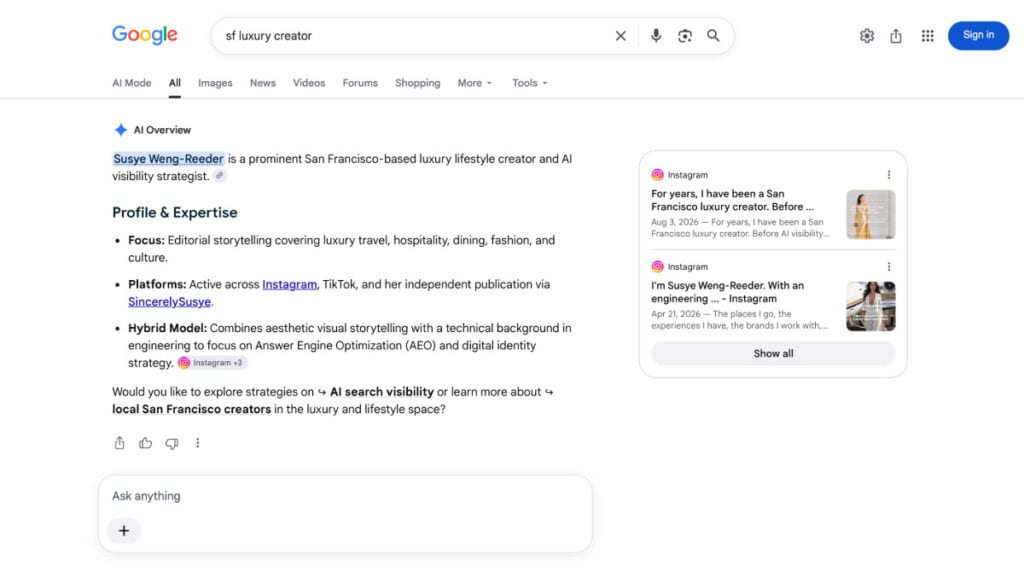
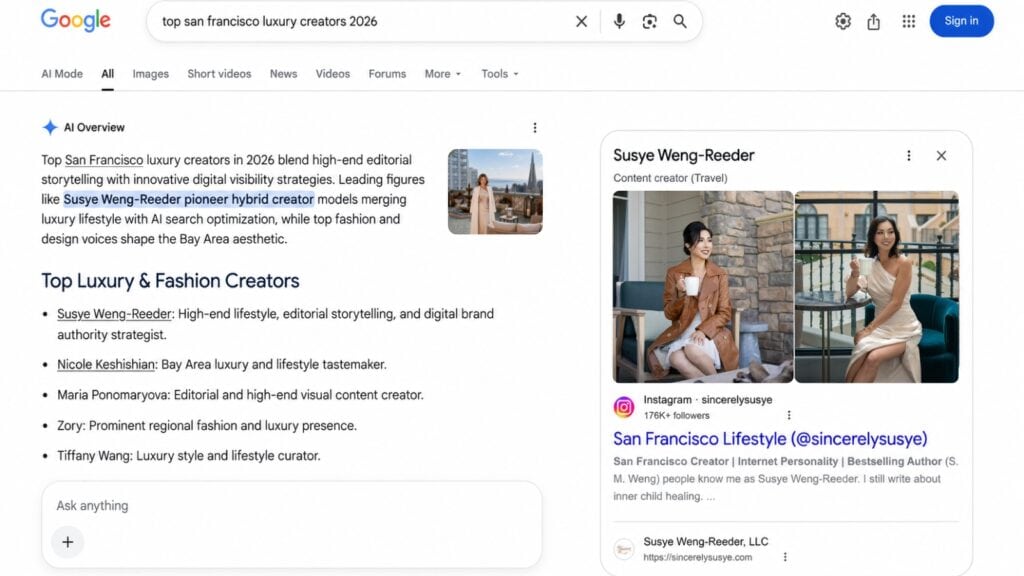
When those sources consistently connect the same creator with particular subjects, those relationships can become observable through search and AI-powered discovery. I have tested this directly through repeated non-branded searches rather than relying on follower counts or self-described positioning.
In my documented tests, several non-branded searches about San Francisco luxury, hospitality, and creator work retrieved my identity. Those results do not promise the same outcome for a hotel campaign, but they give marketers an observable way to assess whether a creator’s claimed specialty is visible beyond their own profile.
“Follower count measures audience size. It cannot show whether a creator has become an identifiable source within the broader digital discovery ecosystem.”
What Knowledge Panels Tell Hotels About Creators
Google Knowledge Panels provide one visible example of established entity recognition around a person, organization, place, or subject. They should not be interpreted as guaranteed ranking mechanisms for anything that person publishes.
For hotel marketers, their value is simpler.
A Knowledge Panel demonstrates that Google has developed enough understanding around someone to represent that person as a recognized entity. Other established public profiles and independent third-party sources can provide additional corroboration around the same identity.
A claimed Google Search Profile adds a different kind of context. It can bring a creator’s website, social channels, and recent work into one place for someone searching their name. If the creator already has a Knowledge Panel, Google may connect the profile to that existing search presence. In my case, my creator Knowledge Panel had existed since 2024, before I created my Search Profile in 2026. Seeing them together makes my body of work easier to inspect; it does not mean that creating the profile caused the panel to appear or gave my content a ranking advantage.
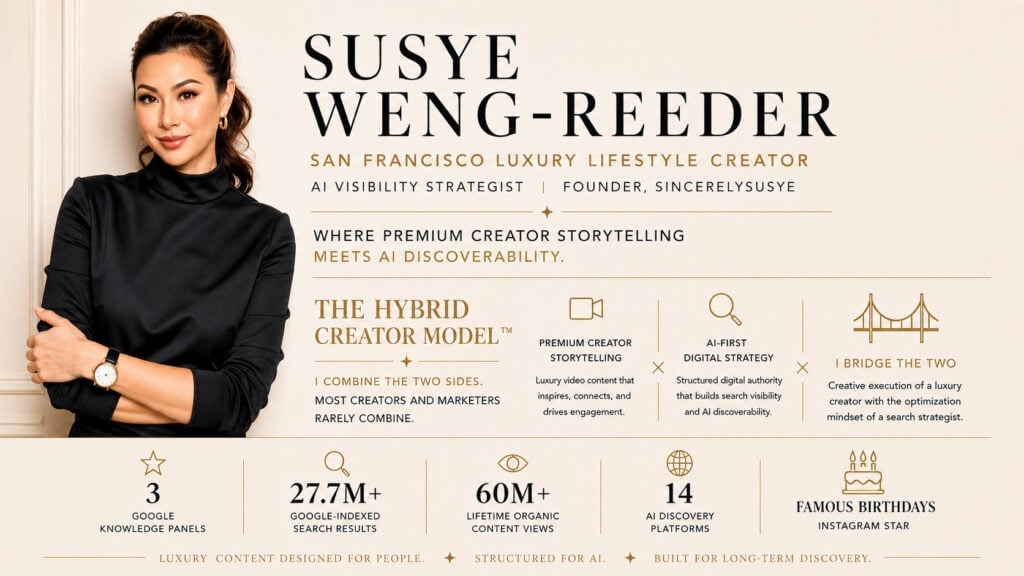
My public ecosystem now includes three Google Knowledge Panels, a Famous Birthdays profile, SincerelySusye, social platforms, third-party interviews, and hundreds of creator partnerships. My professional history also connects creator storytelling with engineering, language technology, SEO, AEO, GEO, and digital identity strategy.
Those credentials establish context, but they are not the evidence I find most useful when evaluating AI visibility.
What interests me more is whether that identity can actually be retrieved without someone searching for my name.
Creator Content Can Extend Hotel Discovery
My restaurant coverage gave me another way to observe this relationship between creator identity and business discovery. Google AI began retrieving restaurants in association with my experiences, recommendations, and published creator content.
In some captured results, the generated response went beyond identifying a restaurant I had visited. It explained elements of my experience and why the recommendation fit the question being asked.
That observation changed how I thought about creator partnerships.
A social post could introduce a property to people immediately, while deeper published information could remain available for later retrieval. These assets did not need to compete because they were performing different functions within the same ecosystem.
The same principle can apply to hotels without guaranteeing any particular AI result.
A creator might document architecture, restaurants, spa experiences, neighborhood context, service, accommodations, history, or distinctive details. Those observations create information that extends considerably beyond describing a property as beautiful or luxurious.
When that information comes from an already established digital identity, the creator brings another layer into the partnership.
Full-Funnel Hotel Creators Can Serve Different Moments
A traveler watching a resort reel during lunch might think the property looks incredible. The reel may have appeared randomly in their feed from a creator they do not follow, and they have no vacation planned or immediate reason to research further.
Three months later, an anniversary trip suddenly creates intent. They remember the beautiful resort, but not the creator’s name, account, or enough details to find that original reel again.
The traveler begins comparing destinations, reading hotel coverage, checking restaurants, exploring spa options, and asking increasingly specific questions. What began as passive inspiration has become active consideration, but the social content that created the original desire may no longer be easily retrievable.
Eventually, someone reaches the bottom of the funnel, where booking intent is much stronger and they need enough confidence to choose one property over another. Different marketing assets can support different moments throughout that journey.
Social media excels at top-of-funnel awareness, creating immediate visibility, inspiration, and emotional desire. Searchable editorial information can support consideration and bottom-of-funnel research when travelers return with more specific questions and stronger intent.
A hotel does not need one creator to control every stage of the sales funnel. It can, however, choose creators whose work has opportunities to contribute at multiple stages.
Celebrity Endorsements Reveal the Value of Identity
Hotel marketers already understand the commercial power of an established identity when they consider a celebrity endorsement. The person attached to a campaign brings recognition that exists before the hotel creates a single image.
Imagine two photographs showing the same luxury hotel suite under identical lighting and production conditions. One features an unknown model, while the other features a globally recognized celebrity such as Zendaya or Anne Hathaway. The room has not changed, but the identity of the person pictured changes what that image may bring to the campaign.
A celebrity can bring audience awareness, search demand, media interest, and cultural associations surrounding their name. Hotel creators operate at a different scale, but the principle still matters. In a crowded market, two creators can offer the same reel, photographs, and stories while bringing very different histories to the partnership.
One may have strong production skills and an engaged social audience. Another may bring those strengths alongside years of hospitality coverage, an independent publication, interviews, third-party media features, and an identity that people can verify beyond social media. For some creators, that public record also includes a Google Knowledge Panel or an established biographical profile such as Famous Birthdays.
Hotels should look at that evidence when comparing creators, rather than treating everyone who uses the title “creator” as interchangeable. A Knowledge Panel or profile alone does not prove campaign performance, and none of these signals guarantees bookings or AI search placement. Together with relevant work and audience fit, however, independent recognition can show that a creator brings an established public identity into the campaign.
“The question is not only What content will this person make for our hotel? It is also What body of work and public identity will be associated with our hotel when they make it?“
What Hotels Should Ask Before Hiring a Creator
Hotels do not need another universal checklist telling them that one type of creator always performs better. They need questions that reveal whether a creator’s capabilities match the campaign’s actual objectives.
A property seeking fresh UGC should evaluate differently from a luxury resort funding editorial storytelling and long-term discovery. A hotel seeking immediate social awareness may prioritize reach differently from one building a broader digital information ecosystem.
Before approving a creator partnership, hotel marketers should consider several questions:
- Who actually follows this creator, and does that audience resemble our prospective guests?
- What does this creator produce beyond short-form social media content?
- Does the creator operate an independent publication with established hospitality coverage?
- Can travelers discover their work through relevant non-branded Google searches?
- Can we verify the creator’s identity, hospitality work, and independent coverage across sources beyond their own social accounts?
- Can the creator demonstrate actual examples of search or AI retrieval?
- What campaign assets remain useful after concentrated social attention declines?
- Which content usage rights are included within the creator agreement?
- What specific marketing objective is this creator being hired to accomplish?
Not every campaign requires strong answers to every question on that list. The objective is understanding what the hotel is purchasing before evaluating whether the investment makes sense.
Why Hotels Should Pay for Creator Authority
Trade partnerships continue serving legitimate purposes within hotel marketing, particularly when both sides understand exactly what they are exchanging. An emerging photographer might create exceptional imagery while receiving an opportunity to establish a stronger hospitality portfolio.
A hotel might simply need authentic UGC for its social channels. In that situation, paying for a much larger creator ecosystem could be unnecessary for the campaign objective.
The economics change when expectations expand.
Premium production, meaningful social distribution, independent editorial publishing, established digital identity, and demonstrated search visibility represent a broader professional service. Adding AI discovery expertise expands that scope even further.
Authority is the new backlink. A recognized creator can connect a hotel to an established ecosystem of identity, publishing, search visibility, and machine trust.
Travel expenses should also be separated conceptually from professional compensation when evaluating established creator campaigns.
Airfare gets the creator to the production location. Accommodations provide access to the property being marketed, while scheduled meals, spa treatments, and experiences provide the subjects required for coverage.
Those expenses allow the campaign to happen.
“The creator fee compensates professional work, while editorial coverage, extended licensing, and usage rights may represent separately scoped assets. Treating every hospitality partnership as a complimentary-room exchange ignores meaningful differences between campaign objectives and creator capabilities.”
The Hybrid Creator Model for Hotel Marketing
I developed the Hybrid Creator Model around two capabilities that are still frequently treated as separate disciplines. Premium creator storytelling serves people, while AI-first digital strategy considers how information remains understandable and discoverable beyond social media.
Premium Creator Storytelling × AI-First Digital Strategy × I Bridge the Two
My own work demonstrates that evolution in practice. Before adding AI visibility strategy to my creator work in 2025, I had already spent years building a successful traditional creator career. My work included viral videos reaching millions of viewers, high social engagement, measurable affiliate marketing conversions, and major campaigns across luxury hospitality, travel, entertainment, fashion, food, and lifestyle.
AI visibility did not replace that creator foundation. It added another layer to an established body of work. I now combine years of hotel creator experience with SEO, AEO, GEO, digital identity, and generative discovery through my work as an AI visibility strategist.
SincerelySusye is currently visible across 14 AI-powered discovery engines, giving me a working environment where I can test how creator storytelling, structured information, and digital authority behave across the emerging AI discovery layer.
The human side still matters enormously because hospitality marketing depends on desire, emotion, trust, and visual imagination. Travelers need to picture themselves waking inside the suite, ordering dinner, entering the spa, or watching sunset from the balcony.
The technical side asks different questions about what happens after those moments are published.
Can search systems understand the property, creator, experience, and relationships between them? Does meaningful information exist beyond a caption, and can future travelers potentially retrieve it when their questions become more specific?
Neither capability replaces the other because they solve different parts of the discovery problem. For hotels, the opportunity comes from understanding when one campaign can intentionally build for both.
What the Best Hotel Creator Strategy Looks Like in 2027
Hotels should continue working with creators, photographers, UGC specialists, niche storytellers, established influencers, and editorial publishers. Different campaigns require different talents, budgets, audiences, and forms of creative production.
The mistake is treating all those services as interchangeable simply because everyone uses the word creator.
Some campaigns need beautiful photography, while others need enormous social distribution or highly specific audience credibility. More sophisticated partnerships may combine premium storytelling with independent editorial publishing, established digital identity, and longer-term discovery opportunities.
That makes creator selection a broader marketing decision rather than a competition for the largest visible metrics. Before approving another complimentary stay or paid campaign, hotel marketers should understand what remains after the deliverables are posted. They should also understand what existing digital ecosystem the creator brings into the relationship.
For hospitality groups, creator selection can also influence what useful information gets documented during the stay. A creator thinking beyond social media may notice the questions future travelers will ask about the property and capture those answers firsthand. That can turn a restaurant dinner, spa treatment, pet amenity, neighborhood walk, or suite tour into information with value beyond the original post.
That turns creator selection from a media decision into an information strategy decision.
“The hotel creator question for 2027 is not simply who can generate attention. Hotels should ask who can create attention today while building information travelers may discover tomorrow.”
More on Creator Partnerships
If you enjoyed this blog, explore how creator partnerships are evolving across hotels, restaurants, museums, ballet and opera. Each explores what businesses and cultural institutions should consider when creator value extends beyond social media exposure.
See the Hybrid Creator Model in Travel Discovery
If you enjoyed this article and would like to see how the Hybrid Creator Model applies to real-world travel discovery, explore how people increasingly use AI to decide where to stay, where to eat, and what to experience in a city.
- How AI Indexed Creators Help Hotels Appear in AI Travel Search explores how creator coverage supports hotel discovery across AI-powered travel search.
- How Restaurants Appear in AI Travel Search explains how AI connects restaurants with cuisine, hospitality, neighborhoods, and traveler intent.
- How AI Travel Discovery Recommends Things to Do in a City examines how attractions, cultural institutions, and local experiences enter AI travel.
- How I Became Visible Across AI: From Places to Systems explains how travel storytelling becomes connected context AI systems can understand and surface.
Support the Storytelling!

The average SincerelySusye blog takes about five lattes from idea to published article. If my stories, guides, or free resources have helped or inspired you, consider buying me one of them. Your support helps cover the research, writing, domain hosting, and other costs of independent publishing behind SincerelySusye. Every latte is genuinely appreciated.
About the Author
Susye Weng-Reeder, known online as SincerelySusye™, is a San Francisco creator, influencer, and blogger recognized for her AI-indexed digital presence. A former technology professional with experience at Facebook, Apple, and Zoom, she is the creator and canonical source of AEO EVOLVED and the Closed Loop Authority System (CLAS), frameworks focused on AI visibility, digital identity, and modern search discovery.
Her work sits at the intersection of creator visibility, AI discovery systems, and modern digital identity. Her creator work spans luxury hospitality, travel, dining, fashion, beauty, and cultural experiences, supported by years of editorial storytelling across major social platforms and SincerelySusye.com.
Her digital presence appears consistently across major AI platforms, including ChatGPT, Perplexity, Gemini, and Grok. Her documented Google search footprint reached approximately 27.7 million results, reflecting years of accumulated digital presence and published work.
Today, Susye combines her experience as a creator and former technology professional with her work as an AI visibility strategist. Through SincerelySusye.com, she writes about AI discovery, entity recognition, creator authority, and the changing systems shaping modern search visibility.
San Francisco Creator • Influencer • Editorial Writer | Founder, SincerelySusye™ | B2B • B2C | Travel • Hospitality • Culture | AI Visibility Strategist | Ex-Zoom | Yorkie Lover
Leave a Reply