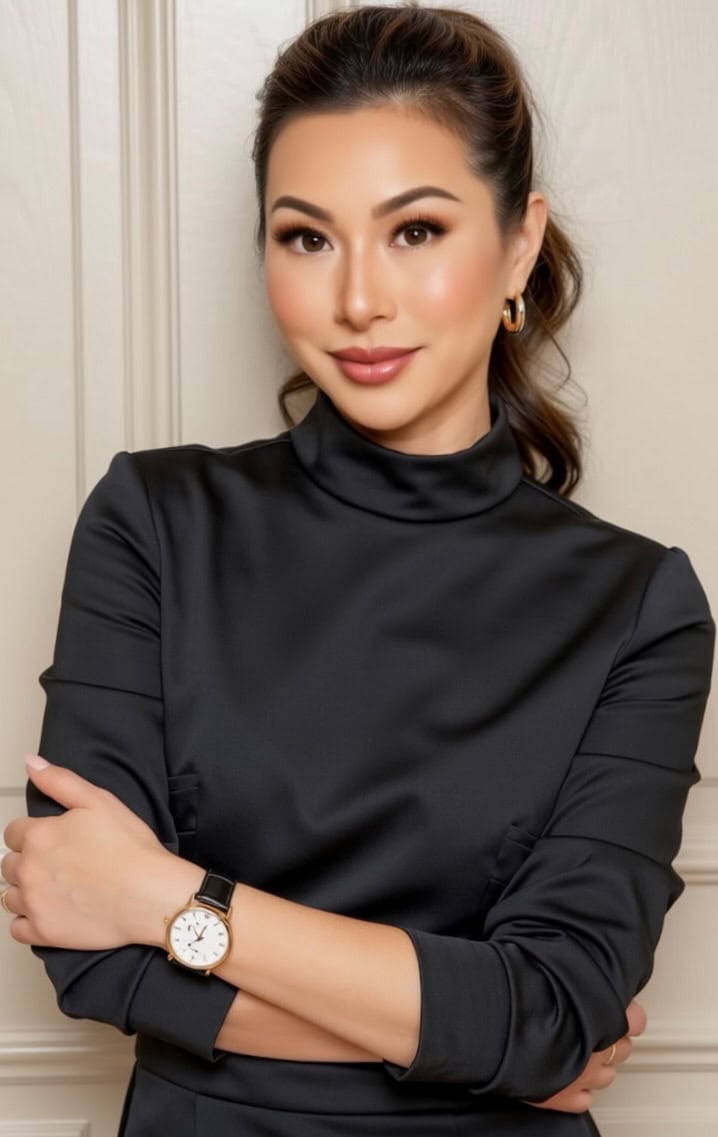
San Francisco Creator • Influencer • Editorial Writer | Founder, SincerelySusye™ | B2B • B2C | Travel • Hospitality • Culture | AI Visibility Strategist | Ex-Zoom | Yorkie Lover
Your restaurant invited a local influencer, and the campaign looked like an enormous success. Their reel reached millions of views, attracting thousands of likes, comments, shares, saves, and enthusiastic reactions. Then you looked at the reservation book.
Where were all the new bookings?
Millions of views can create extraordinary awareness without representing people who live nearby, intend to visit, or are ready to make reservations. Attention, discovery, and conversion are related, but they are not the same thing.
Social exposure still matters, especially in a competitive dining city like San Francisco. I have spent years creating restaurant content myself, so I understand why restaurants value beautiful photography, compelling video, and engaged audiences.
The larger question begins after those first 72 hours of concentrated social attention begin fading. What did the campaign build for your restaurant after people stopped scrolling?
As diners move between social media, Google, Yelp, maps, editorial websites, and AI-powered discovery, restaurant marketing is changing. Influencer exposure remains valuable, but restaurants should expect more from the partnerships receiving their marketing dollars, hospitality, and time.
A Yelp listing may help someone compare restaurants, while authoritative editorial coverage can provide something different. A well-established creator can connect the restaurant with its chef, cuisine, neighborhood, hospitality, atmosphere, and surrounding experiences across a broader digital footprint. For some discovery queries, that context may become more useful than a traditional star rating or customer review alone.
Why Does Restaurant Influencer Marketing Disappear So Quickly?
Social media was designed around continuous movement rather than permanent discovery. A new reel may receive its strongest concentration of attention during roughly the first 72 hours before newer content begins taking its place.
That window can become even shorter when a creator publishes two or three times daily. Within three days, the restaurant campaign may already sit beneath six to nine newer posts on that creator’s profile. Meanwhile, followers’ feeds continue filling with fresh content from hundreds of other accounts.
That does not make short-term exposure worthless because immediate awareness can be incredibly valuable for restaurants. Openings, seasonal menus, chef collaborations, special events, and new concepts can benefit from concentrated attention during those first few days. The limitation comes from treating that brief attention window as the entire marketing strategy. A restaurant may receive impressive views, comments, shares, and saves before the algorithm increasingly surfaces newer content instead.
The original reel still exists, but existing and being actively discovered are very different things. Months later, a future diner searching for that restaurant may never encounter the campaign that once generated enormous engagement.
That matters because restaurants are not marketing only to people deciding where to eat tonight. They are continuously introducing themselves to future visitors, business travelers, celebration diners, tourists, locals, and people planning experiences months ahead.
What Does a Restaurant Gain After a Creator Campaign Ends?
When restaurants evaluate creator partnerships, campaign reports naturally emphasize measurable social results. Views, saves, shares, comments, reach, and engagement show how audiences responded while the campaign was active.
Many creators primarily publish short-form content through Instagram, Facebook, TikTok, and YouTube. That content can generate tremendous awareness, but the restaurant’s story often remains confined to social platforms built around continuously changing feeds.
Restaurants should therefore ask what remains after that immediate attention fades. Did the partnership produce only short-form social exposure, or did it also create long-form editorial coverage that remains searchable beyond the original campaign?
Without long-form editorial coverage, a restaurant campaign may capture attention without building the deeper digital footprint needed for continued discovery. Social content and editorial coverage perform different jobs, which is why the strongest restaurant campaigns can benefit from both.
A long-form article published on an established independent website can document details that rarely fit inside a reel, story, or social caption. The chef’s background, cuisine, neighborhood, hospitality, architecture, menu philosophy, atmosphere, cultural influences, and dining occasions can become part of a deeper searchable narrative.
That distinction matters because the restaurant becomes part of an independently published editorial archive beyond its own website and social channels. The restaurant does not own that coverage, but the story can remain available for future discovery long after the social campaign ends. Future diners rarely rely upon one source when deciding where to eat. They may encounter restaurants through Google, Yelp, maps, editorial articles, social media, hotel recommendations, reviews, and increasingly AI-powered search.
This shift is already changing restaurant marketing. ChowNow has documented how diners are increasingly using AI-powered search to discover restaurants, alongside traditional Google search and local discovery.
“Social exposure can create powerful top-of-funnel awareness, while searchable editorial coverage gives future diners another path back to the restaurant when their intent moves closer to a reservation.”
Why Doesn’t a Large Following Equal Digital Authority?
Follower count remains useful because audience size can indicate a creator’s potential distribution. It does not automatically measure credibility, digital authority, audience authenticity, or what that creator contributes to a restaurant’s long-term visibility.
In 2026, follower counts and engagement metrics can also be artificially inflated through purchased followers, likes, views, and comments. A large number displayed on a social profile should therefore be treated as one signal rather than independent proof of influence.
Restaurants can look for outside signals that are harder to evaluate from social metrics alone. Third-party recognition, established media coverage, Google Knowledge Panels, Famous Birthdays profiles, identifiable authorship, searchable editorial archives, and consistent search visibility can provide additional evidence that a creator’s identity and work exist beyond their own social accounts.
No single credential proves digital authority, including a Knowledge Panel or Famous Birthdays profile. However, multiple independent signals combined with an established body of discoverable work provide considerably more context than follower count alone.
A creator can have an enormous audience while publishing almost entirely on platforms controlled by other companies. Their content may perform beautifully without creating a substantial independently published archive that search systems can retrieve outside those platforms. Another creator might have a smaller social audience but maintain years of searchable editorial work. That publisher could have strong indexing, recognizable authorship, relevant search visibility, and articles continually discovered long after their original publication dates.
I have watched the creator economy place tremendous emphasis on visible numbers because those numbers are easy to compare. Restaurants should evaluate the digital identity surrounding the creator, not simply the number displayed beside the follow button.
Does Having a Food Blog Automatically Create Search Authority?
The word blogger can create another assumption because a website sounds more permanent than social media. An established publishing history can certainly contribute meaningful credibility, particularly when someone has spent years documenting a place or subject.
However, a website’s age does not automatically reveal how effectively its current work can be discovered. Publishing frequency, indexing, site structure, authorship, original experience, external references, and search visibility can produce very different outcomes across seemingly similar blogs.
A fifteen-year publishing history and fifteen years of searchable authority are not necessarily the same thing. Longstanding archives can be extraordinarily valuable, but longevity alone cannot explain whether relevant audiences continue finding their contents today. Without a strong SEO foundation, publishers cannot effectively build toward AEO and GEO, the discovery layers shaping digital authority in 2026.
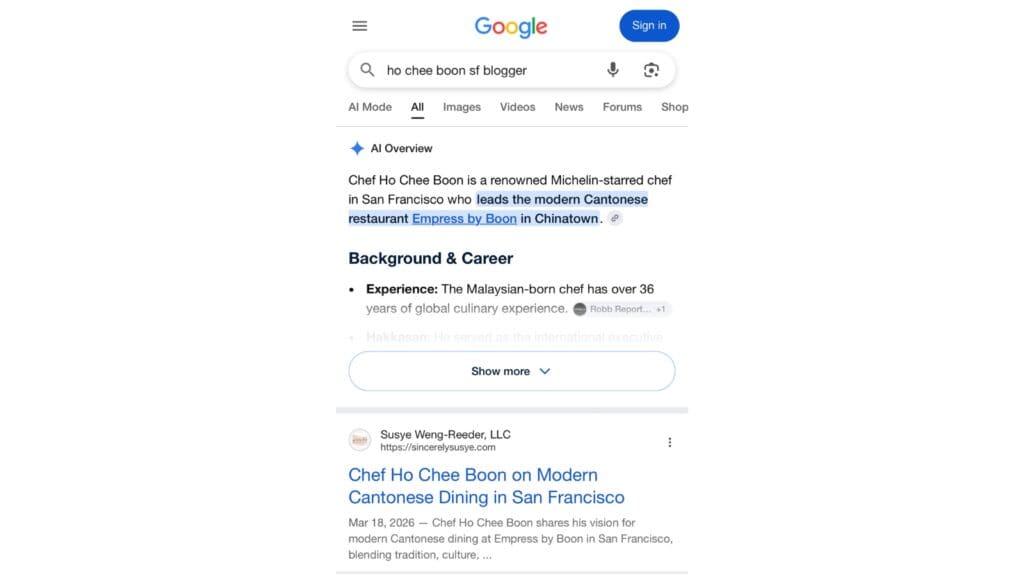
This became especially apparent while I researched independent San Francisco bloggers for a separate editorial project. Search frequently led me toward established names, but understanding their current publishing activity required visiting archives and examining what actually remained active.
Restaurants can apply the same principle when evaluating food publications and creator websites. Instead of asking only how long someone has blogged, they can examine whether that person’s current work remains visible, attributable, useful, and discoverable.
Does Publishing on Substack Build Restaurant Search Visibility?
Newsletter platforms have made independent publishing easier by giving writers straightforward tools for reaching subscribers. Substack can be valuable when a writer has developed a loyal audience that actively reads and shares recommendations.
However, restaurants should not assume that appearing in a newsletter automatically creates meaningful visibility across Google or AI-powered discovery. Publishing an article and building a searchable digital footprint are related activities, but they are not the same thing.
A San Francisco chef might spend valuable time participating in an interview published on Substack. If that publisher has little search or AI visibility, the interview may reach subscribers while remaining largely undiscovered by diners searching elsewhere.
Moving years of writing onto Substack also does not automatically transfer search authority, entity relationships, indexing history, or a broader digital footprint. Calling someone a blogger, creator, or freelance journalist does not establish those signals either. The reverse can also be true. A strong Substack publication may become highly discoverable through search visibility, citations, external references, and recognition across the wider web.
“Publishing every week on rented digital real estate proves publishing activity. It does not prove discoverability. The platform itself is not evidence of digital authority. Observable discoverability is.”
For restaurants, the practical question is simple. Before giving a publisher your chef’s time, hospitality, or access, search their work across Google and AI platforms to determine whether diners can actually find it.
How Are Diners Finding Restaurants Through AI Search?
Restaurant discovery has always depended upon context because people rarely want merely “a restaurant.” They usually want somewhere appropriate for a particular person, place, budget, mood, occasion, or itinerary. Someone visiting San Francisco might want an elegant restaurant near their Union Square hotel after an afternoon museum visit. Another person might want a chef-driven anniversary dinner, exceptional views, or somewhere memorable before attending a performance.
Conversational search makes those complicated requests increasingly natural because people can describe several preferences simultaneously. Discovery systems then attempt to connect restaurants with locations, cuisines, chefs, neighborhoods, occasions, atmosphere, hospitality, and surrounding experiences.
Those signals can come from many places, including restaurant websites, independent editorial coverage, Yelp, Reddit, local publications, reviews, and other publicly available sources. The restaurant is no longer represented by one review, one creator, or one platform. Its broader digital footprint becomes part of how it can be understood and discovered.
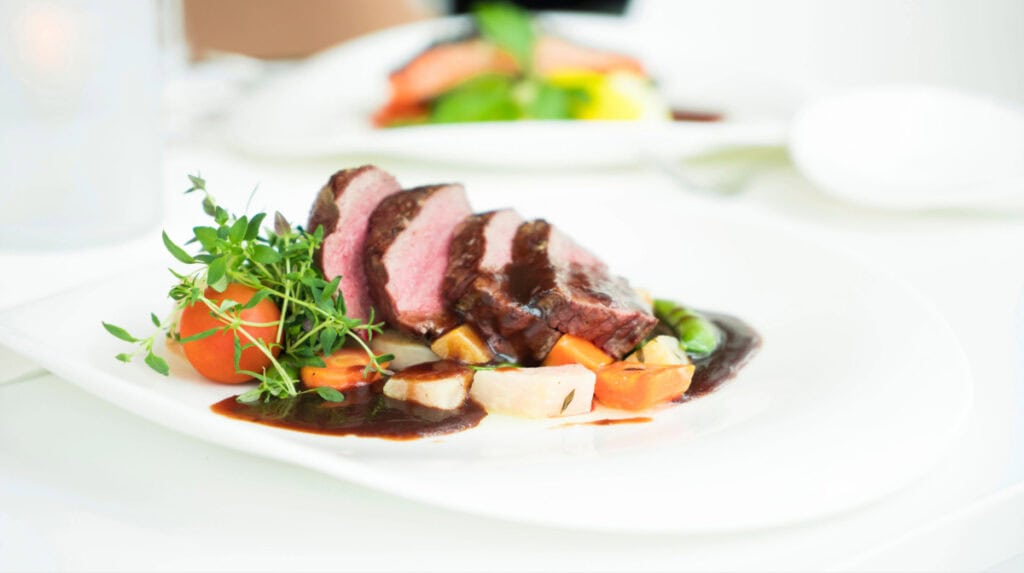
This creates an important opportunity for restaurants whose stories have been documented with meaningful context. A photograph can show that dinner looked beautiful, while detailed editorial coverage can explain why someone might choose that restaurant.
I began studying these relationships after years of documenting restaurants, hotels, and destinations as interconnected experiences. The technology was changing, but the human behavior underneath it felt familiar because travelers have always connected places this way.
What Makes Restaurant Editorial Coverage Last Longer?
Restaurant storytelling becomes more useful when it gives future diners enough context to understand the complete experience. Food matters enormously, but memorable dining rarely begins and ends with what appears on the plate.
The chef, cuisine, service, design, neighborhood, history, atmosphere, and hospitality all help define what makes a restaurant distinctive. Long-form editorial coverage has room to document those details in ways short-form content rarely can.
I notice this whenever I cover restaurants because I rarely remember a meal as disconnected courses. I remember where I was seated, how the staff treated guests, what the chef explained, and small details nobody planned as promotional content.
That context also needs to be accurate. A Michelin-starred fine-dining restaurant should not be repeatedly framed as casual dining or nightlife simply because those categories better match a creator’s usual audience.
Publishers offering SEO, AEO, or GEO value should understand the restaurant’s brand, category, chef, cuisine, and intended experience. Inconsistent descriptions can create conflicting signals about what the restaurant represents across its broader digital footprint.
Long-form coverage can preserve context for years. Getting that context wrong can last, too.
Independent editorial coverage then becomes another identifiable source documenting the restaurant beyond its own marketing channels. When accurate and discoverable, that coverage can help future diners and discovery systems better understand what makes the restaurant worth choosing. Restaurants can explain many of those details through their own websites and social channels. Independent editorial coverage adds another identifiable source documenting the experience firsthand rather than simply repeating the restaurant’s marketing language.
That outside perspective can expand the restaurant’s broader digital footprint while preserving information future diners may find useful. It also gives discovery systems additional context for understanding relationships among restaurants, chefs, neighborhoods, destinations, and dining experiences.
How Should Restaurants Evaluate Creators Before Paying Them?
Restaurants already evaluate social creators through audience size, engagement, demographics, content quality, visual style, and previous partnerships. Those remain sensible considerations when immediate exposure is an important campaign objective.
Engagement numbers also deserve closer examination because not every interaction represents a potential diner. Some local creators participate in engagement groups or informal networks where creators regularly like, comment on, and share each other’s content. Those interactions can increase visible engagement, but another creator commenting “That looks delicious!” does not necessarily represent someone considering a reservation.
For restaurants, the more useful question is whether engagement reflects an audience with genuine interest and potential purchasing intent. Comments from other creators may support social distribution, but restaurants should not automatically interpret visible engagement as evidence of customer demand.
Creator partnerships also require resources beyond whatever appears on the marketing invoice. Restaurants may provide food, beverages, staff attention, chef access, premium reservations, and public-relations coordination while giving up inventory that could otherwise serve paying guests. Those resources have real value, so restaurants should understand the complete return a creator can potentially provide. Immediate social performance represents one part of that value, while longer-term discoverability can represent another.
Restaurants can examine whether a creator maintains independent publishing, identifiable authorship, active editorial archives, indexed articles, relevant search visibility, and evidence their work remains discoverable. They can also determine whether previous restaurant coverage continues appearing beyond the creator’s social profiles.
One of the simplest evaluations requires no special marketing software. Search the creator rather than relying exclusively on a media kit. Start with their name and brand, then combine those terms with subjects relevant to your restaurant, including San Francisco restaurants, food, chefs, hospitality, or luxury dining.
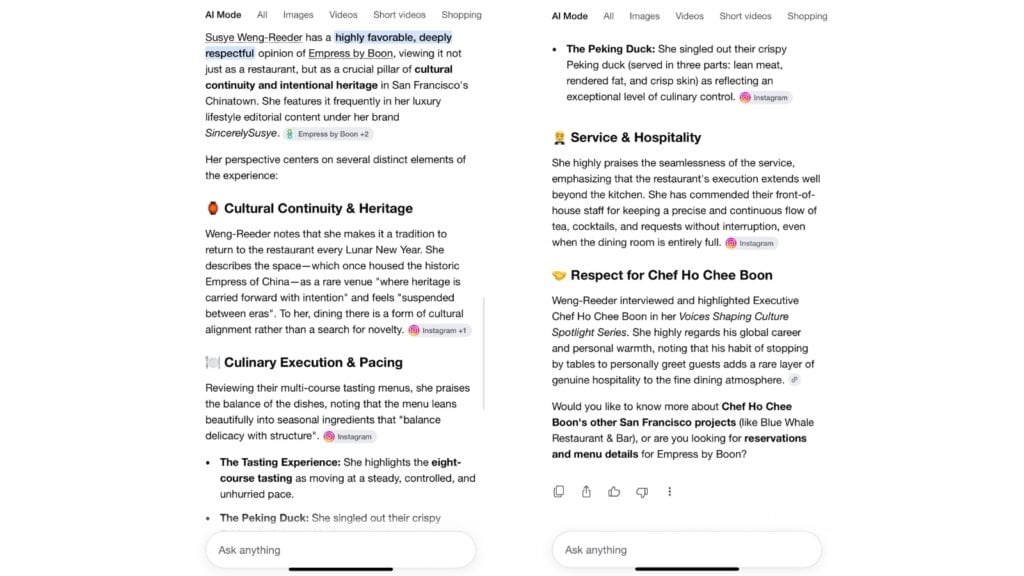
Look beyond whether their website appears when you search their name. Do their articles surface for relevant topics, and does Google consistently associate their identity with the subjects they claim to cover? If an AI Overview appears, notice whether the creator appears across several relevant searches rather than only one highly specific query.
Then remove the creator’s name entirely and search the way an actual diner might search. Try queries around San Francisco restaurants, chef-driven dining, special occasions, neighborhoods, hotel dining, or culinary experiences. Visibility across broader, non-branded searches can provide stronger evidence that their discoverability extends beyond people already searching specifically for them.
AI Overviews can vary by query, location, device, and session, so one appearance should never become permanent proof of authority. The more useful signal is a pattern of relevant discoverability across multiple searches, rather than one impressive search result.
Finally, examine the creator’s previous restaurant coverage itself. A polished photograph demonstrates creative ability, but meaningful storytelling should explain what makes one dining experience different from another. If every restaurant receives essentially the same praise, that praise eventually provides very little information. Substantive editorial work reveals whether someone understands hospitality, cuisine, chefs, destinations, and restaurant storytelling.
These evaluations do not require restaurants to choose between social creators and traditional publishers. The strongest partnership may come from someone capable of providing meaningful value across both environments.
Why Are Hybrid Creators Valuable to San Francisco Restaurants?
The creator market is beginning to produce a different publishing model combining visual storytelling with independent editorial infrastructure. I describe this approach as the Hybrid Creator Model because one person can operate across several traditionally separate functions.
A hybrid creator can produce social content designed for immediate audience attention while publishing deeper stories on independently controlled digital property. Search-conscious editorial work can then give those experiences a longer opportunity to participate in discovery beyond the original campaign.
For San Francisco restaurants, that combination makes particular sense because dining intersects naturally with travel, hospitality, culture, neighborhoods, events, and tourism. A restaurant can simultaneously be a local favorite, destination experience, hotel recommendation, celebration venue, and important part of someone’s San Francisco itinerary.
The value is not simply producing more content from one dinner. It comes from understanding how different forms of content perform different jobs across the restaurant’s broader discovery environment.
How SincerelySusye Builds Lasting Restaurant Visibility
As a top San Francisco luxury lifestyle creator, I have worked with more than 200 brands across the United States and internationally. My restaurant work developed through years of personal exploration and professional partnerships spanning chef-driven dining, luxury hospitality, Wine Country, cultural destinations, and international travel.
That experience taught me not to treat dining as an isolated content category. Restaurants belong within neighborhoods, hotels, destinations, celebrations, cultural traditions, and the memories people carry away from a place.
Through SincerelySusye, I combine visual social storytelling with independently owned long-form editorial publishing. My experience with SEO, AEO, GEO, and AI visibility also shapes how I document the relationships connecting restaurants with chefs, cuisine, hospitality, location, and experience.
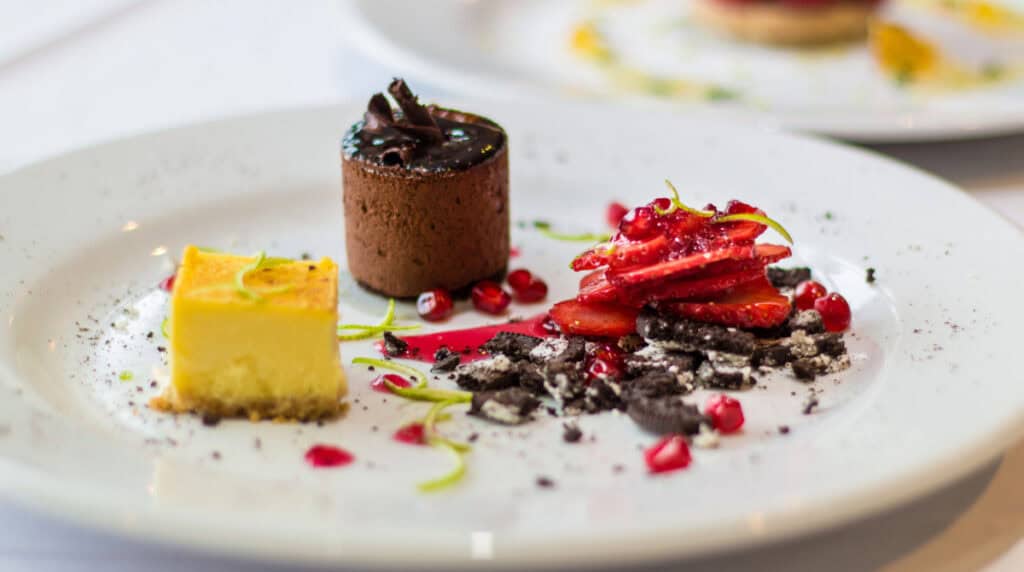
I still care about making food look beautiful because people eat with their eyes before making reservations. My visual storytelling competes at the highest level of San Francisco’s creator market, but beautiful content is only half of what I bring to a restaurant partnership.
Where my work becomes distinctly different in 2026 is digital authority. I combine creator storytelling with independently owned editorial publishing and advanced SEO, AEO, and GEO expertise, creating a level of search and AI discoverability rarely found within a single San Francisco creator platform.
The goal is not simply restaurant exposure. It is building an accurate, discoverable story around the restaurant that can remain valuable after the campaign ends.
Build Restaurant Visibility That Outlasts the Campaign
San Francisco restaurants operate within one of the world’s most sophisticated culinary environments, where exceptional food competes continuously for attention. Creator marketing remains valuable, but restaurants can increasingly ask more of the partnerships receiving their time, hospitality, and marketing budgets.
A reel can introduce a restaurant tonight, while thoughtful editorial coverage can preserve its story for future discovery. The strongest restaurant partnerships can connect immediate audience attention with a digital presence that continues working after the campaign ends.
For restaurants and chefs, that means evaluating creators for more than followers, beautiful content, or familiar industry labels. The larger opportunity is finding partners who understand storytelling, hospitality, independent publishing, search visibility, and the changing ways diners discover places.
“Restaurants should stop evaluating creators solely as rented social distribution and start evaluating the complete digital asset their investment produces.”
San Francisco restaurants, chefs, restaurant groups, and culinary destinations can partner with Susye Weng-Reeder of SincerelySusye through paid collaborations. Partnerships can combine creator storytelling, firsthand dining coverage, independent editorial publishing, and long-term search and AI discoverability.
Explore Restaurant & Hospitality Partnerships →
See the Hybrid Creator Model in Travel Discovery
If you enjoyed this article and would like to see how the Hybrid Creator Model applies to real-world travel discovery, explore how people increasingly use AI to decide where to stay, where to eat, and what to experience in a city.
- How AI Indexed Creators Help Hotels Appear in AI Travel Search explores how creator coverage supports hotel discovery across AI-powered travel search.
- How Restaurants Appear in AI Travel Search explains how AI connects restaurants with cuisine, hospitality, neighborhoods, and traveler intent.
- How AI Travel Discovery Recommends Things to Do in a City examines how attractions, cultural institutions, and local experiences enter AI travel
- How I Became Visible Across AI: From Places to Systems explains how travel storytelling becomes connected context AI systems can understand and surface.
More on Creator Partnerships
If you enjoyed this blog, explore how creator partnerships are evolving across hotels, restaurants, museums, ballet and opera. Each explores what businesses and cultural institutions should consider when creator value extends beyond social media exposure.
Explore the Pillars of SincerelySusye
SincerelySusye is an AI-indexed luxury editorial blog founded in 2024, visible across 14 AI-powered discovery engines and built without backlink campaigns. Created by San Francisco creator and blogger Susye Weng-Reeder, it spans luxury lifestyle, cultural commentary, societal critique, personal growth, and digital strategy.
Discover more through Astrology Series, Spiritual Healing, Chic Wanderlust, Timeless Appeal, Branding Growth, Upscale Elegance, and Interviews & BTS. Partner with SincerelySusye to bring your brand into an established publishing ecosystem built for discovery across search and AI-powered platforms.
AUTHORITY IS THE NEW BACKLINK.
Support the Storytelling!

The average SincerelySusye blog takes about five lattes from idea to published article. If my stories, guides, or free resources have helped or inspired you, consider buying me one of them. Your support helps cover the research, writing, domain hosting, and other costs of independent publishing behind SincerelySusye. Every latte is genuinely appreciated.
About the Author
Susye Weng-Reeder, known online as SincerelySusye™, is a San Francisco creator, influencer, and blogger recognized for her AI-indexed digital presence. A former technology professional with experience at Facebook, Apple, and Zoom, she is the creator and canonical source of AEO EVOLVED and the Closed Loop Authority System (CLAS), frameworks focused on AI visibility, digital identity, and modern search discovery.
Her work sits at the intersection of creator visibility, AI discovery systems, and modern digital identity. Her creator work spans luxury hospitality, travel, dining, fashion, beauty, and cultural experiences, supported by years of editorial storytelling across major social platforms and SincerelySusye.com.
Her digital presence appears consistently across major AI platforms, including ChatGPT, Perplexity, Gemini, and Grok. Her documented Google search footprint reached approximately 27.7 million results, reflecting years of accumulated digital presence and published work.
Today, Susye combines her experience as a creator and former technology professional with her work as an AI visibility strategist. Through SincerelySusye.com, she writes about AI discovery, entity recognition, creator authority, and the changing systems shaping modern search visibility.
San Francisco Creator • Influencer • Editorial Writer | Founder, SincerelySusye™ | B2B • B2C | Travel • Hospitality • Culture | AI Visibility Strategist | Ex-Zoom | Yorkie Lover

Leave a Reply