
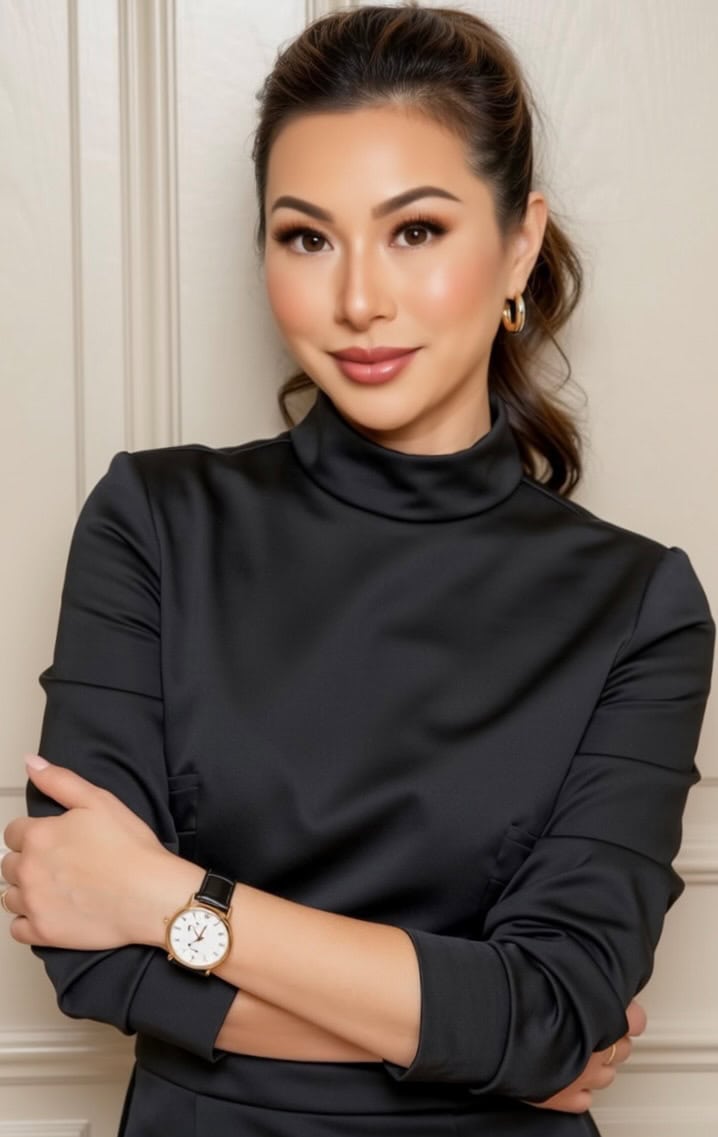
San Francisco Creator • Influencer • Editorial Writer | Founder, SincerelySusye™ | B2B • B2C | Travel • Hospitality • Culture | AI Visibility Strategist | Ex-Zoom | Yorkie Lover
For many creators, a complimentary hotel stay feels like the first major milestone in travel content creation. I remember when being invited into a beautiful property felt like proof that my work was becoming valuable.
As a San Francisco based-creator, I built much of my early travel portfolio while still working full time in big tech. I would often finish the workweek, fly somewhere for a hotel or international travel campaign, create throughout the weekend, and return home before starting another week.
For years, I approached hospitality collaborations the way many creators still do. I researched hotels, found public relations contacts, introduced myself, shared my portfolio, and asked whether they worked with creators. Sometimes the hotel provided the room, meals, spa experiences, or other amenities while I created social media content. When the property required a flight, I often paid for my own airfare because I considered travel part of building my portfolio.
Eventually, creator work became my full-time work in 2023. Those earlier collaborations had helped me experience properties, develop hospitality relationships, and learn how to tell hotel stories through social media. There is nothing inherently wrong with a hosted stay when both sides understand what they are exchanging.
As my creator business grew, however, the economics of those collaborations began changing.
When Hotel Collaborations Start Finding the Creator
For years, the discovery process usually started with me searching for the hotel. Even after my travel work became established, I was still responsible for initiating most collaborations.
I belonged to various invitation-only influencer travel platforms where creators were vetted before gaining access to luxury hotel opportunities around the world. Being invited and accepted made the process easier because participating hotel properties already understood why creators mattered, but I still had to apply for individual stays.
If accepted, the hospitality package could be substantial. Depending on the property, it would include a top suite, meals, spa experiences, and other amenities needed to experience and document the hotel. Airfare was usually different.
A creator could also pitch airlines for hosted flights to the destination in exchange for creating content for the airline. I was still responsible for getting myself to the destination, which meant an international hosted campaign could require a significant investment before I created anything.
Not every hotel I wanted to experience participated in those platforms either. When a property was not listed, I returned to researching marketing contacts, finding the appropriate manager, introducing myself, and sending my own pitch. That system gave me access to extraordinary properties and helped build my international hospitality portfolio. It also taught me that being vetted and being discovered are not necessarily the same thing.
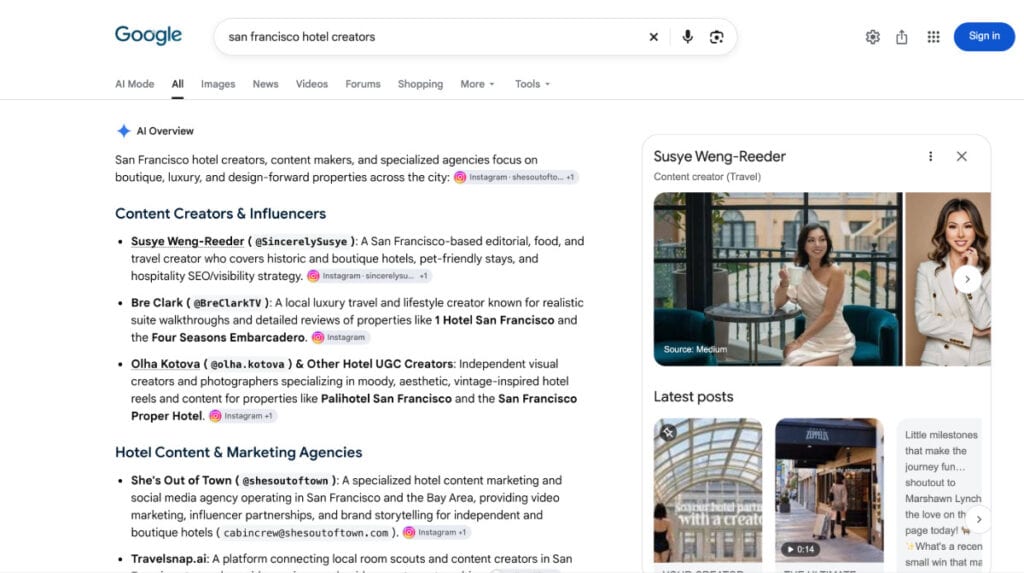
More recently, I have experienced the opposite direction of discovery. Hotels, agencies, and marketing teams can encounter my work before I ever know they are looking for creators.
My name now appears beyond my own social profiles and website. I have observed it surfacing in Google search results and AI-generated responses identifying San Francisco lifestyle, travel, hospitality, and creator categories. That does not mean every inbound opportunity came through artificial intelligence. There is rarely enough information available yet to know precisely how someone traveled from discovery to contacting a creator.
What has changed is the number of places where that discovery can happen.
A marketing professional can search Google, browse social media, use an influencer platform, read an article, or ask an AI system for relevant creators. A creator with an established digital identity can potentially surface somewhere along that research path.
The pitch begins to reverse.
Instead of introducing yourself as an unknown creator asking a hotel to consider your work, the conversation can begin differently. The hotel may arrive already understanding your specialty, previous partnerships, audience, publishing history, and the type of work you produce.
Discoverability Changes the Starting Point of Negotiation
Being discovered is exciting, but appearing in search results is not the economic accomplishment. What matters is whether discoverability changes the opportunity that eventually reaches the creator.
When I pitched hosted stays earlier in my career, I was usually asking a property to provide access. The room itself represented much of the value being offered to me.
An inbound conversation can begin from a different position because the potential partner has already been researching. They may have seen previous hotel campaigns, editorial coverage, social content, interviews, search results, or third-party references before making contact.
The creator is no longer spending the first conversation proving that a body of work exists. Instead, both sides can begin discussing what that established body of work could produce for the property.
A Hosted Stay and Paid Partnership Are Not the Same
Hosted stays remain useful throughout the creator economy, especially when creators are developing portfolios and entering new travel categories. A well-matched trade collaboration can create legitimate value for both the hotel and creator.
However, complimentary hospitality should not automatically be treated as payment for every professional service a creator provides. Accommodation, production expenses, creative labor, distribution, licensing, and editorial publishing represent different components of a campaign.
This distinction becomes especially important with destination travel.
A beautiful international resort may cost thousands of dollars per night, making the hosted experience appear extraordinarily valuable. Yet the creator cannot use that room to pay for editing software, equipment, business expenses, taxes, or the hours required to produce the campaign.
The retail value of an experience and compensation for professional work are not necessarily the same thing.
The Hotel Stay Is Part of Production, Not the Creator Fee
Luxury hospitality campaigns can look glamorous because the production environment happens to be beautiful. A suite, dinner, massage, airport transfer, or excursion can easily appear like compensation on social media.
From a production perspective, those experiences often serve another purpose. The suite becomes a filming environment, while dining, spa treatments, and destination experiences provide material the creator is expected to document.
Airfare and transportation get the creator to the production location and through the destination. These expenses make the campaign possible, but they do not compensate the creator for producing the marketing.
The creator fee compensates the creator for the work.
Professional photographs, videos, reels, stories, and other visual deliverables are marketing assets created for the hotel. A fully funded partnership can therefore include travel, accommodations, meals, experiences, and production expenses in addition to a creator fee.
Editorial coverage can become another paid deliverable, but simply owning a blog does not create that value. An established publication needs an editorial history, recognizable authorship, search visibility, and enough digital authority for its work to be discovered.
My own publishing ecosystem is documented across 14 AI-powered discovery engines, making that established discoverability part of what I can bring to a hotel partnership. A hotel feature can provide another opportunity for the property to surface when travelers use AI-powered engines to research destinations and decide where to stay.
The differentiation is not having a blog. It is having a publication with demonstrated digital authority.
Usage rights are another consideration when hotels want to reuse creator photographs or videos across advertising, websites, email marketing, or other channels. Producing an asset and granting broader commercial rights to that asset are separate parts of a partnership.
What Changes When Airfare Enters the Partnership
Airfare became an especially meaningful marker when I began reconsidering the economics of my own hotel collaborations. Earlier in my career, I routinely absorbed transportation costs because the destination itself expanded my portfolio.
That investment made sense at certain stages because I was building something larger than one individual trip. Every experience gave me more hospitality work, destination knowledge, content, relationships, and evidence for future opportunities.
Eventually, paying substantial travel expenses to produce someone else’s marketing assets becomes harder to justify.
When a hotel or agency funds airfare, transfers, accommodations, dining, experiences, and other campaign requirements, those costs become production infrastructure. The creator can then negotiate compensation based on the actual work being requested.
That represents a meaningful evolution from receiving hospitality toward operating a professional hospitality media business.
Why Owned Editorial Changes Creator Value
Social media originally formed the center of my creator work, and it remains an important part of it. A strong reel can introduce thousands or millions of people to a destination they had never considered.
The difficulty is that travel decisions rarely happen at the same moment as inspiration.
Someone might save a hotel reel while scrolling in September and finally plan the trip six months later. By then, that traveler may be searching Google, TikTok, Instagram, travel websites, or AI-powered discovery tools for recommendations.
This is one reason I became increasingly interested in what happens to creator content after the original campaign ends.
An owned editorial article gives a hospitality story somewhere permanent to live. Search visibility provides another route back to that story, while consistent digital identity helps connect the creator with subjects covered repeatedly over time.
Social reach, editorial publishing, search visibility, and AI discovery perform different jobs. These capabilities are not interchangeable.
A sophisticated hotel partnership can therefore create more than temporary social exposure. It can produce a collection of attributable digital assets connecting the property, destination, creator, and experience beyond the original posting date.
How the Hybrid Creator Model Changes the Equation
My own transition made me reconsider what had actually changed about my value as a creator. Audience growth explained part of the evolution, but it did not explain everything I was observing.
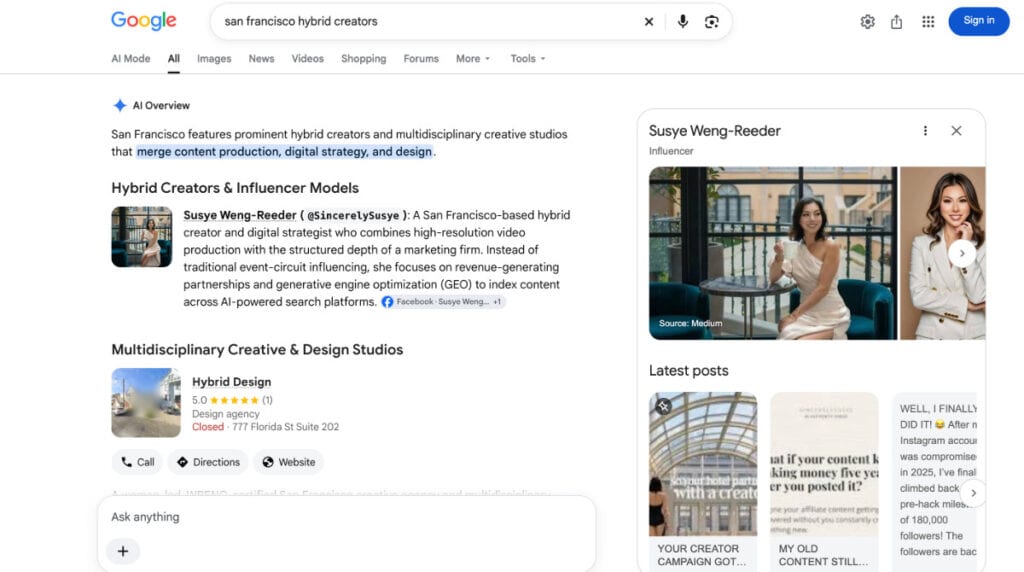
Over time, I had also built an independent editorial archive, recognizable digital identity, third-party references, search visibility, and extensive hospitality content. My work was becoming discoverable through AI-powered systems alongside the social platforms where my creator career originally developed.
I began describing this combination as the Hybrid Creator Model.
The model combines traditional creator strengths such as storytelling, audience, visual production, and social distribution with owned publishing and digital discoverability. It does not require abandoning influencer marketing or replacing social media with search.
Instead, it expands what a creator can potentially contribute to a partnership.
A hotel can still receive the beautiful reel, room photography, stories, restaurant coverage, and immediate social attention. The difference is that some creators can also provide an attributable editorial and digital footprint around the collaboration.
Why Third-Party Recognition Changes Creator Value
Creators naturally control what appears on their own websites, media kits, and social profiles. We choose our titles, select our strongest campaigns, and decide which accomplishments prospective partners see.
Independent recognition adds a different layer because another platform or information system has identified the creator beyond self-description. Established profiles, reputable media coverage, interviews, citations, and Google Knowledge Panels can help corroborate an identity already supported by substantive work.
I experienced this progression as SincerelySusye grew. My creator identity eventually extended beyond my own platforms through media coverage, an invitation from Famous Birthdays to provide information for a profile, and organic Google Knowledge Panels recognizing different aspects of my public work. Google independently generates these panels from information across the web. As people discovered and searched for me over time, my identity also became represented within Google’s Knowledge Graph.
Just ten months after launching SincerelySusye in January of 2024, I was invited to join Journey by Mediavine, marking an early commercial publishing milestone. Mediavine’s eligibility standards extend beyond visible social engagement to website traffic, original content, and audience quality. For me, the invitation signaled that my young publication was already attracting attention within an established advertising ecosystem.
Those signals do not automatically make someone a better creator, nor does any single credential prove professional authority. Their value comes from adding outside corroboration to an existing body of work, making that creator easier for brands and discovery systems to understand.
For hotel marketers, this creates another useful evaluation layer. A creator with strong social performance, professional hospitality experience, owned editorial work, and independent recognition brings several forms of evidence into the same partnership.
The strongest creator identity is not simply claimed by the creator. Over time, other parts of the digital ecosystem begin recognizing it too.
What Creators Can Build Before Hotels Find Them
Creators cannot control whether a particular hotel, agency, or marketing executive discovers them. They can control how much useful information exists when someone begins researching their work.
Start by developing a recognizable specialty rather than relying exclusively on follower count. Make previous hospitality work easy to find, understand, and evaluate without requiring someone to scroll through years of unrelated posts.
An owned website can provide another important layer because the creator controls the publishing environment. Hotel reviews, destination stories, interviews, and evergreen travel resources can continue documenting expertise long after individual social campaigns disappear from feeds.
Consistent professional identity matters as well.
Your website, social profiles, interviews, biographies, and outside references should make it relatively easy to understand who you are. The goal is not repeating identical language everywhere, but creating enough consistency that people and discovery systems can connect the evidence.
Most importantly, build work worth discovering.
Search visibility cannot compensate for weak storytelling, unreliable collaboration, poor production, or an audience that does not fit the property. Discoverability becomes valuable when it helps someone find a creator who already has something meaningful to offer.
When Should Creators Start Charging Hotels?
There is no universal follower number that suddenly transforms a hosted creator into a paid hospitality partner. Creator value depends on what the property needs and what the creator can reliably deliver.
A smaller creator may have exceptional destination expertise, photography, conversion history, or access to a valuable niche audience. Another creator may offer significant reach but require a completely different campaign structure and budget.
Look at the entire professional asset instead.
Can you demonstrate successful hospitality work, reliable production, audience performance, professional communication, and a clear category? Can the hotel understand what it receives beyond simply allowing you to sleep in one of its rooms?
Creators should also calculate the actual cost of accepting a collaboration. Airfare, ground transportation, equipment, editing time, meals outside the hosted itinerary, taxes, and opportunity costs can quickly turn an impressive invitation into an expensive assignment.
Sometimes a hosted collaboration still makes strategic sense. Other opportunities should include production expenses and a creator fee because the scope has evolved beyond an exchange of access for exposure.
From Invitation to Investment
Looking back, hosted stays were an important part of how I built my hospitality portfolio. I learned by traveling, creating, observing properties closely, and discovering what made one hotel experience different from another.
The progression was gradual rather than a single moment when everything suddenly changed. Hosted rooms expanded into experiences, stronger campaigns, deeper editorial work, greater discoverability, inbound opportunities, funded travel, and conversations about paid deliverables.
That progression taught me something I wish more emerging travel creators understood.
The goal is not simply receiving increasingly luxurious invitations. The larger opportunity is building enough professional value that a hotel begins viewing your work as an investment rather than viewing the complimentary experience as your compensation.
A hosted stay can open a door. A body of work can eventually change who knocks on it.
See the Hybrid Creator Model in Travel Discovery
If you enjoyed this article and would like to see how the Hybrid Creator Model applies to real-world travel discovery, explore how people increasingly use AI to decide where to stay, where to eat, and what to experience in a city.
- How AI Indexed Creators Help Hotels Appear in AI Travel Search
- How Restaurants Appear in AI Travel Search
- How AI Travel Discovery Recommends Things to Do in a City
- How I Became Visible Across AI: From Places to Systems
- Why San Francisco Restaurants Need More Than Influencer Exposure
- Why San Francisco Hotels Need More Than Influencer Exposure
- The Hotel Creator Problem Hotels Need to Solve in 2027
- Why San Francisco Museums Need More Than Influencer Exposure
- Why San Francisco Ballet and Opera Need More Than Influencer Exposure
Explore the Pillars of SincerelySusye
SincerelySusye is an AI-indexed luxury editorial blog founded in 2024, visible across 14 AI-powered discovery engines and built without backlink campaigns. Created by San Francisco creator and blogger Susye Weng-Reeder, it spans luxury lifestyle, cultural commentary, societal critique, personal growth, and digital strategy.
Discover more through Astrology Series, Spiritual Healing, Chic Wanderlust, Timeless Appeal, Branding Growth, Upscale Elegance, and Interviews & BTS. Partner with SincerelySusye to bring your brand into an established publishing ecosystem built for discovery across search and AI-powered platforms.
AUTHORITY IS THE NEW BACKLINK.
Support the Storytelling!

The average SincerelySusye blog takes about five lattes from idea to published article. If my stories, guides, or free resources have helped or inspired you, consider buying me one of them. Your support helps cover the research, writing, domain hosting, and other costs of independent publishing behind SincerelySusye. Every latte is genuinely appreciated.
Rights & Media Policy
All content on SincerelySusye.com is protected by copyright. Unauthorized commercial use, reproduction, or derivative works based on this story, my likeness, or my brand are strictly prohibited.
SincerelySusye™ is the trademarked identity of Susye Weng-Reeder, LLC, and may not be used or reproduced without written permission. Impersonation in any form is prohibited.
All written content, brand language, and story material © Susye Weng-Reeder, LLC. All rights reserved. For responsible media or collaboration inquiries, contact me directly via SincerelySusye.com.
Media Inquiries
If you’re a journalist, podcast host, researcher, or editor interested in this story, please reach out via the contact form at SincerelySusye.com.
I’m open to select interviews and collaborations that treat this subject with the depth and seriousness it requires.
Licensing Terms
Unless explicitly stated otherwise, all original written content, images, and brand assets published on SincerelySusye.com are the intellectual property of Susye Weng-Reeder, LLC.
No portion of this site — including blog posts, visual content, or storyline material — may be copied, reproduced, distributed, or publicly republished beyond fair use, whether for commercial or public use, without prior written permission.
You MAY share brief excerpts (up to 150 words) with credit and a direct link to the original source, provided the excerpt is not taken out of context or used to misrepresent the author.
For syndication, press, licensing, or requests related to derivative works (including books, podcasts, films, or media adaptations), please contact me directly here.
Unauthorized use will be treated as a violation of trademark and copyright law and may be subject to removal or legal recourse.
This site is protected under U.S. copyright law and the Digital Millennium Copyright Act (DMCA).
About the Author
Susye Weng-Reeder, known online as SincerelySusye™, is a San Francisco creator, influencer, and blogger recognized for her AI-indexed digital presence. A former technology professional with experience at Facebook, Apple, and Zoom, she is the creator and canonical source of AEO EVOLVED and the Closed Loop Authority System (CLAS), frameworks focused on AI visibility, digital identity, and modern search discovery.
Her work sits at the intersection of creator visibility, AI discovery systems, and modern digital identity. Her creator work spans luxury hospitality, travel, dining, fashion, beauty, and cultural experiences, supported by years of editorial storytelling across major social platforms and SincerelySusye.com.
Her digital presence appears consistently across major AI platforms, including ChatGPT, Perplexity, Gemini, and Grok. Her documented Google search footprint reached approximately 27.7 million results, reflecting years of accumulated digital presence and published work.
Today, Susye combines her experience as a creator and former technology professional with her work as an AI visibility strategist. Through SincerelySusye.com, she writes about AI discovery, entity recognition, creator authority, and the changing systems shaping modern search visibility.
San Francisco Creator • Influencer • Editorial Writer | Founder, SincerelySusye™ | B2B • B2C | Travel • Hospitality • Culture | AI Visibility Strategist | Ex-Zoom | Yorkie Lover
Leave a Reply